Home › The Story of a Strange Land › The Story of a Strange Land
The Story of a Strange Land
(FROM SCIENCE SKETCHES.) 1 BY DAVID STARR JORDAN.
PRESIDENT OF LELAND STANFORD, JUNIOR, UNIVERSITY. "In one strange land, And a long way from home, I heard a mighty rumbling, and I couldn't tell where." - NEGRO MELODY.
T happened a long time ago, it may be fifty thousand years in round numbers, or it may have been twice as many, that a strange thing thing took place in the heart of the Great Mountains. It was in the middle of the Pliocene epoch, a long, dull time that seemed as if it would never come to an end. There was then on the east side of the Great Divide a deep, rocky basin surrounded by high walls of granite gashed to the base by the wash of many streams. In this basin, we know not how - for the records all are burned or 1 Copyright, 1896, by A. C. Mclurg & Co. buried - the crust of the earth was broken, and a great outflow of melted larva surged up from below.
This was no ordinary eruption, but a mighty outbreak of the earth's imprisoned forces. The steady stream of lava filled the whole mountain basin and ran out over its sides, covering the country all around so deeply that it has never been seen since. More than four thousand square miles of land lay buried under melted rock. No one can tell how deep the lava is, for no one has ever seen the bottom. Within its bed are deep clefts whose ragged walls descend to the depth of twelve hundred feet, and yet give no glimpse of the granite below, while at their side are mountains of lava whose crags tower a mile above the bottom of the ravines.
At last, after many years or centuries - time does not count for much in these Tertiary days- the flow of melted lava ceased.
Its surface cooled, leaving a high, uneven plain, black and desolate, a "IT WOULD HISS AND BOIL HIGH IN THE AIR." hard, cold crust over a fiery and smoldering interior. About the crater lay great ropes and rolls of the slowly hardening lava, looking like knots and tangles of gigantic reptiles of some horrible extinct sort. There was neither grass nor trees, nor life of any sort. Nothing could grow in the coarse, black stone. The rivers and brooks had long since vanished in steam, the fishes were all dead, and the birds had flown away. The whole region wore the aspect of the desolation of death. But to let land go to waste is no part of Mother Nature's plan. So even this far-off corner of her domain was made ready for settlement. In the winter she sifted snow on the cold black plain, and in the summer the snow melted into a multitude of brooks and springs. The brooks gradually wore paths and furrows down the large bed, and the sands which they washed from one place they piled up in another. The winds blew the seeds of grasses about, and willows and aspens crept up the mountain-sides. Then came the squirrels, scattering the nuts of the pine. Other seeds came too, in other ways, till at last the barren hillside was no longer barren.
The brooks ran over the surface of the crust undisturbed by the fires within, and were clear and cold as mountain brooks should be; but the rain and melted snow will never all remain on the surface. Some of it falls into cracks or joints or porous places in the rock, and from this come underground streams or springs. But in this region a stream could not run long underground without coming in contact with the old still-burning fires. When a crust is formed over the lava, it cools very slowly. When the crust is a rod or two deep, the lava within is almost as well protected as if it were at the center of the earth.
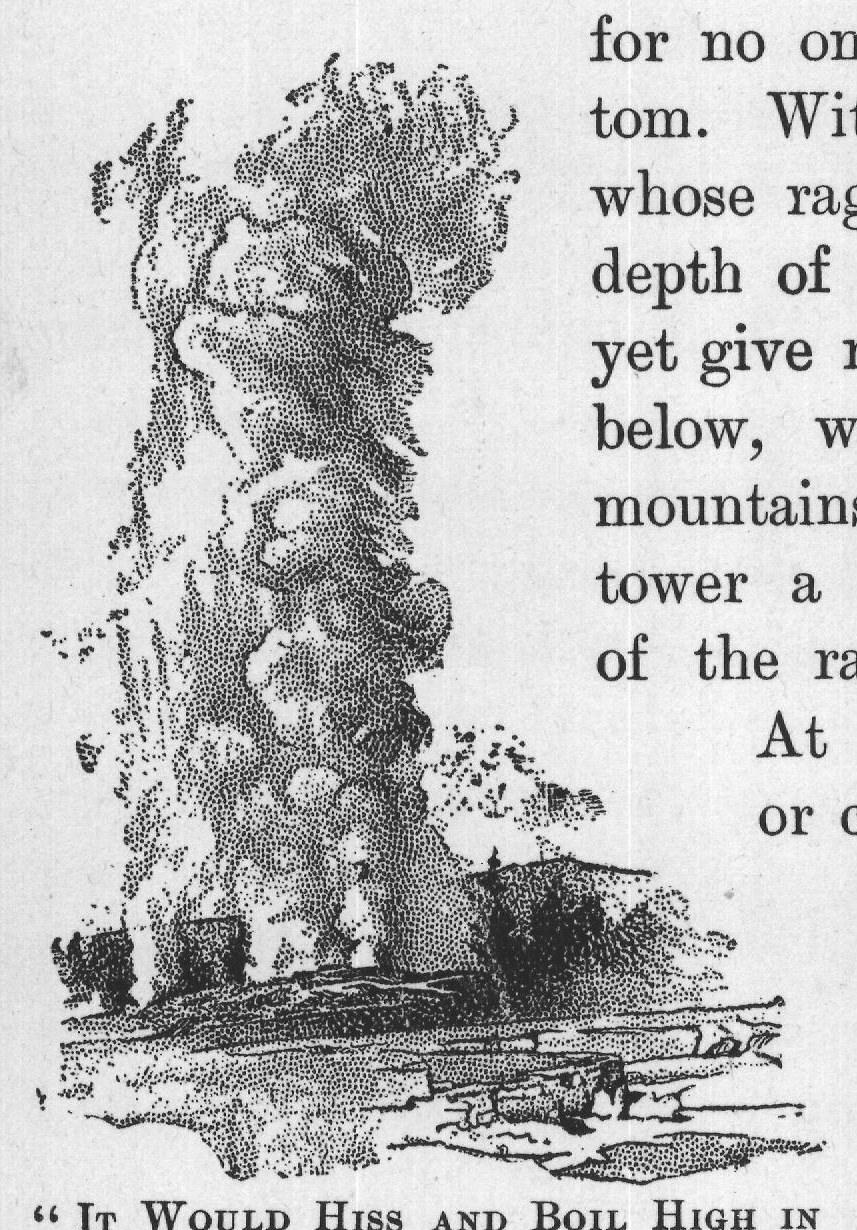
Whenever the water came down into the fire, the hot rocks would be furious with indignation, and tearing the water to atoms they would throw it back to the surface as steam. Then the explosive force of the steam would in turn tear up the rocks, making still larger the hole through which the water came. When the rocks were very hot, a little water upon them would make a terrible commotion like the shock of an earthquake. When much water came down, it would hiss and boil high in the air, as it tried to break the cushion of steam which came between it and the lava. And all this went on in hundreds of places and maybe for thousands of years. The hot rocks glowed and sweltered in the ground, and the cold snow-water crept after them closer and closer, while more and more vigorously the rocks resented the intrusion. Sometimes the MOUTH OF GEYSER.
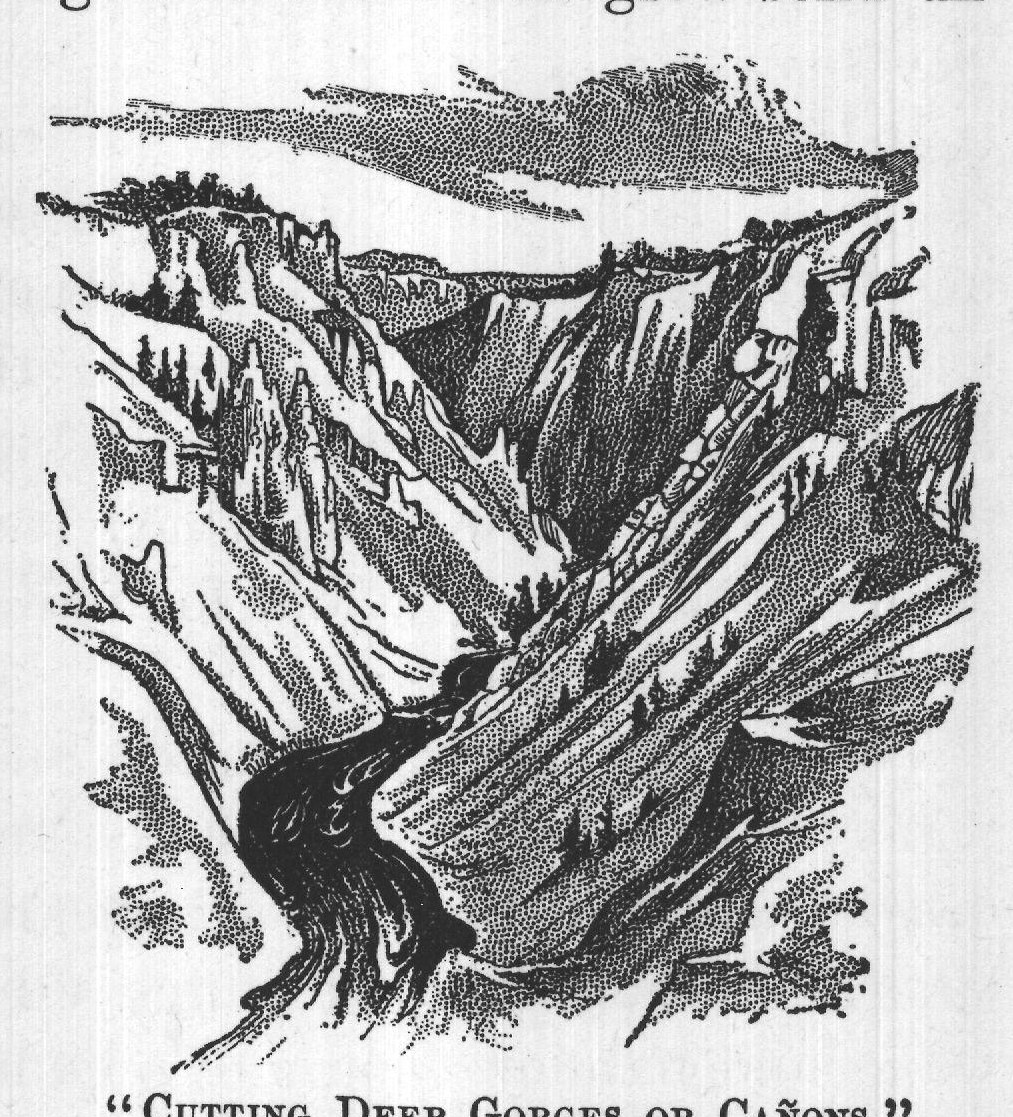
At water would go down in a mass through a cleft, when it would be hurled bodily the very way it came. other times the water came down little by little, insinuating itself into many places at once. Then the hot rocks threw it back in many little honeycomb channels, and by the spreading of these channels the rocks were at last crumbled to pieces. The hard black lava on the glass-like obsidian were changed to white kaolin as soft and powdery as chalk. And as the water fought its way, gaining a little every year, steadily working between the joints in the enemy's armor and as surely being thrown back with violence if it penetrated too far, the animals and the plants followed in the wake of the water, and took possession of the territory as fast as it was won. At last the Pliocene times were over, for all times come to an end. The one sure thing on the earth is the certainty of change. With the change of time came on the earth's great winter. The snow-drifts on the lava were piled up mountain-high. Snow is but ice gathered in little fragments which will grow solid under pressure. the snow accumu- As lated it began to move, forming great rivers of ice which ran down the courses of the stream. And as these slowly moving, gigantic icerivers tore away huge blocks of lava and pushed them down the mountainsides, where the "CUTTING DEEP GORGES OR CAÑONS." rocks had been softened by the action of steam, the ice wore out deep valleys, and everything that it touched was smoothed and polished. The winter of the great Ice age lasted a very long time, many thousands of years; but, long as it was and long ago, it came at last to an end - not to a full stop, of course, for even now, some of its snow still lingers on the highest peaks that surround the lava-beds.
Then the winters grew shorter and the summers longer. The south winds blew and the ice melted away, first from the plain and then from the mountains. The water ran down the sides of the lava-bed, cutting deep gorges or cañons, so deep that the sun can hardly see the bottom. And into the joints and clefts of the rocks more and more water went, to be hurled back with greater and greater violence, for all the waters of all the snow cannot put out a mile deep of fire.
In the old depressions where the ice had chiselled away the softer rocks, there were formed lakes of the standing water, and one of these was more than thirty miles long, winding in and out among the mountain-ridges.
In the lake bottom the water soaked through down to the hot lava below, from which it was thrown boiling back to the surface again, fountains of scalding water in the icy lake.
The cold Ice age had killed all the plants in the region; and it had driven off the animals that could be driven, and had then buried the rest. But when the snow was gone the creatures all came back again.
Grass and meadow-flowers of a hundred kinds came up from the valleys below. The willow and the aspen took their place again by the brook-side, and the red fir and the mountain pine covered the hills with their sombre green. The birds came back. The wild goose swam and screamed, and the winter wren caroled his bright song - loudest when there seemed least cause for rejoicing. The beaver cut his timber and patiently worked at his dams. The thriftless porcupine destroyed a tree for every morning meal. The gray jay, the "camp robber," followed the Indians about in hope that some forgotten piece of meat or of boiled root might fall to his share; while the buffalo, the bear, and the elk each carried on his affairs in his own way, as did a host of lesser animals, all of whom rejoiced when this snow-bound region was at last opened for settlement. Time went on. The water and the fire were every day in mortal struggle, and always when the water was thrown back repulsed, it renewed the contest as vigorously as before.
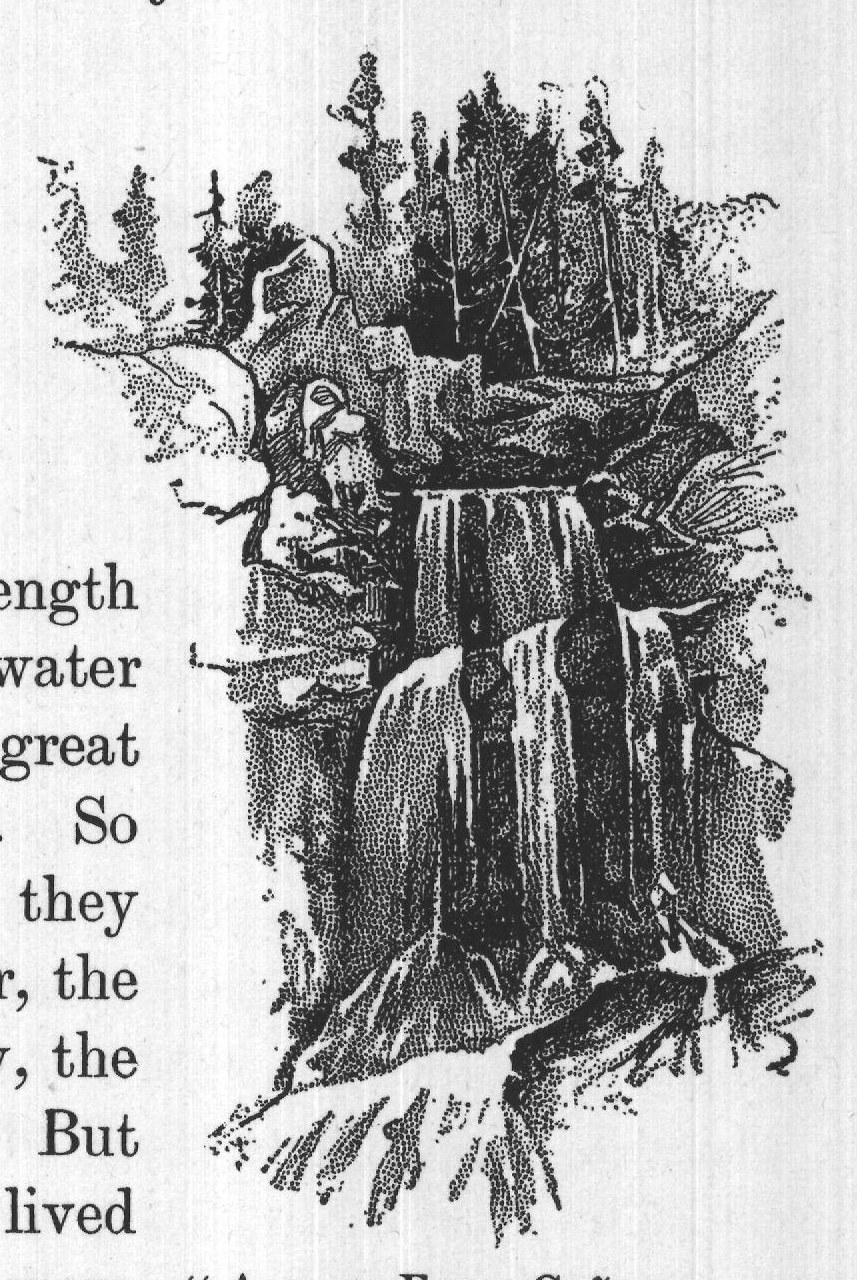
The fire retreated, leaving great stretches of land to its enemy, that it might concentrate its strength where its strength was greatest. And the water steadily gained, for the great ocean ever lay behind it. So for century after century they wrestled with each other, the water, the fire, the snow, the animals and the plants. But the fishes who had once lived in the mountain torrents were "AND IN EACH CAÑON WAS A no longer there. They had WATERFALL." been boiled and frozen, and in one way or another destroyed or driven away. Now they could not get back. Every stream had its cañon, and in each cañon was a waterfall so high that no trout could leap up. Although they used to try it every day, not one ever succeeded.