Home › The Man-Like Apes › The Man-Like Apes: Savage
The Man-Like Apes: Savage
From the time of Tyson and Tulpius downward the habits of the young Chimpanzee in a state of captivity have been abundantly reported and commented upon. But trustworthy evidence as to the manners and customs of adult anthropoids of this species, in their native woods, was almost wanting up to the time of the publication of the paper by Dr. Savage, to which I have already referred, containing notes of the observations which he made, and of the information which he collected from sources which he considered trustworthy, while resident at Cape Palmas, at the north-western limit of the Bight of Benin.
The adult Chimpanzees, measured by Dr. Savage, never exceeded, though the males may almost attain, five feet in height. "When at rest, the sitting posture is that generally assumed. They are sometimes seen standing and walking, but when thus detected, they immediately take to all fours and flee from the presence of the observer. Such is their organization that they cannot stand erect, but lean forward. Hence they are seen, when standing, with the hands clasped over the occiput, or the lumbar region, which would seem necessary to balance or ease of posture. "The toes of the adult are strongly flexed and turned inward, and cannot be perfectly straightened. In the attempt the skin gathers into thick folds on the back, showing that the full expansion of the foot, as is necessary in walking, is unnatural. The natural position is on all fours, the body anteriorly resting upon the knuckles. These are greatly enlarged, with the skin protuberant and thickened like the sole of the foot. "They are expert climbers, as one would suppose from their organization. In their gambols they swing from limb to limb at a great distance, and leap with astonishing agility. It is not unusual to see the 'old folks' (in the language of an observer) sitting under a tree regaling themselves with fruit and friendly chat, while their 'children' are leaping around them, and swinging from tree to tree with boisterous merriment. "As seen here, they cannot be called gregarious, seldom more than five, or ten at most, being found together. It has been said, on good authority, that they occasionally assemble in large numbers, in gambols.
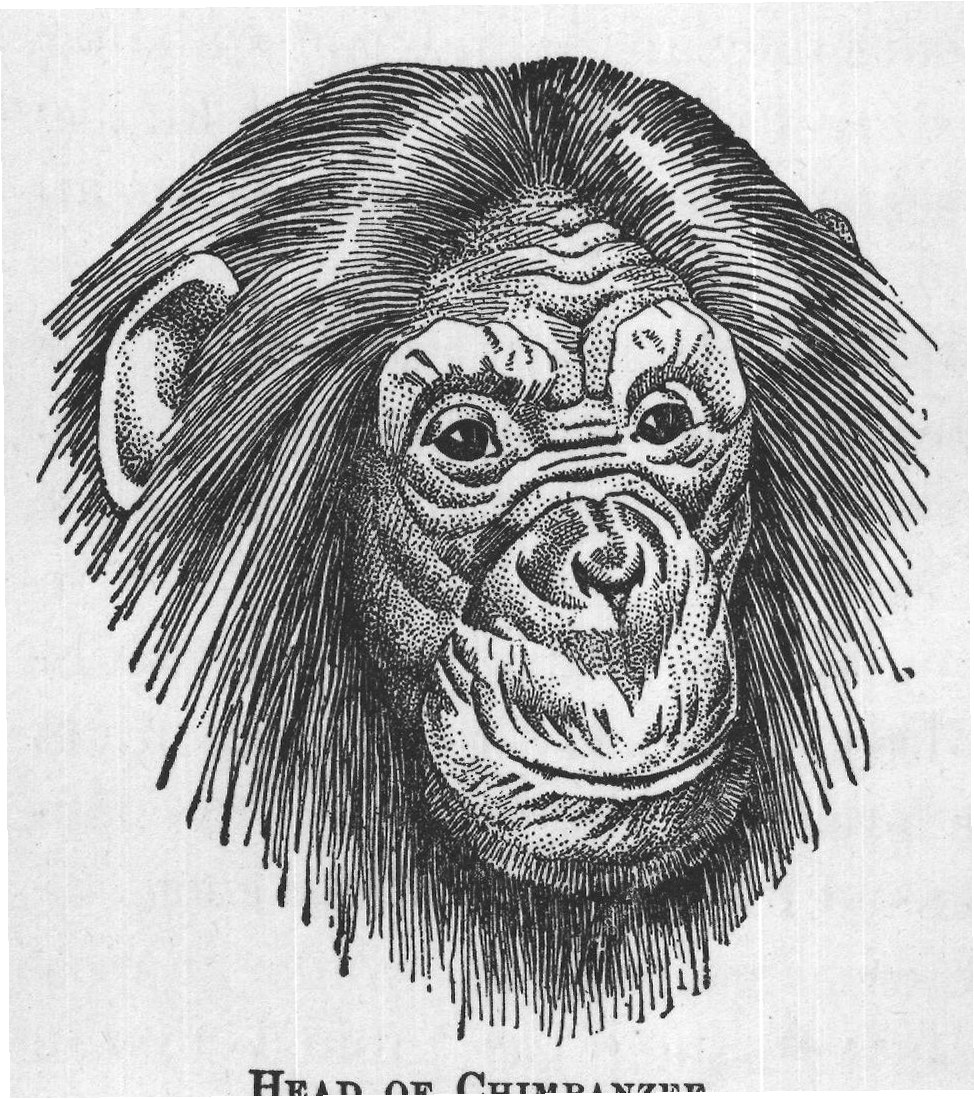
My informant asserts that he saw once not less than fifty so engaged, hooting, screaming, and drumming with sticks upon old logs, which is done in the latter case with equal facility by the four extremities. They do not appear ever to act on the offensive, and, seldom, if ever, really on the defensive. When about to be captured, they resist by throwing their arms about their opponent, and attempting to draw him into contact with their teeth."
With respect to this last point Dr. Savage is very explicit in another place : "Biting is their principal art of defence. I have seen one man who had been thus severely wounded in the feet. "The strong development of the canine teeth in the adult would seem to indicate a carnivorous propensity; but in no state save that of domestication do they manifest it. At first they reject flesh, but easily acquire a fondness for it. The canines are early developed, and evidently designed to act the important part of weapons of defence. When in contact with man almost the first effort of the animal is - to bite. "They avoid the abodes of men, and build their habitations in trees. Their construction is more that of nests than huts, as they have been erroneously termed by some naturalists. They generally build not far above the ground.
Branches or twigs are bent, or partly broken, and crossed, and the whole supported by the body of a limb or a crotch. Sometimes a nest will be found near the end of a strong leafy branch twenty or thirty feet from the ground. One I have lately seen that could not be less than forty feet, and more probably it was fifty. But this is an unusual height. "Their dwelling-place is not permanent, but changed in pursuit of food and solitude, according to the force of circumstances. We most often see them in elevated places; but this arises from the fact that the low grounds, being more favorable for the natives' ricefarms, are the oftener cleared, and hence are almost always wanting in suitable trees for their nests.
It is seldom that more than one or two nests are seen upon the same tree, or in the same neighborhood: five have been found, but it was an unusual circumstance."... "They are very filthy in their habits. It is a tradition with the natives generally here that they were once members of their own tribe; that for their depraved habits they were expelled from all human society, and that, through an obstinate indulgence of their vile propensities, they have degenerated into their present state of organization. They are, however, eaten by them, and when cooked with the oil and pulp of the palm-nut considered a highly palatable morsel. "They exhibit a remarkable degree of intelligence in their habits, and, on the part of the mother, much affection for their young. The second female described was upon a tree when first discovered, with her mate and two young ones (a male and a female). Her first impulse was to descend with great rapidity and make off into the thicket with her mate and female offspring. The young male remaining behind, she soon returned to the rescue. She ascended and took him in her arms, at which moment she was shot, the ball passing through the forearm of the young one, on the way to the heart of the mother. "In a recent case the mother, when discovered, remained upon the tree with her offspring, watching intently the movements of the hunter. As he took aim, she motioned with her hand, precisely in the manner of a human being, to have him desist and go away. When the wound has not proved instantly fatal, they have been known to stop the flow of blood by pressing with the hand upon the part, and when they did not succeed, to apply leaves and grass.