Home › How Animals Spend the Winter › How Animals Spend the Winter
How Animals Spend the Winter
(FROM GLEANINGS FROM NATURE.)1 BY W. S. BLATCHLEY.
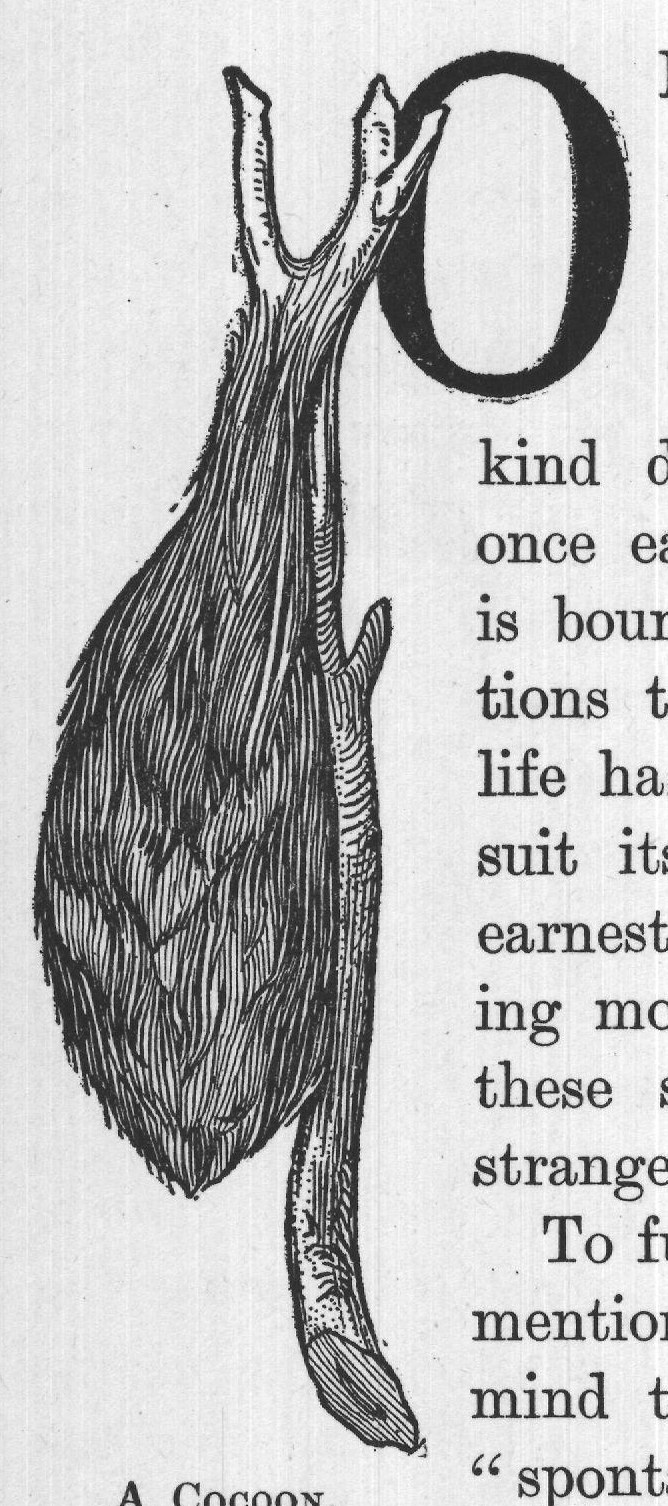
A COCOON.
NE of the greatest problems which each of the living forms about us has had to solve, during the years of its existence on earth, is how best to perpetuate its kind during that cold season which once each year, in our temperate zone, is bound to come. Many are the solutions to this problem. Each form of life has, as it were, solved it best to suit its own peculiar case, and to the earnest student of Nature there is nothing more interesting than to pry into these solutions and note how varied, strange, and wonderful they are.
To fully appreciate some of the facts mentioned below it must be borne in mind that there is no such thing as " spontaneous generation" of life. Every cell is the offspring of a pre-existing cell.
Nothing but a living thing can produce a living thing. 1 "Popular Science Monthly," February, 1897. Copyright by William Stanley Blatchley, 1899.
Hence every weed that next season will spring up and provoke the farmer's ire, and every insect which will then make life almost intolerable for man or beast, exists throughout the winter in some form.
Beginning with the earth-worms and their kindred, we find that at the approach of winter they burrow deep down where the icy breath of the frost never reaches, and there they live, during the cold season, a life of comparative quiet. That they are exceedingly sensitive to warmth, however, may be proven by the fact that when a warm rain comes some night in February or March, thawing out the crust of the earth, the next morning reveals in our dooryards the mouths of hundreds of the pits or burrows of these primitive tillers of the soil, each surrounded by a little pile of pellets, the castings of the active artisans of the pits during the night before.
If we will get up before dawn on such a morning we can find the worms crawling actively about over the surface of the ground, but when the first signs of day appear they seek once more their protective burrows, and only an occasional belated individual serves as a breakfast for the early birds.
The eyes of these lowly creatures are not visible, and consist of single special cells scattered among the epidermal cells of the skin, and connected by means of a sensory nerve fibre with a little bunch of nervous matter in the body. Such a simple visual apparatus serves them only in distinguishing light from darkness, but this to them is most important knowledge, as it enables them to avoid the surface of the earth by day, when their worst enemies, the birds, are in active search for them.
The fresh-water mussels and snails and the crayfish burrow deep into the mud and silt at the bottom of ponds and streams where they lie motionless during the winter. The land snails, in late autumn, crawl beneath logs, and, burrowing deep into the soft mould, they withdraw far into their shells. Then each one forms with a mucous secretion two thin transparent membranes, one across the opening of the shell and one a little farther within, thus making the interior of the shell perfectly air-tight. There for five or six months he sleeps, free from the pangs of hunger and the blasts of winter, and when the balmy breezes of spring blow up from the south he breaks down and devours the protecting membrane and goes forth with his home on his back to seek fresh leaves for food and to find for himself a mate.
Next in the scale come the insects, which comprise four-fifths of all existing animals, and each one of the mighty horde seen in summer has passed the winter in some form. One must look for them in strange places and under many disguises; for they cannot migrate, as do the majority of the birds, nor can they live an active life while the source of their food supply, the plants, are inactive.
The majority of those insects which in May or June will be found feeding on the buds or leaves of our trees, or crawling worm-like over the grass of our lawns, or burrowing beneath the roots of our garden plants, are represented in the winter by the eggs alone. These eggs are deposited in autumn by the mother insect, on or near the object destined to furnish the young, or larvæ, their food. Each egg corresponds to a seed of one of our annual plants; being, like it, but a form of life so fashioned and fitted as to withstand for a long period intense cold; the mother insect, like the summer form of the plant, succumbing to the first severe frost.
Thus myriads of the eggs of grasshoppers are in the early autumn deposited in the ground, in compact masses of forty to sixty each. About mid-April they begin to hatch, and the sprightly little insects, devoid of wings, but otherwise like their parents, begin their life-work of changing grass into flesh.
A comparatively small number of insects pass the winter in the larval or active stage of the young. Of these, perhaps the best known is the brown "woolly worm" or "hedgehog caterpillar," as it is familiarly called. It is thickly covered with stiff black hairs on each end, and with reddish hairs on the middle of the body. These hairs appear to be evenly and closely shorn, so as to give the animal a velvety look; and as they have a certain degree of elasticity, and the caterpillar curls up at the slightest touch, it generally manages to slip away when taken into the HEDGEHOG CATERPILLAR. hand. Beneath loose bark, boards, rails, and stones, this caterpillar may be found in midwinter, coiled up and apparently lifeless. On the first bright, sunny days of spring it may be seen crawling rapidly over the ground, seeking the earliest vegetation which will furnish it a literal "breakfast." In April or May the chrysalis, surrounded by a loose cocoon formed of the hairs of the body interwoven with coarse silk, may be found in situations similar to those in which the larva passed the winter. From this, the perfect insect, the Isabella tiger moth, Pyrrharctia isabella Smith, emerges about the last of June. It is a medium sized moth, dull orange in color, with three rows of small black spots on the body, and some scattered spots of the same color on the wings.
By breaking open rotten logs one can find in midwinter the grubs or larvæ of many of the wood-boring beetles, and, beneath logs and stones near the margins of ponds and brooks, hordes of the maggots or larvæ of certain kinds of flies may often be found huddled together in great masses. The larvæ of a few butterflies also live over winter beneath chips or bunches of leaves near the roots of their food plant, or in webs of their own construction, which are woven on the stems close to the buds, whose expanding leaves will furnish them their first meal in spring.
Many insects pass the winter in the quiescent or pupal stage; a state exceedingly well fitted for hibernating, requiring as it does, no food, and giving plenty of time for the marvellous changes which are then undergone. Some of these pupæ are enclosed in dense silken cocoons, which are bound to the twigs of the plants upon which the larvæ feed, and thus they swing securely in their silken hammocks through all the storms of winter. Perhaps the most common of these is that of the brown Cecropian moth, Attacus cecropia L., the large oval cocoon of which is a conspicuous object in the winter on the twigs of our common shade and fruit trees. Many other pupæ may be found beneath logs or on the under side of bark, and usually have the chrysalis surrounded by a thin covering of hairs, which are rather loosely arranged. A number pass the cold season in the earth with no protective covering whatever. Among these is a large brown chrysa- CHRYSALIS OF TOMATO WORM. lis with a long tongue case bent over so as to resemble the handle of a jug. Every farm boy has ploughed or spaded it up in the spring, and is it but the pupa of a large sphinx moth, Protoparce celeus Hub., the larva of which is the great green worm, with a "horn on its tail," so common on tomato plants in the late summer. Each of the winter forms of insects above mentioned can withstand long and severe cold weather - in fact, may be frozen solid for weeks and retain life and vigor, both of which are shown when warm weather and food appear again. Indeed, it is not an unusually cold winter, but one of successive thawings and freezings, which is most destructive to insect life. A mild winter encourages the growth of mould which attacks the hibernating larvæ and pupæ as soon as, from excess of rain or humidity, they become sickly; and it also permits the continued activity of insectivorus mammals and birds. Thus, moles, shrews, and field mice, instead of burying themselves deeply in the ground, run about freely during an open winter and destroy enormous numbers of pupe; while such birds as the woodpeckers, titmice, and chickadees are constantly on the alert, and searching in every crevice and cranny of fence and bark of tree for the hibernating larvæ.
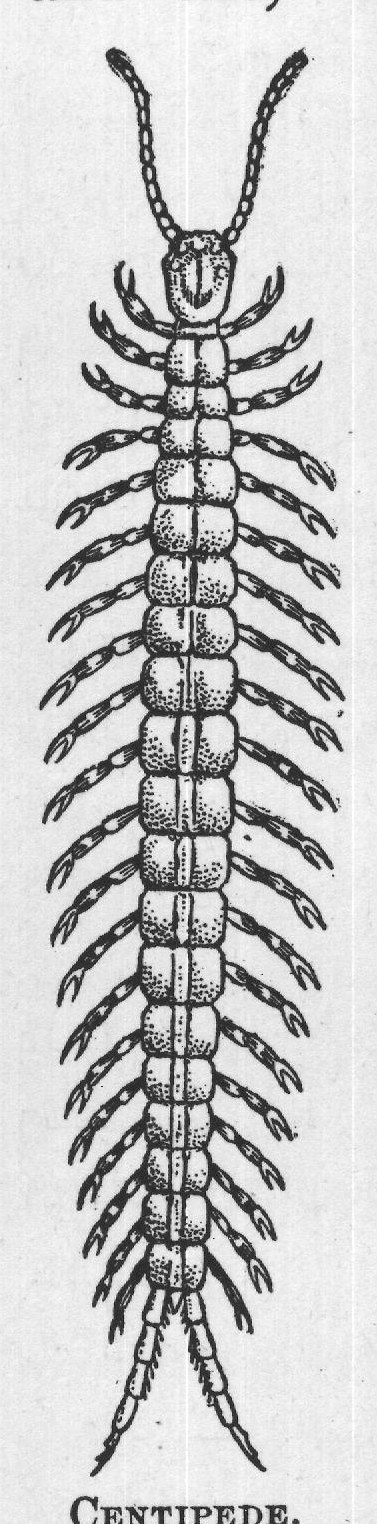
Of the creeping, wingless creatures, which can ever be found beneath rocks, rails, chunks, and especially beneath those old decaying logs which are half buried in the rich vegetable mould, the myriapods, or "thousand-legs," deserve more than a passing notice. They are typical examples of that great branch of the animal kingdom known as arthropods, which comprises all insects and crustaceans. Each arthropod has the body composed of rings placed end to end and bearing jointed appendages, and in the myriapods each ring and its appendages can be plainly seen; whereas in the higher forms of the branch many of the rings are so combined as to be very difficult to distinguish. Full forty kinds of myriapods occur in any area comprising one hundred square miles in the eastern United States. About twenty-five of them go by the general name of "thousand-legs" or millipedes, as each has from forty to fifty-five cylindrical rings in the body, and two pairs of legs to each ring. The other fifteen belong to the " centipede" group, the body consisting of about sixteen flattened segments, or rings, each bearing a single pair of legs. When disturbed, the "thousand-legs" generally coils up and remains motionless, shamming death, or "playing possum," as it is popularly put, as a means of defence; while the centipede scampers hurriedly away and endeavors to hide beneath leaf, chip, or other object. All those found in the Northern States are perfectly harmless, the true centipede, whose bite is reputed much more venomous than it really is, being found only in the South. True, some of the centipede group can pinch rather sharply with their beetle-like jaws; and one, our largest and most common species, a brownish red fellow about three inches long and without eyes, can even draw blood if its jaws happen to strike a tender place.