Home › How Animals Spend the Winter › How Animals Spend the Winter: Orthoptera
How Animals Spend the Winter: Orthoptera
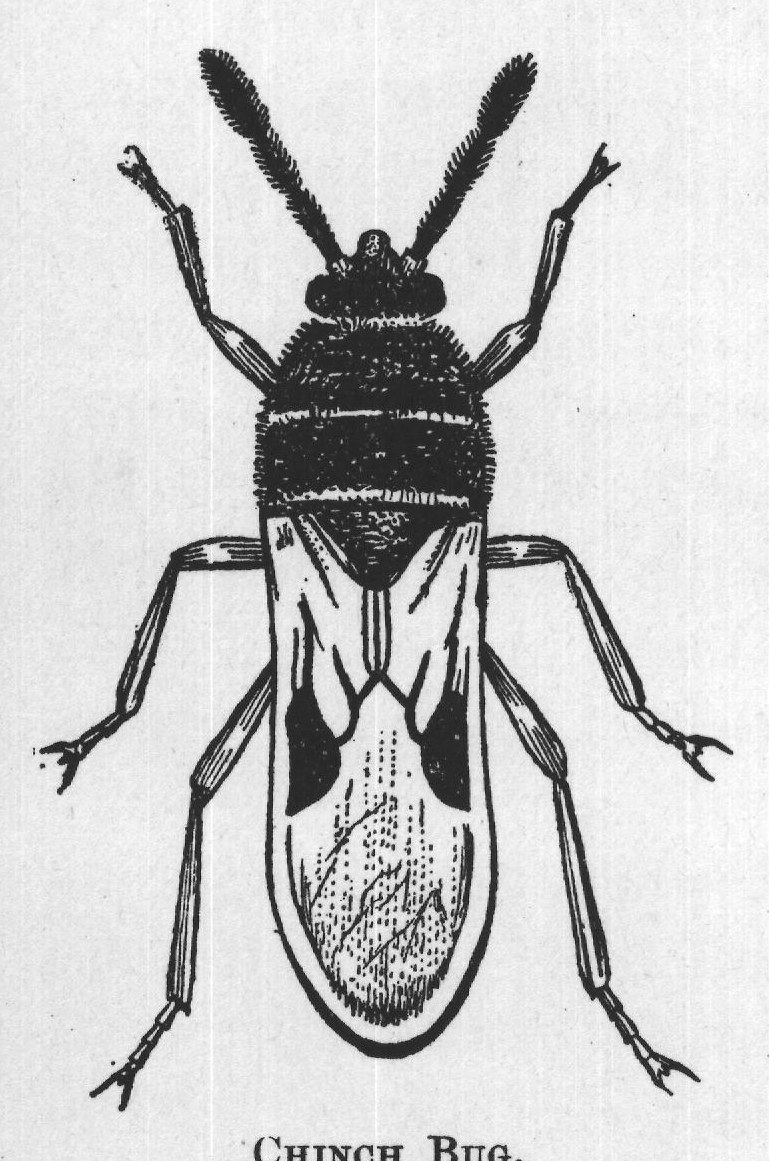
In any Northern State as many as four hundred different kinds of the six-footed or true insects, in the winged or adult stage, may be taken in winter by any one who is so disposed, and knows where to search for them. Among the Orthoptera, the "grouse grasshoppers" live during the cold season beneath the loose bark of logs, or beneath the bottom rails of the old Virginia worm fences. From these retreats every warm, sunny day tempts them forth in numbers. On such occasions the earth seems to swarm with CHINCH BUG. them, as they leap before the intruder, their hard bodies striking the dead leaves with a sound similar to that produced by falling hail. The common field cricket belongs also to the Orthoptera, and the young of various sizes winter under rails and logs, bidding defiance to Jack Frost from within a little burrow or pit beneath the protecting shelter.
The true bugs, or Hemiptera, hibernate in similar places; squash bugs, chinch bugs, "stink" bugs, and others being easily found in numbers beneath loose bark or hidden between the root leaves of mullein and other plants.
Nearly three hundred species of Coleoptera, or beetles, occupy similar positions. Almost any rotten log or stump when broken open discloses a half dozen or more "horn" or "bess beetles," Passalus cornutus L., great, shining, clumsy, black fellows with a curved horn on the head. They are often utilized as horses by country children, the horn furnishing an inviting projection to which may be fastened, by a thread or cord, chips and pieces of bark to be dragged about by the strong and never lagging beast of burden. When tired of "playing horse" they can make of the insect an instrument of music; for, when held by the body, it emits a creaking, hissing noise, produced by rubbing the abdomen up and down against the inside of the hard, horny wing covers. This beetle passes its entire life in cavities in the rotten wood on which it feeds, and when it wishes a larger or more commodious home it has only to eat the THIRTEEN-SPOTTED LADY BEETLE. more.
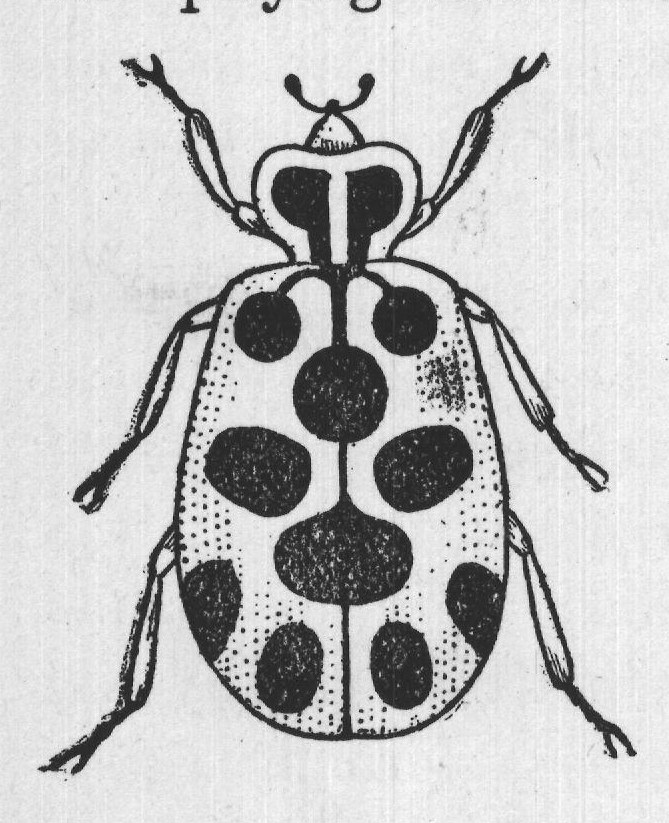
The handsome and beneficial lady beetles winter beneath fallen leaves or between and beneath the root leaves of the mullein and the thistle. Our most common species, the thirteen-spotted lady beetle, Megilla maculata De G., is gregarious, collecting together by thousands on the approach of cold weather, and lying huddled up like sheep until a breath of spring gives them the signal to disperse. Snout beetles galore can be found beneath piles of weeds near streams and the borders of ponds or beneath chunks and logs in sandy places. All are injurious, and the farmer by burning their hibernating places in winter can cause their destruction in numbers. Rove beetles, ground beetles, and many others live deep down in the vegetable mould beneath old logs, where they are, no doubt, as secure from the ice king as if they followed the swallow to the tropics.
Of the Diptera, or flies, but few forms winter in the perfect state, yet the myriads of house flies and their kin, which next summer will distract the busy housewife, are represented in winter by a few isolated individuals which creep forth occasionally from crevice or cranny and greet us with a friendly buzz.
In mid-winter one may also see in the air swarms of small, gnat-like insects. They belong to this order and live beneath the bark of freshly fallen beech and other logs. On warm, sunny days they go forth in numbers for a sort of rhythmical courtship; their movements while in the air being peculiar in that they usually rise and fall in the same vertical line - performing a curious aërial dance which is long continued. Among the dozen or more butterflies and moths which winter in the perfect state, the most common and the most handsome is the "Camberwell beauty" or "mourning cloak," Vanessa antiopa L., a large butterfly whose wings are a rich purplish brown above, duller beneath, and broadly margined with a yellowish band. It is often found in winter beneath chunks which are raised a short distance above the ground, or in the crevices of old snags and fence rails. It is then apparently lifeless, with the antennæ resting close along the back, above which the wings are folded. But one or two warm days are necessary to restore it to activity, and I have seen it on the wing as early as the 2d of March, hovering over the open flowers of the little snow trillium.
All the species of ants survive the winter as mature forms, either in their nests in the ground or huddled groups in half rotten logs and stumps; while here and there beneath logs a solitary queen bumble-bee, bald hornet, or yellow jacket is found - the sole representatives of their races. - Thus insects survive the winter in many ways and in many places, some as eggs, others as larvæ, still others as pupæ, and a large number as adults all being able to withstand severe cold and yet retain vitality sufficient to recover, live, grow, and replenish the earth with their progeny when the halcyon days of spring appear once more.
In the scale of animal life the vertebrates or backboned animals succeed the insects. Beginning with the fishes, we find that in late autumn they mostly seek some deep pool in pond or stream at the bottom of which the water does not freeze. Here the herbivorous forms eke out a precarious existence by feeding upon the innumerable diatoms and other small plants which are always to be found in water, while the carnivorous prey upon the herbivorous, and so maintain the struggle for existence. The moving to these deeper channels and pools in autumn and the scattering in the spring of the assembly which has gathered there constitute the so-called "migration of fishes," which is far from being so extensive and methodical as that practiced by the migratory birds.
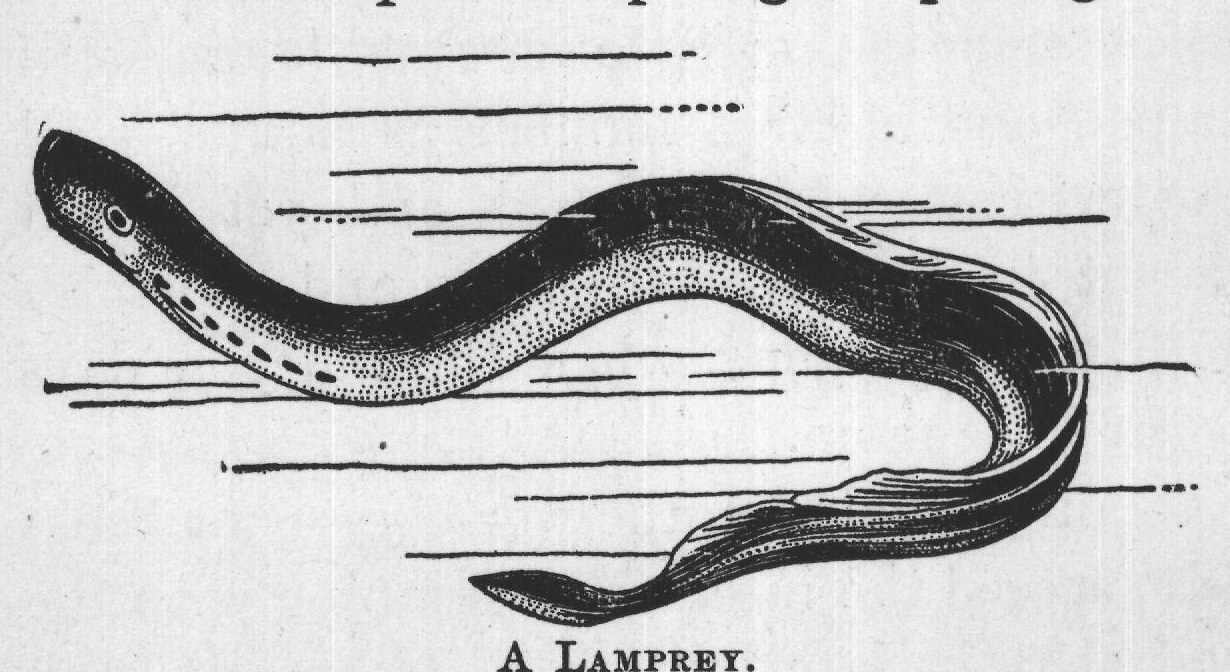
Many of the smaller species of fishes, upon leaving these winter resorts, ascend small, clear brooks in large numbers for the purpose of depositing their eggs; as, when hatched in such a place, the young will be comparatively free from the attacks of the larger carnivorous forms. Among the lowest vertebrate often found in numbers in early spring in these meadow rills and brooks is the lamprey, Ammocætes branchialis (L.), or "lamper eel," as it is sometimes called. It has a slender eel-like body, of a uniform leaden or blackish color, and with seven purse-shaped gill openings on each side.
A LAMPREY.
The mouth is fitted for sucking rather than biting, and with it they attach themselves to the bodies of fishes and feed on their flesh, which they scrape off with their rasp-like teeth. Later in the season they disappear from these smaller streams, probably returning in midsummer to deeper water. Thoreau, who studied their habits closely, says of them: "They are rarely seen on their way down stream, and it is thought by fishermen that they never return, but waste away and die, clinging to rocks and stumps of trees for an indefinite period; a tragic feature to the scenery of the river bottoms worthy to be remembered with Shakespeare's description of the sea floor." A few of the fishes, as the mud minnow and smaller catfishes, together with most frogs, turtles, and salamanders, on the approach of winter, burrow into the mud at the bottom of the streams and ponds, or beneath logs near their margins. There they live without moving about and with all the vital processes in a partially dormant condition, thus needing little if any food.
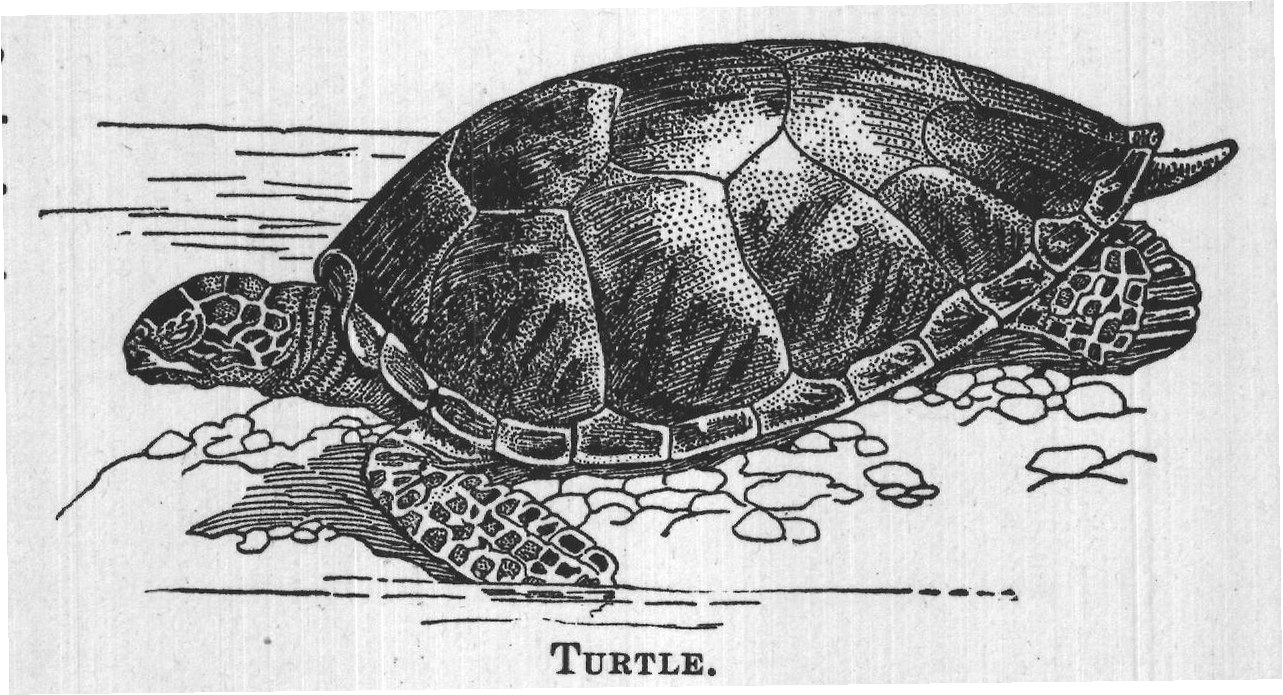
The box tortoise or "dry land terrapin," the common toad, and some salamanders burrow into the dry earth, usually going deep enough to escape frost; while snakes seek some crevice in the rocks or hole in the ground where they coil themselves together, oftentimes in vast numbers, and prepare for their winter's sleep.
In an open winter this hibernation is often in- TURTLE. terrupted, the animal emerging from its retreat and seeking its usual summer haunts as though spring had come again. Thus I have, on one occasion, seen a softshelled turtle moving gracefully over the bottom of a stream on a day in late December, and have in mid- January captured snakes and salamanders from beneath a pile of drift-wood, where they had taken temporary refuge.
With frogs, especially, this hibernation is not a perfect one, and there is a doubt if in a mild winter some species hibernate at all. For example, the little cricket frog or "peeper" has been seen many times in midwinter alongside the banks of flowing streams, and during the open winter of 1888–89 numerous specimens of leopard and green frogs were seen on different occasions in December and January, while on February 18th they, together with the "peepers," were in full chorus.
Of our mammals, a few of the rodents or gnawers, as the ground-hogs, gophers and chipmunks, hibernate in burrows deep enough to escape the cold, and either feed on a stored supply of food, or, like the snakes and crayfish, do not feed at all.
CHIPMUNK.
Others, as the rabbits, field-mice, and squirrels, are more or less active and forage freely on whatever they can find, eating many things which in summer they would spurn with scorn. To this class belongs that intelligent but injurious animal the musquash or muskrat. Those which inhabit the rivers and larger streams live in burrows dug deep beneath the banks, but those inhabiting sluggish streams and ponds usually construct a conical winter house about three feet in diameter and from two to three feet in height. These houses are made of coarse grasses, rushes, branches of shrubs, and small pieces of driftwood, closely cemented together with stiff, clayey mud. The top of the house usually projects two feet or more above the water, and when sun-dried is so strong as to easily sustain the weight of a man. The walls are generally about six inches in thickness and are very difficult to pull to pieces.
Within is a single circular chamber with a shelf or floor of mud, sticks, leaves and grass, ingeniously supported on coarse sticks stuck endwise into the mud after the manner of piles. In the centre of this floor is an opening, from which six or eight diverging paths lead to the open water without, so that the little artisan has many avenues of escape in case of danger. These houses are often repaired and used for several winters in succession, but are vacated on the approach of spring. During the summer the muskrat is, in the main, a herbivorous animal, but in winter necessity develops its carnivorous propensities and it feeds then mainly upon the mussels and crayfish which it can dig from the bottom of the pond or stream in which its house is built.
The bats pass the winter in caves, the attics of houses, and barns, or in hollow trees, hanging downward by their hind claws. Motionless for months they thus remain, and those in the more exposed situations are, doubtless, frozen solid. Yet, in time, their blood flows freely once again and they become as expert on the wing as though the year were one continual jubilee of insect chasing, and frost and snow were to them unknown.
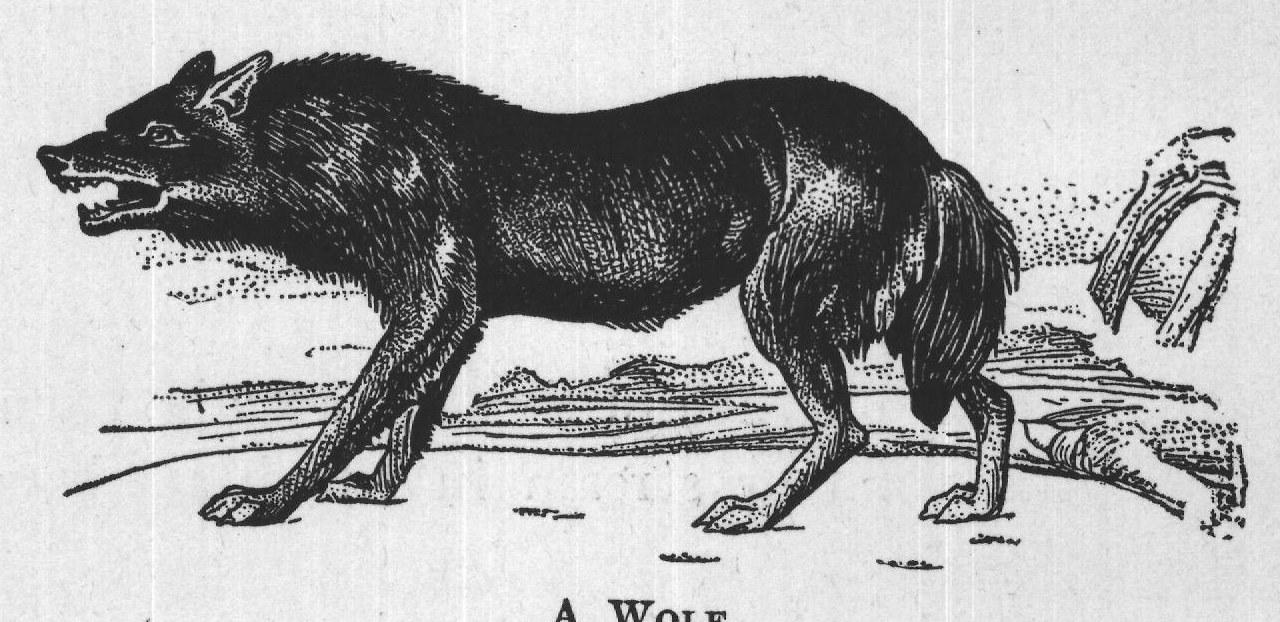
All the carnivora, or flesh-eaters, as the mink, skunk, opossum, fox, and wolf, are in winter active and voracious, needing much food to supply the necessary animal heat of the body. Hence they are then much more bold than in summer, and the hen yard or sheep pen of the farmer is too frequently called upon to supply this extra demand.
But of all our animals it seems to me the birds have solved the winter problem best. Possessing an enduring power of flight and a knowledge of a southern sunny sky, beneath which food is plentiful, they alone of all the living forms about us have little fear of the coming of the frost. True, fifty or more species remain in each of the Northern States during the cold season, but they are hardy birds which feed mainly upon seeds, A WOLF. as the snow-bird and song sparrow; on flesh, as the hawks and crows; or on burrowing insects, as the nuthatches and woodpeckers. Such are some of the solutions to the problem of life in winter which the plants and animals about us have worked out; such some of the forms which they undergo; the places which they inhabit.
To the thinking mind a knowledge of these solutions but begets other and greater problems, such as how can a living thing be frozen solid for weeks and yet retain vitality enough to fully recover? How can a warmblooded animal sleep for months without partaking of food or drink? And greater than either, what is that which we call life?
I hold in my hand two objects, similar in size, color, organs, everything - twins from the same mother in all outward respects. One pulsates and throbs with that which we call "life." It possesses heat, bodily motion, animal power. The other is cold, motionless, pulseless, throbless - a thing of clay. What is that "life" which the one possesses and the other lacks ? Ah, there's the rub! With the wisest of men we can only answer, "Quien sabe?" (Who knows?) WINTER HOUSE OF MUSKRAT.