Home › Bats › Bats: Long-eared
Bats: Long-eared
The Long-eared Bat, so called from the great size of its ears, which are nearly as long as the whole animal exclusive of the tail, has perhaps a wider distribution than the Pipistrelle, but is hardly so abundant in Britain. Its head and body measure nearly two inches long, while its wings spread to about ten inches. This Bat generally sleeps during the day under the roofs of Bats houses and in church towers, and when sleeping its long ears are carefully stowed away under the folded wings, but the earlet or inner lobe of the ear still projects, so that the creature appears to have a pair of short-pointed ears. The Long-eared Bat flies very late in the evening, and indeed seems to continue its activity throughout the night; its food appears to consist to a great extent of the smaller moths, although other insects are by no means disdained. This species also soon becomes very tame and familiar; it will fly about the room, play with its fellows, and come fearlessly to take its food from the hand.
Professor Bell gives an interesting account of one kept by Mr.
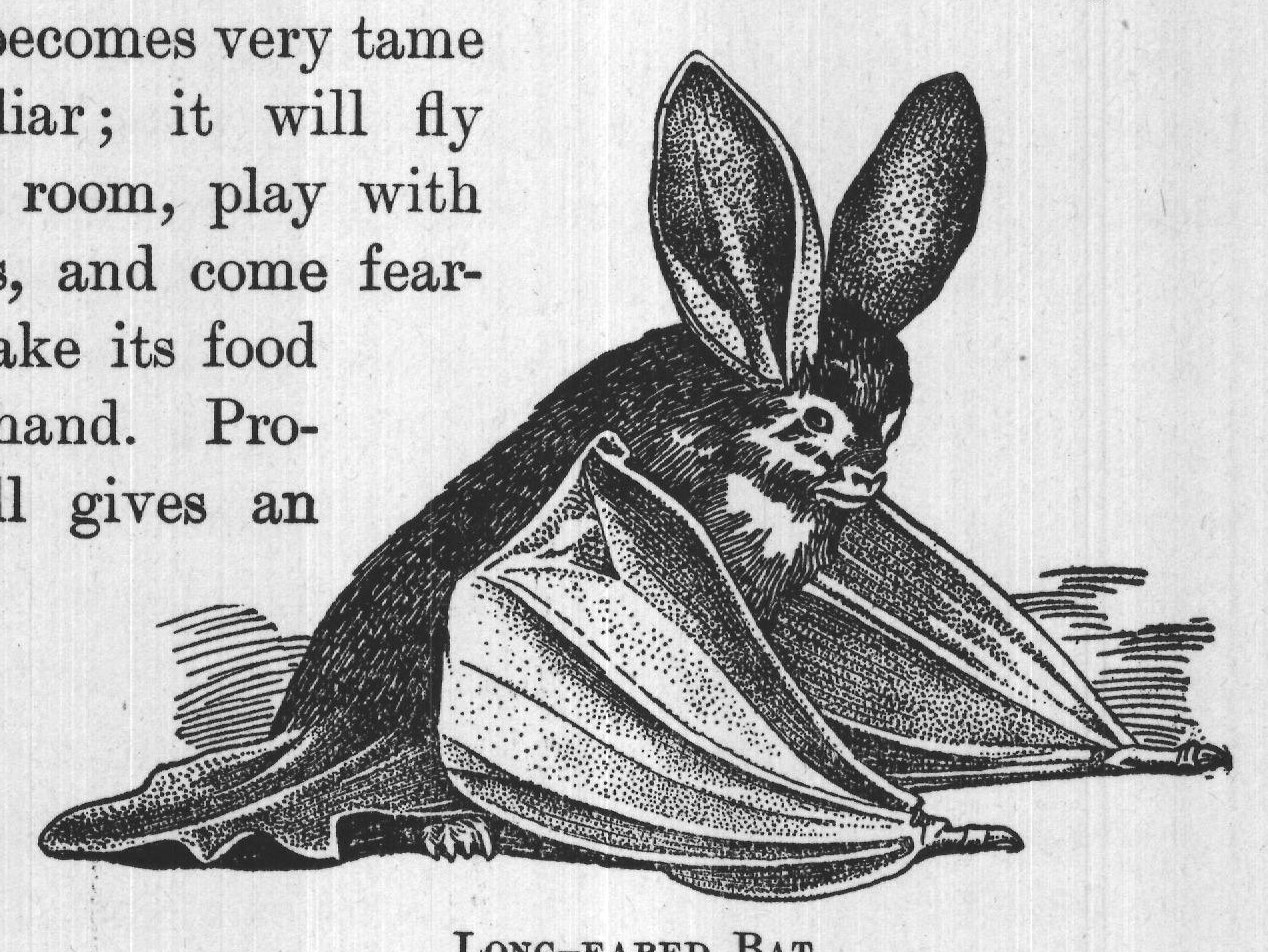
James LONG-EARED BAT.
Sowerby, which, "when at liberty in the parlor, would fly to the hand of any of the young people who held up a fly toward it, and, pitching on the hand, take the fly without hesitation. If the insect was held between the lips, the Bat would then settle on its young patron's cheek, and take the fly with great gentleness from the mouth; and so far was this familiarity carried, that, when either of the young people made a humming noise with the mouth, in imitation of an insect, the Bat would search about the lips for the promised dainty." This habit of taking its food when off the wing, would seem to be natural to the Long-eared Bat under certain circumstances, as Mr. Tomes records his having seen one feeding in this manner upon the myriads of small moths which swarmed about a spindle tree in bloom.
It is unnecessary to say that the creatures which display all this activity and intelligence are well endowed with at least all the senses possessed by the other animals of their class. The organs of smell and hearing are well developed, and in many cases associated with external membranous expansions of great size, as seen in the ears of the Long-eared Bat; and the eyes, though generally of small size except in the Fruit Bats, are bright and efficient, serving the creatures in good stead in the rapid pursuit of their insectprey, which must be directed principally by sight. The common expression "as blind as a Bat," must be taken to apply to Bats accidentally driven from their retreats in the day-time, when it must be confessed that they fly about in a dazed manner; but at night and in their dark retreats they show no such imbecility of purpose, but find their way with astonishing precision and certainty. In fact, instead of being blind, the Bats must be especially sharp-sighted, if all their evolutions be guided by the sense of sight, for in many cases they habitually resort to the inmost recesses of caverns and other places where, so far as our judgment goes, no light can possibly penetrate. Hence it was long since suspected that some other sense than that of sight must come to their aid when they plunge into such outer darkness as prevails in some places through Bats which they fly with the greatest freedom, and more than a century ago numerous experiment were made by a distinguished Italian naturalist, the Abbé Spallanzani, in order to discover, if possible, what might be the secret of these curious phenomena.
He set free, in a long passage which was bent at a right angle about the middle of its length, a blinded Bat, which flew through the whole of this passage, turning the corner correctly, without anywhere touching the walls; while flying, too, it in some mysterious manner detected a hole in the roof at a distance of eighteen inches, and proceeded at once to ensconce itself in this shelter. In another experiment the Abbé took two Bats, one blinded, the other not, and placed them in a space shut off from a garden and roofed in with nets, and with sixteen strings suspended from the top in different parts. Both Bats flew about briskly and avoided the hanging strings equally well, until at length the blinded Bat discovered that the meshes of the net were large enough for him to get through, when he at once made his escape, and after flying about for a short time, went off directly to the only roof in the vicinity, under which he disappeared. In short, from these experiments it became perfectly clear that under these circumstances the sense of sight was not of primary importance in guiding the course of the Bat. Similar trials with the organs of smell and hearing showed that they had nothing to do with it, and the only other sense that could be appealed to was the general sense of touch. Baron Cuvier, the great French comparative anatomist, was the first to suggest, from the consideration of the results obtained by the Abbé Spallanzani and others, especially by M. de Jurine, of Geneva, that the peculiar phenomena in question might be accounted for by the existence, especially in the great membranous expansions of the wings, of a most delicate sensibility; and subsequent investigations of the structure of those organs has tended to confirm this view, so that it is now the one generally accepted. It is found that these great membranes are traversed in all parts by numerous nerves, the delicate terminations of which form little loops, exactly resembling those which occur in our skin in those parts where the sense of touch is most highly developed; and this resemblance is heightened by the fact that the membrane is covered with rows of little points. Even the organs of circulation in the wings are so constructed as to render it almost certain that those organs have a quite exceptional sensibility. Their ramifications are very numerous, and the veins as well as the arteries have contractile walls, rendering the circulation of the blood exceedingly active, the conditions, as Professor St. George Mivart remarks, being almost those of a state of inflammation.
If these membranous expansions have the functions just ascribed to them, we can easily understand that the larger they are the better, and this will explain why the Bats generally exhibit so great a tendency to run out into naked membranes. Thus although the ears, as organs of hearing, have probably nothing to do with guiding the Bat when flying in dark places, we find that in a great number of species the external ears are exceedingly large and delicately membranous, of which indeed we have an example in the British Long- Bats eared Bat already referred to. In like manner, while the nose, as a nose, may also be left out of consideration, the development of membranous appendages of the part of the face in which the nostrils open is one of the most curious peculiarities of a vast number of Bats, in many of which these singular nose-leaves almost rival the ears in size, while their structure often renders them most grotesque. We have two Bats thus adorned in Britain, namely, the Greater and the Lesser Horseshoe Bats, but most of the leaf-nosed species are inhabitants of warmer regions, and it is there that they run out into the most remarkable eccentricities of structure. In Blainville's Bat, a small species inhabiting South America and the West Indies, these expansions of the skin of the face seem to have reached the utmost possible grotesqueness, but the membranous leaves are larger and the ears much more developed in many species allied to our own Horseshoe Bats, especially such as the Megaderms. We can hardly imagine that these great membranous expansions of the outer ears and the region of the nose can have any other purpose than that of enlarging the surface of highly sensitive skin specially adapted for the perception of external impressions, and it is a remarkable fact, strictly in accordance with this view, that, so far as we know, the Bats so endowed are more decidedly nocturnal in their habits and frequent darker retreats than their less gifted fellows. Thus our Long-eared Bat, as already stated, continues active on the wing throughout the whole night, and the Horseshoe Bats are distinguished as specially affecting dark caves.