Bats: Flying
Perhaps the special characteristics of the Bats will be brought out most distinctly by a comparison of their structure with that of a bird, seeing that the modification of the fore-limbs into wings is their most striking distinction from other Mammalia; for, although some other members of the class are spoken of as "flying," such as the Flying Squirrels, Flying Lemurs, and Flying Phalangers, these creatures do not really fly, but merely glide through the air to considerable distances by the action of a broad fold of skin which runs down each side of the body, and Bats which, when stretched between the extended limbs, buoys the creatures up in the air after the fashion of a parachute.
Most of us must have had occasion to pick the bones of a bird's wing, a piece of practical anatomy which may serve us in good stead at present. They consist of a long bone, which may be called the arm-bone (humerus), jointed to the shoulder-bones (the so-called "side-bones" of a fowl or turkey), followed by a pair of parallel bones constituting the fore-arm, at the end of which we find two or three small bones, then two parallel bones united at their extremities, and some smaller joints terminating the whole.
We need say nothing about the arm-bone and the two bones of the fore-arm, the peculiarity of birdstructure lying chiefly in the terminal portion of the limb, or the hand. Here we find, after two little bones forming the wrist, a pair of long bones as above described, firmly united both at base and apex, and on the outside of the base of these, close to the wrist, a small bone, which may be either free or soldered to the others, and which represents the thumb in the human hand. At the other end of the piece formed by the two united bones, the limb is continued by two joints, forming a second finger, inside of which there is usually a single small bone, representing a third finger. But all these parts are stiffly attached to one another, admitting of very little motion, so that the whole hand forms as it were a single piece. The bony structure of the bird's wing is in point of fact a rod hinged in two places, at the elbow and the wrist, for the convenience of being folded into a small compass. The flight of the bird is effected by the agency of a number of stiff feathers implanted in the skin covering the bones and muscles of the arm and hand; these fold together like the sticks of a fan when the wing is folded, and are spread into an elastic instrument for striking the air when the different sections of the bony framework are extended by the action of their respective muscles.
In the Bat the structure is very different. Of course, as in the Vertebrata generally, we find in the Bat's fore-limb the same three main sections as in birds; and as the function of the limb is the same, and a certain stiffness is necessary in the extended organ, the movements of the joints at the elbow and wrists are hinge-like. But the bones of the arm and fore-arm are longer and more slender, especially the latter; and in this part, in place of the two parallel bones of the bird's wing, we find in the Bat only a single long bone representing the smaller bone of the bird, the larger one being usually reduced to very small dimensions, and firmly united with the other into a single piece, although it still forms the elbowjoint. At the other end of this long fore-arm we find some small wrist-bones and to these the fingers are articulated. In birds, as we have seen, only two or three fingers are represented, and these are more or less reduced in size, and the most important of them soldered together; Bats, on the contrary, show the whole five fingers as distinctly as in the hand of man or any other mammals. The first of them, or the thumb, is short, slender, and flexible, and composed of three joints; the other four are very long and slender, Bats but chiefly composed of the metacarpal bones, corresponding to those of the palm of the human hand. The first, or index finger, indeed, in many Bats, consists of this bone alone; but in the others it is followed by two or three slender joints, gradually tapering to the extremity, the second finger, corresponding to our middle finger, being always the longest of all.
Just as is the bird's wing, these various parts can be folded together or extended by the action of the muscles, but in the Bat the long fingers become separated when the wing is stretched out, and by this action they at the same time stretch a thin leathery double membrane in which they are enclosed, which is thus converted into a broad surface for striking the air in flight. This membrane is continued from the fingers to the sides of the body, and even to the hind limbs, which are often included in it to the ankle-joints; while in the great majority of Bats there is even a further portion of membrane between the hind legs, enclosing the whole or a portion of the tail. There is usually also a narrow strip of the same membrane in front of each arm, so that the skin of the animal is extended as much as possible, in order to give it support in its aërial evolution. It is to be noted that the long second finger extends to the extreme point of the wing and that the first finger runs close beside it and thus assists in stiffening that part of the organ. The thumb is left free, and is furnished with a rather strong hooked claw.
Supported by the action of these great leathery wings, the Bat flies about almost incessantly during the twilight, and often late into the night. In full career its flight is swift, though perfectly noiseless, and it has the power of executing rapid turns and changes of direction with the greatest facility, as required for the capture of its prey, which, in the great majority of cases, consists of the insects of various kinds that in most places fly by night. In pursuit of these, the Bats flit rapidly about trees, houses, and other buildings, now and then resting by clinging for a moment to the rough surfaces of the walls or the trunks and branches of trees. Old country church-yards, which are usually full of trees, are naturally favorite haunts of these nocturnal insect-hunters, offering them an excellent field for the chase of their prey, while at the same time, the church itself, with its architectural peculiarities, usually affords them a safe retirement during the day in the dark and secluded corners of its structure. Hence in the popular mind the Bat has long been associated with the church-yard, that spot so dreaded that few can pass through it after nightfall without experiencing certain peculiar feelings, so that it is no great wonder if a portion of the superstitious fear thus engendered has transferred itself to these frail and harmless creatures, and given them and their companions, the owls, something of an evil reputation. And it must be confessed that when seen against the light, flitting silently overhead, there is something weird in the Bat's form, and this is no doubt the reason why, while angels of all kinds are represented with birds' wings, those of Bats have, by universal consent, always been conferred upon demons, dragons, and similar uncanny creatures.
When it descends from its flight upon the ground or Bats any solid body, the Bat becomes to all intents and purposes a genuine quadruped. The fingers being drawn together, with the membranes of the wings thrown into folds between them, the whole hand of the creature is brought up parallel to the fore-arm, and so got out of the way, and the animal can then walk more or less easily, its hind legs, though short and rather feeble, being perfectly formed, and the fore limbs, from which the thumbs with their sharp claws now project freely, becoming available for terrestrial progression. Nevertheless, this progression is generally rather clumsy, as indeed might be expected from creatures so curiously constructed.
While on the wing, our Bats are constantly engaged in the pursuit of the numerous insects of various kinds which, like themselves, are active in the evening and after dark, and of these they must destroy immense quantities. The swarms of delicate gnats and midges which disport themselves in the most complicated aërial dances, moths of all kinds, and even the hard-shelled beetles, many of which fly about in the evening or at night, fall a prey to these leathern-winged rovers of the night air, and weak as the latter would seem to be, some of them are able to seize and devour beetles which appear to be far beyond their powers. Thus, the largest of our British species, the Great Bat, or Noctule (Scotophilus noctula), which, however, is only about three inches in length, preys freely upon such large and hard-shelled insects as cockchafers; these, in fact, appear to be its favorite food, and for their consumption its broad and comparatively strong jaws would seem to be specially fitted, while its large and powerful wings, measuring fourteen or fifteen inches from tip to tip when expanded, enable it to fly with the rapidity necessary for the pursuit and capture of such powerful prey. When thus engaged, the Noctule haunts the neighborhood of trees, and generally flies at a considerable elevation, from which, however, his shrill cry easily reaches the ear of the passer-by. His addiction to large prey gives rise to a curious movement, thus noticed by Professor Bell in his valuable book on "British Quadrupeds." "An observer will not watch his movements long," says the Professor, "without noticing a manœuvre which at first looks like the falling of a tumbler-pigeon, but on closer examination proves to be simply a closing of the wings, and a consequent drop of about a foot. Sometimes this is repeated every few yards, as long as in sight. It is occasioned by some large and intractable insect having been captured, and the anterior joint of the wing, with its well-armed thumb, is required in retaining it until masticated." Notwithstanding this little difficulty, however, the Noctule is pretty rapid in disposing even of his most recusant prey, as he has been known to consume as many as thirteen cockchafers one after another.
The foregoing statements apply to all our British Bats, and indeed, in the matter of food and general habits, to the great majority of the species of the order, in whatever country they may occur. But in the tropical and sub-tropical regions of the eastern hemisphere, we find a great and important group of Bats, which, although agreeing in general structure and habits with our European species, differ from them altogether in THE VAMPIRE BAT Bats their diet. These Bats, distinguished generally, among other things, by their larger size and more robust construction, and by certain characters of the molar teeth (grinders), from the ordinary Bats, are almost exclusively confined to a fruit diet, in search of which they fly vigorously, often in flocks, like birds, at the commencement of the night. From this peculiarity of their food they are commonly known as Fruit Bats, while the larger species, such as the Indian Fruit Bat and the Kalong of the Eastern Archipelago, which are respectively eleven and fourteen inches in length, are sometimes called Flying Foxes, in allusion to the prevalence of a reddish tint in their fur, and their more or less lengthened and dog-like muzzles. In many parts of the Eastern world, in India, the Malayan Archipelago, Australia, Africa, and even in outlying islands at some distance from their main range, these Fruit Bats occur in great numbers. Swarms of them roost together during the day, hanging from the branches of the trees which they select as their regular resting-place, and taking wing at sunset, fly off frequently to great distances in search of their favorite articles of food; for they by no means devour indiscriminately any kind of fruit, but show a distinct preference for particular sorts, generally selecting such as are also prized by their human competitors. Hence they often do considerable damage in plantations of fruit trees, as when they meet with articles that suit taste, they seem, like some human gourmands, not to know when to leave off eating. Of one of the smaller Indian species, the Margined Fruit Bat, Mr. Dobson obtained a living specimen in Calcutta, and he gives the following account of its voracious appetite: - He gave it "a ripe banana, which, with the skin removed, weighed exactly two ounces. The animal immediately, as if famished with hunger, fell upon the fruit, seized it between the thumbs and the index fingers, and took large mouth. fuls out of it, opening the mouth to the fullest extent with extreme voracity. In the space of three hours the whole fruit was consumed. Next morning the Bat was killed, and found to weigh one ounce, half the weight of the food eaten in three hours! Indeed, the animal when eating seemed to be a kind of living mill" - so continuously does its food pass through it. From the statements of some writers, it would appear that although these Bats live chiefly upon fruits, they occasionally, like many other frugivorous animals, diversify their diet with animal food, devouring insects of various kinds, caterpillars, birds' eggs, and even young birds, while there seems to be some reason to believe that one species even feeds upon shell-fish which it picks up upon the seashore.
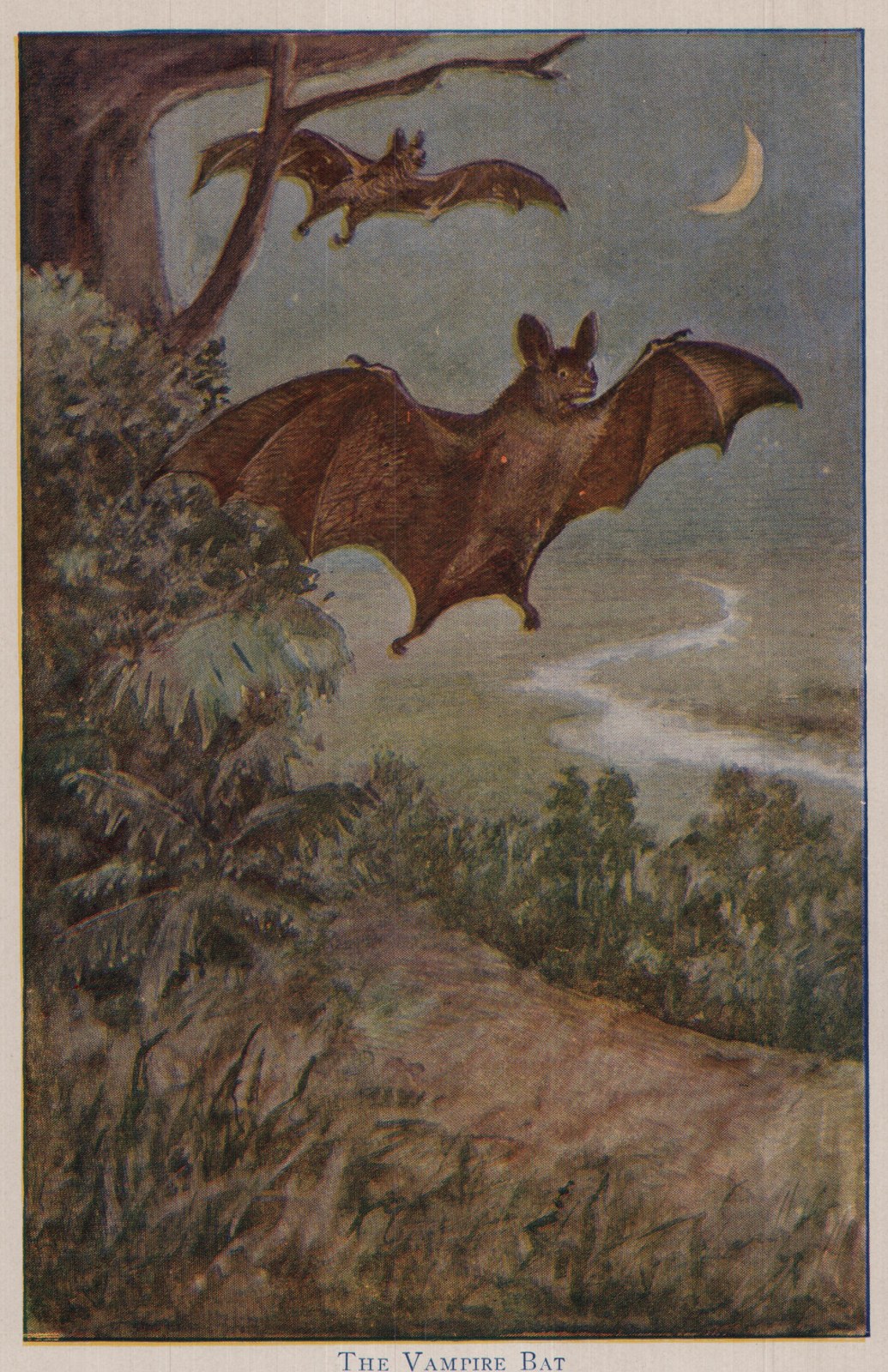
The fruit-eating Bats of this group are not found in the warmer parts of America, but some American Bats feed chiefly upon fruits, while many of the large essen tially insectivorous species which occur there vary their diet more or less with fruits, and also occasionally attack and devour other vertebrate animals. Some of them - but it is still very doubtful how many have another habit connected with their feeding, which renders them very decidedly objectionable, namely, that of inflicting wounds upon birds and mammals, even including man himself, and sucking up the blood that flows from them. This charge has been brought -- Bats against many Bats of South and Central America, some of which have been commonly named Vampires in consequence, after the ghostly blood-suckers, which were formerly the objects of so much superstitious terror in Hungary and other parts of Eastern Europe; but so far as can be made out from a consideration of the evidence, a verdict of "not proven," at all events, must be arrived at in the case of all but two species, which constitute a little group distinguished by what is apparently a special organization adapting them to this peculiar diet. These wretched little beasts, which only measure two and a half or three inches in length, are furnished in the upper jaw with a single pair of incisor or front teeth, but these are of great size and strength, triangular in form, and so excessively sharp that when the creatures are seized they can draw blood from the hand of their captor by what seems a mere touch.