Home › Volumes › Moths › Geometer Moths
Spring Canker-worm
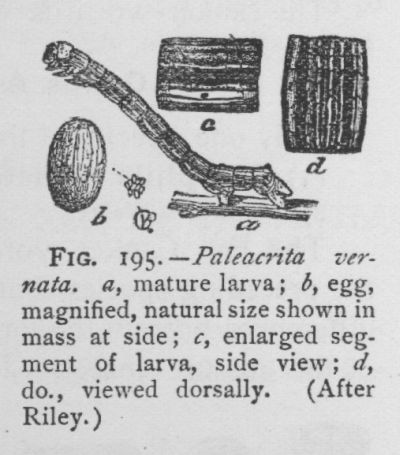
There are two insects known as canker-worms. One of these, the smaller of the two, is properly named the Spring Canker-worm, because the great majority of the moths issue from the ground in the spring. It has been a great pest in orchards, and formerly in our Eastern cities was a nuisance, not only because of the injury which it inflicted upon the foliage of shade-trees, but because of the annoying manner in which the larvae, pendent from the branches by long threads of silk, were blown about over things and persons beneath them. It was to effect their destruction that the English sparrow was originally imported into this country. The ravages of the insects upon the foliage of trees in parks and gardens have measurably decreased since this step was taken, but in the open country especially in the Valley of the Mississippi, the insects are still numerous enough to do much harm to orchards. The females being apterous, the best method of preventing the multiplication of the insects upon trees is to prevent them from climbing up upon the foliage and ovipositing. A simple device, which has proved very effective, is to tie a piece of rope about the trunk of the tree which it is intended to protect, and to insert between the rope and the bark strips of tin, which, having been put into place, should be bent downwardly and outwardly, so as to form a collar with a downward flare. The insects have been found not to be inclined to pass such a barrier, and they will congregate just below it, and may there be captured and destroyed. Birds are the chief enemies of the canker-worm, and every wise orchardist will see to it that all species of insectivorous birds are not molested in his neighborhood, but are encouraged to find in his trees a hospitable welcome. The small amount of fruit which the birds take as toll is amply compensated for by the work which they perform in keeping down insect pests, such as the one under consideration. It is the part of wisdom in every way to protect the birds.
The canker-worm is widely distributed from the Atlantic to the Pacific.