Home › Volumes › Moths › Geometer Moths
Fall Canker-worm
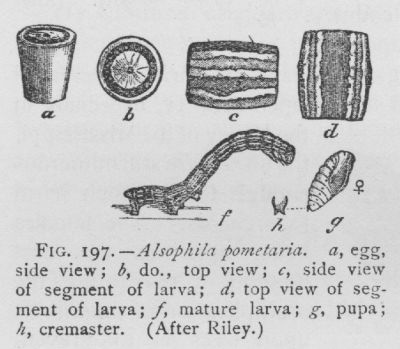
The Fall Canker-worm in many respects closely resembles the preceding species, but a critical eye can at once detect great differences both in the form and markings of the caterpillar and of the mature insect. The moths generally emerge from the pupal state in the late fall, or during mild spell of weather in the winter, and may even continue to come forth until the spring is well advanced. The eggs are not laid as those of the preceding species, singly under the scales of bark, but are deposited in a compact mass fastened to the twigs by a strong gluey secretion, and are loosely covered with gray hairs, which the female rubs from her abdomen. The caterpillars are not ornamented on the back by a multitude of fine lines, but have a broad brown stripe along the dorsal line. The moths are larger than those of the Spring Canker-worm, and have a distinct whitish spot on the costa of the primaries near the apex. The caterpillar undergoes but two molts, and matures very rapidly. It has rudimentary prolegs on the eighth somite. The precautionary measures which have proved effective in combating the Spring Canker-worm are not efficacious in dealing with this species. To effectively destroy them the best means is to spray the foliage, just as the buds are opening, with some one of the poisonous mixtures which are prepared as insecticides. One of the very best means of keeping down the ravages of the insects is to encourage the cherry-birds (Ampelis) to stay about the place. They wage relentless war upon the pests.