Home › Volumes › Moths › Pyralidae Family
Larger Corn-stalk Borer
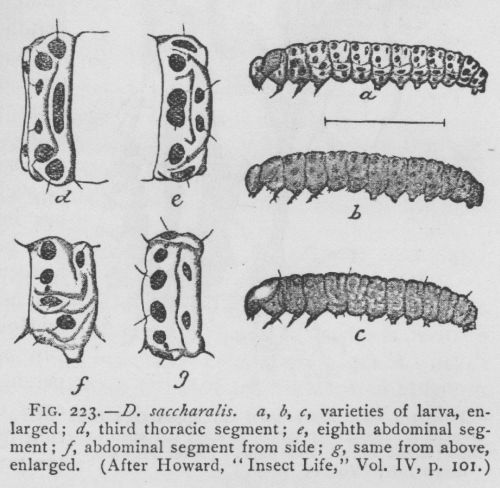
As early as the year 1828 the attention of the world was called to the damage inflicted upon the sugar-cane in the West Indies by the larva of a lepidopterous insect. The author of the paper in which it was described was the Rev. Lansdown Guilding, who was awarded a gold medal by the Society of Arts for his account of the insect. About thirty years later, attention was called to the ravages of a similar insect in the island of Mauritius, into which it had been introduced. From the West Indies the insect was transported to Louisiana, and a study of its pernicious habits was accurately made in the year 1881 by Dr. L. O. Howard of the United States Department of Agriculture. It had been known in Louisiana as a pest since 1855.
The ravages of the insect are not confined to the sugar-cane. It attacks with equal avidity sorghum and the stalks of the common Indian corn, or maize. The insect has gradually worked its way northward from the region of the Gulf, having found lodgment here and there throughout the Southern States, and is now known to occur quite abundantly at times as far north as Maryland. It is double-brooded in Virginia.
The most serious damage is inflicted upon the crop where the larvae attack young stalks. Plants which are older and well established, though they may suffer to some extent from the insects, are generally not damaged sufficiently to prevent the maturing and hardening of the grain; but where the stalks are young and quite tender, they fail to mature, are stunted, sicken, and ultimately die. The accompanying figure shows the dwarfed and sickly appearance of such a stalk, which has been invaded by the borer. The life-history of the insect has been briefly given by Howard as follows: "In early spring the parent moth lays her eggs upon the young cane near the axils, and the young borer penetrates the stalk at or near the joint, and commences to tunnel, usually upward, through the soft pith. The larval growth is rapid, and the borer is active, and frequently leaves the stalk at one place and enters at another, making several holes in the course of its growth. When ready to transform, it burrows to the surface, making a hole for the exit of the future moth, and transforms to the pupa state. There are several generations in the course of a season, and the insect hibernates in the larval state within the stalks."
The fact that the insect makes its home in the winter months in the dry stalks furnished the means for most effectually combating its attacks. The remedy is found in destroying the stalks, either by burning them or by gathering them up and feeding them to live stock. It is well known that where crops are rotated, and the stalks are not left standing in the fields all winter, the insect does not succeed in inflicting much damage. Careful and intelligent tillage of the soil, cleanliness in the fields, will do much to prevent the increase of these insects, as well as of many other injurious species which might be named. In addition to feeding upon sugar-cane, sorghum, and corn, it has been ascertained that the insect will attack "Gama-grass" (Tripsacum dactyloides), and it is recommended to burn over fields in which this grass grows in proximity to corn-fields. The student who is desirous to know more about this insect may consult the pages of "Insect Life," Vol. IV, p. 95, where Dr. Howard has written at length upon its habits. It is from this article that much of the information contained in the preceding paragraphs has been drawn.