Home › Volumes › Moths › Pyralidae Family
Bee-moth
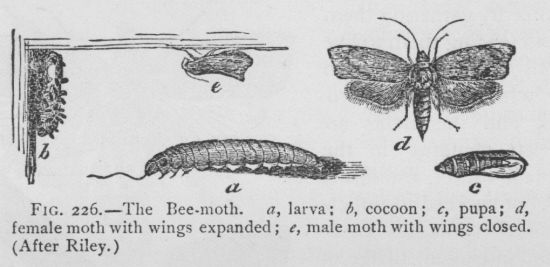
The Bee-moth was undoubtedly introduced into this country from Europe. It is a well-known enemy of the apiarist, and has been active in doing mischief on this side of the Atlantic for more than a century, while it has been known from time immemorial in Europe as one of the most dreaded pests of the hive. The moth is double-brooded, the first generation appearing on the wing in the latter part of May and the beginning of June, and the second in August. We cannot do better than to quote in this connection the following account of the insect which is given by Professor C. V. Riley in the "First Annual Report of the State Entomologist of Missouri," p. 166:
"During the daytime these moths remain quietly ensconced in some angle of the hive, but, as night approaches, they become active, and the female uses her best endeavors to get into the hive, her object being to deposit her eggs in as favorable a place as possible. Wire-gauze contrivances are of no avail to keep her out, as she frequently commences flying before all the bees have ceased their work. But even if she were entirely prevented from entering the hive, she could yet deposit her eggs on the outside, or, by means of her extensile ovipositor, thrust them in between the slightest joint or crack, and the young worms hatching from them would readily make their way into the hive. The moment the worm is hatched, it commences spinning a silken tube for its protection, and this tube is enlarged as it increases in size. The worm cuts its channels right through the comb, feeding on the wax, and destroying the young bees on its way. When full-grown, it creeps into a corner of the hive or under some ledge at the bottom, and forms a tough white cocoon of silk mingled with its own black excrement, as shown in Figure 226, b. In due time the moth emerges from this cocoon.
A worm-infested hive may generally be known by the discouraged aspect which the bees present, and by the bottom-board being covered with pieces of bee-bread mixed with the black gunpowder-like excrement of the worm....If a hive is very badly infested with the worm, it is better to drive out the bees and secure what honey and wax there may be left than to preserve it as a moth-breeder to infest the apiary. If put into a new hive, the bees may do something; and if they do not, there is no loss, as they would have perished, finally, from the ravages of the worm."