Home › Volumes › Game Birds › Shearwaters and Petrels
Wilson's Stormy Petrel
Also called: MOTHER CAREY'S CHICKEN; DEVIL'S BIRD
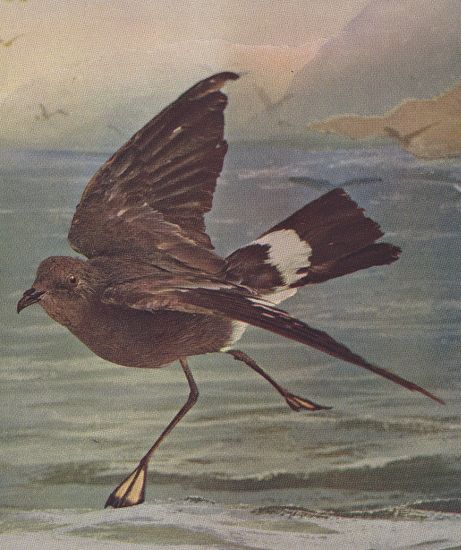
Length.—7 inches. Very long wings, with an extent of 16 inches, give appearance of greater size.
Male and Female.—Upper parts, wings, and tail sooty black; paler underneath, and grayish on wing coverts. The upper tail coverts and frequently the sides of rump and base of tail, white. Bill and feet black. Legs very long, and webs of toes mostly yellow. Tail square and even.
Range.—Atlantic Ocean, North and South America, nesting in southern seas (Kerguelen Island) in February; afterward migrating northward.
Season.—Common summer visitor off the coast of the United States.
This is the little petrel most commonly seen off the coast of the United States in summer, silently flitting hither and thither with a company of its fellows like a lot of butterflies in their airy, hovering flight. Owing to the spread of their long wings they appear much larger than they really are, for in actual size the birds are only a trifle longer than the English sparrow, and look like the barn swallow; yet these tiny atoms of the air spend their "life on the ocean wave," and have "their home on the rolling deep,"
"O'er the deep! o'er the deep!
Where the whale and the shark and the swordfish sleep--
Outflying the blast and the driving rain,"
like the stormy petrel of the east Atlantic (Procellaria pelagica), an even smaller species, which doubtless was the bird "Barry Cornwall" had in mind when he wrote his famous verses.
Those who go down to the sea in ships are familiar with the petrels that gather in flocks in the wake of the vessel, coursing over the waves, now down in the through, now up above the crest that threatens to break over their tiny heads; half leaping along a wave, half flying as their distended feet strike the water, and they bound upward again; darting swallow-fashion and skimming along the surface, or flitting like a butterfly above the refuse thrown overboard from the ship's galley. "But the most singular peculiarity of this bird," to quote Wilson, for whom it was named, "is its faculty of standing, and even running, on the surface of the water, which it performs with apparent facility. When any greasy matter is thrown overboard, these birds instantly collect around it, and face to windward, with their long wings expanded, and their webbed feet patting the water, which the lightness of their bodies and the action of the wind on their wings enable them to do with ease. In calm weather they perform the same manoeuvre by keeping their wings just so much in action as to prevent their feet from sinking below the surface." It is this appearance of walking on the waves, like the Apostle Peter, that has caused his name to be applied to them.
Particles of animal matter, particularly anything fat or oily, are what the petrels are searching for when they follow a ship; and seeing any such they quickly settle down to enjoy it, then rising again, soon overtake a vessel under steam. Their wing power is marvellous, yet when a gale is blowing in full blast at sea, these little birds are often blown far inland; the capped petrel, for example, that has its proper home in Guadeloupe, in the West Indies, having been found in the interior of New York state after a prolonged "sou'easter." The petrels swim little, if any, though their webbed feet are so admirably adapted for swimming, which might be a greater protection to them than flying when the storms blow. The lighthouses attract many to their death on the stern New England coast.
As night approaches the birds show signs of weariness from the perpetual exercise; for not only have they kept pace with a steamer through the day, but they have made innumerable excursions far from the ship, and played from side to side with a flock of companions at hide-and-go-seek or cross-tag until the eye tires of watching them. But by the time it is dark the last one of the merry little hunters has settled down upon the waves, with head tucked under wing, to rest until dawn while "rocked in the cradle of the deep"; yet it is apparently the very same flock of birds that are busily looking for breakfast the next morning in the wake of the ship, which they must have overtaken with the wings of Mercury.
It would seem these innocent sea-rovers might escape persecution at the hands of man; but an English globe-trotter tells of seeing not only sailors, but passengers, too, who ordinarily feel only camaraderie for other fellow travellers on a lonely vessel, shoot these tiny waifs hovering about the ship, to break the tediousness of a long voyage. With the guilty consciences such sailors must have, it is small wonder the petrel is a bird of ill omen to them. They claim it is a harbinger of storms, like its large relative the albatross; and it might easily be, for it delights in rough weather that brings an abundance of food to the surface. All the gruesome superstitions which sailors have clustered around the birds of this entire family, in fact, were woven by Coleridge into his "Rime of the Ancient Mariner."