Home › Volumes › Game Birds › Pheasants and Turkeys
Wild Turkey
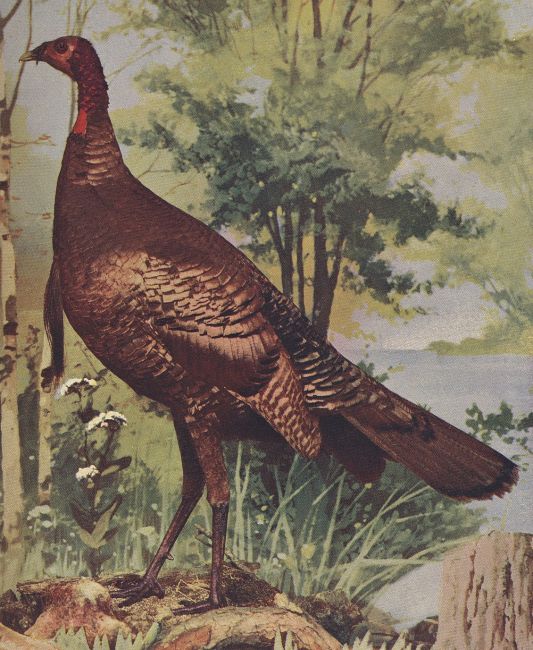
Length.—About four feet; largest of the game birds.
Male.—Head and upper neck naked; plumage with metallic bronze, copper, and green reflections, the feathers tipped with black; secondaries green barred with whitish, the primaries black barred with white. (The wild turkey to be distinguished from the domestic bird chiefly by the chestnut, instead of white, tips to the tail and upper tail coverts.) A long bunch of bristles hangs from centre of breast; bill red, like the head; legs red and spurred.
Female.—Smaller, dull of plumage, and without the breast bristles.
Range.—United States, from the Chesapeake to the Gulf coast, and westward to the Plains.
Season.—Permanent resident.
Once abundant so far north as Maine, Ontario, and Dakota, this noble game bird, now hunted to very near the extinction point, has had its range so restricted by the advance of civilization, for which it has a well grounded antipathy, that the most inaccessible mountains or swampy bottom lands, the borders of woodland streams that have never echoed to the whistle of a steamboat, are not too remote a habitation. Originally no more suspicious and wild than a health hen, according to the testimony of early New Englanders, much persecution has finally made it the most cunning and wary, the most unapproachable bird to be found; but what possible chance of escape has any wild creature once man, with the manifold aids of civilization at his disposal, determines to possess it? It cannot be long at the present rate of shrinkage before the turkey, in spite of its marvelous cleverness, will follow the great auk to extinction.
It is the Mexican turkey, introduced into Europe early in the sixteenth century, that still abundantly flourishes in poultry yards everywhere, and furnishes our Thanksgiving feasts. Another bird of the southwest, the Rio Grande turkey, that ranges over northeastern Mexico and southeastern Texas, and a fourth and smaller variety, confined to southern Florida, show constant, if slight variations in plumage, but little in nature, which awakens the hope that if American sportsmen were to introduce the southern races where the present species has been killed off, and protect the birds, magnificent sport might be indefinitely preserved.
Beginning at early dawn in spring, and before leaving his perch, the male turkey gobbles a shrill, clear love song, quite different at this season, before fat chokes his utterance, from the coarse gobble of the domestic turkey. The females now roost apart, but in the same vicinity. By imitating the hoot of the barred owl, and by skilful counterfeits of the female's plaintive yelp, produced by old sportsmen with the aid of a turkey wingbone, or a vibrating leaf placed on the lips, among other devices, the turkey may be lured within gun range, if his education has not gone far. Sailing to the ground from his perch, in the hope of having attracted some hen to his breakfast ground, the cock, at sight of one, displays every charm he possesses: his widely spread tail, his dewlap and warty neck charged with bright red blood; and drooping his wings as he struts before her, he sucks air into his windbag, only to discharge it with a pulmonic puff, that he evidently considers irresistibly fascinating. Dandified, overwhelmingly conceited, ruffled up with self-importance, he struts and puffs, until suddenly an infuriated rival rushing at him gives battle at once; spurs, claws, beaks, make blood and feathers fly, and the vanquished sultan retires discomfited, leaving the foe in possession of the harem. The turkey is ever a sad polygamist. Once the nesting season, lasting about three months, is over, the male stops gobbling, and not until the young need no care does he rejoin the females and see his well grown offspring for the first time, having enjoyed an idle club life with other selfish males while there was any real work to do.