Home › Volumes › Game Birds › Bob Whites, Grouse, Etc.
Ruffed Grouse
Also called: PARTRIDGE; PHEASANT; BIRCH PARTRIDGE
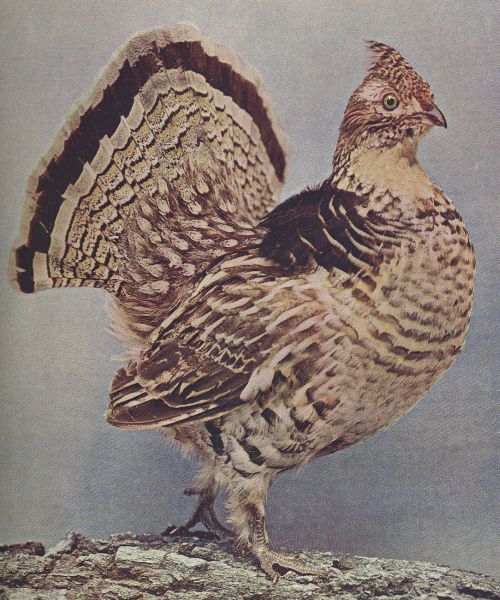
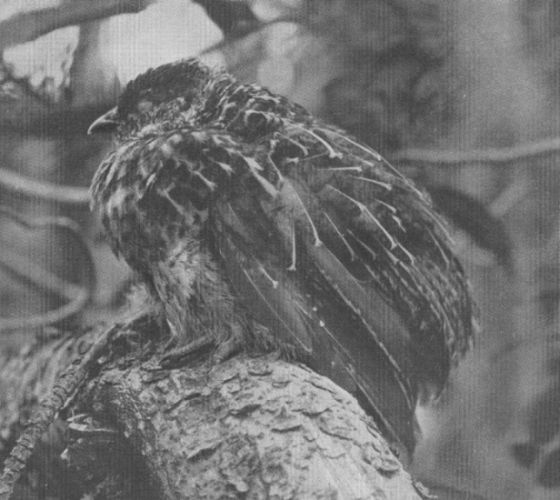
Length.—16 to 18 inches.
Male and Female.—Upper parts chestnut varied with grayish and yellowish brown, white, and black; head slightly crested; yellow line over eye; sides of neck of male with large tufts of glossy greenish black feathers tipped with light brown, much restricted or wanting and dull in female; long tail, which may be spread fan-like, yellowish brown or gray or rusty, beautifully and finely barred with irregular bands half buff, half black; a broad subterminal band of black between gray bands; throat and breast buff, the former unmarked; underneath whitish, all barred with brown, strongly on sides, less distinctly on breast and below; legs feathered to heel; bill horn color.
Range.—Eastern United States and southern Canada west to Minnesota, south to northern Georgia, Mississippi, and Arkansas.
Season.—Permanent but roving resident.
Neither a "partridge" nor a "pheasant," it is by the former name that this superb game bird is best known to the New Englanders, and by the latter that it is commonly called in the middle and southern states; but this most typical grouse (whose Latin name describes two striking characteristics: Bonasus, a bison, referring to the bellowing bull-like noise produced by the male; and umbellus, to the umbrella-like tufts on his neck) appears in literature and the market stalls alike as a "partridge," a misnomer shared by the Bob White, which strictly belongs to a race of European birds of which we have no counterparts on this side of the Atlantic. What's in a name? That which we call a grouse by any other name doth taste as sweet.
Partial to hill country interspersed with cultivated meadows and dingles, or to mountains, rocky, inaccessible, thickly timbered, and well watered with bush-grown streams, it is only rarely, and then chiefly in autumn, that coveys leave high altitudes to feed along the edges of milder valleys and enter the swamps. The dainties preferred include crickets, grasshoppers, the larvae of caterpillars, beechnuts, chestnuts, acorns of the chestnut oak and the white oak, strawberries, blueberries, raspberries, elderberries, wintergreen and partridge berries with their foliage, cranberries, the bright fruit of the black alder and dogwood, sumach berries (including the poisonous varieties, which do the grouse no injury), wild grapes, grain dropped in the stubble of harvested fields, the foliage of many plants, and the leaf buds of numerous shrubs and trees--a varied menu indeed, responsible alike for the bird's luscious, tender flesh and its roving disposition.
The "drumming" of a male ruffed grouse, its most famous characteristic, is surely as remarkable a bird call as is heard in all nature. A thumping, rolling tattoo, like the deep, muffled beating of a drum, sonorous, crepitating, ventriloqual, admirably written down by Mr. Ernest Seton Thompson, thump--thump--thump-thump, thump; thump, thump-rup, rup, rup, r-r-r-r-r-r-r-r-r-r, announces the presence of a cock hopeful of attracting the attention of some shy female hidden in the underbrush. Any one will do, for he is a sadly erring mate, a flagrant polygamist, in spite of much that has been said to whiten his character. On a fallen log, a wall, or broad stump that has been used as a drumming ground perhaps for many years, and well known to the hens as a trysting place, the male puffs out his feathers until, like a turkey cock, he looks twice his natural size, ruffs his neck frills, raises his crest, spreads and elevates his tail, droops his trailing wings beside him, and, with head drawn backward, struts along the surface with the most affected jerking, dandified gait. Suddenly he halts, distends his head and neck, and beats the air with his wings, slowly at first, then faster and faster, until there is simply a blur where wings should be, so marvelously fast do they go. Because they vibrate at a speed at which the human eye can scarcely follow, the method of drumming is a vexed question among the most reliable observers. Thoreau was ready to swear that he had seen the ruffed grouse strike its wings together behind its back to produce the sound, Audubon to the contrary notwithstanding. Most woodsmen will tell you either that the male strikes the log on which he is standing, or the sides of his body; but the strongest scientific judgment now favors the abundant testimony that the bird beats nothing but the air; its wings neither meet behind the back, nor do they touch its sides, nor strike against any substance whatsoever. The drumming may occur at any season, most frequently and vigorously at nesting time, of course; but besides being a love "song." it is doubtless also a challenge to rival cocks, that fight like gamesters until blood and feathers strew the ground; or it may be simply an outlet to the bird's inordinate vanity and vigorous animal spirits. In a lesser degree the sound is precisely the same as when the grouse begins its flight.