Home › Volumes › Game Birds › Bob Whites, Grouse, Etc.
Prairie Chicken
Also called: PINNATED GROUSE; PRAIRIE HEN
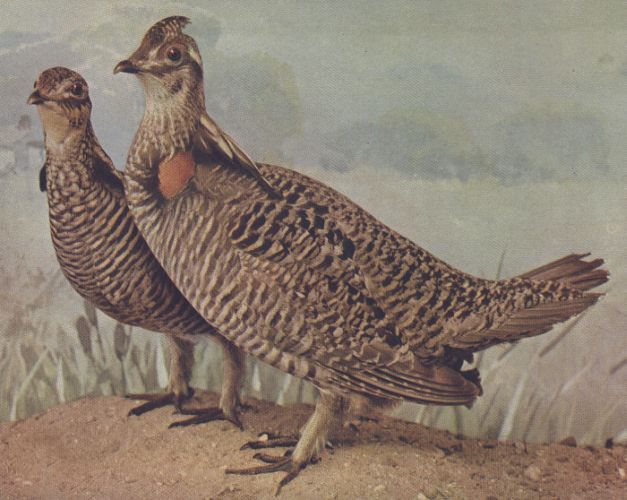
Length.—About 16 to 18 inches.
Male and Female.—Upper parts brown, barred with black, chestnut, ochre, and whitish, the latter chiefly on wings; sides of the neck tufted with ten or more narrow, stiff feathers, rounded at end, which may be erected like conventional Cupid's wings above the head. Their color black, with buff centres, frequently chestnut on inner webs; bare, yellow, loose skin below these feathers may be inflated at will; the dusky, brown, white tipped tail rounded, the inner feathers somewhat mottled with buff; chin and throat buff; breast and underneath whitish, evenly barred with black. Head slightly crested; legs scantily feathered in front only. Female smaller, the neck tufts much restricted, no inflated sacs below them; the tail feathers with numerous distinct buff bars.
Range.—"Prairies of the Mississippi Valley; south to Louisiana and Texas; east to Kentucky, Indiana, Ohio, Michigan and Ontario; west through eastern portions of North Dakota, South Dakota, Nebraska, Kansas, and the Indian Territory; north to Manitoba; general tendency to extension of range westward and contraction eastward; migration north and south in Minnesota, lowa and Missouri."--A. O. U.
Season.—Permanent resident; only locally a migrant at northern limit of range.
Westward the prairie chicken, like the course of empire, takes its way; for although it may increase at the pioneer stage of civilization, it halts at the introduction of the steam plough and railroad, to disappear forever where villages run together into cities. Doubtless its range was once far east-just how far is not certain, since the early writers confused it with the heath hen, once enormously abundant, but now confined to Martha's Vineyard, where in 1890 there were about one hundred of the birds left, and now, for the want of sufficient protection, even this pitiful remnant has diminished to very near the extinction point. So it will be inevitably with the prairie chicken. Modern farming machines destroy thousands of eggs and young annually as they steam over the prairies; in the small, new settlements there is little respect paid to game laws when a dull monotony of salt pork sets up a craving for fresh meat; and since the prairie chicken has strong preferences for certain habitats, and will not or cannot live in others, evidently the day is not far distant when either missionary effort on behalf of this and many other birds must be vigorously applied, or they will certainly perish from the face of the earth. Since the coyote, or prairie wolf, which has preyed on this grouse, is being killed off, and sportsmen are endeavoring to enforce the law against trapping the birds in winter, and to induce farmers to burn off their fields in autumn instead of in May, there is still hope that its extinction may be at least postponed.
Early in the morning in spring the booming of males assembled on the "scratching ground"--some slight elevation of the prairie--summons the hens from that territory to witness their extraordinary performances until the whole region reechoes with the soft though powerful sound, like deep tones from a church organ--harmonious, penetrating, more impressive to the human listener than to the apparently indifferent females. Inflating the loose yellow sacs on the sides of their head, that stand out like two oranges; erecting and throwing forward their Cupid like feathers at the back of the neck; ruffling the plumage until it stands out straight; drooping the wings and spreading the erect tails, the males present an imposing picture of pompous display and magnificence that melts not the flinty hearts of the coquetting spectators. Now the proud cock, incited to nobler deeds by the indifference of his chosen sweetheart, rushes madly forward, letting the air out of his cheek sacs as he goes, to produce the booming noise, repeating the rush toward her and the boom until she gives some sign that his mad endeavors to win her awaken some response in her cold little heart. Toward the end of courtship she moves about quickly among the performers, then stands perfectly still for a time, evidently taking note of the fine points of the numerous lovers that embarrass her choice. Shortly after the sun rises, the circus and concert end for the day, to be repeated the next morning, and the next, for a week or longer, at the end of which time the inflamed cocks usually fall to fighting, clawing at each other as they leap into the air and scatter blood and feathers. To the victor belongs the sweetheart. The note of the male bird is closely imitated by many farmers' boys. It may be written, uck-ah-umb-boo-oo-oo-oo.