Home › Volumes › Game Birds › Pigeons and Doves
Passenger Pigeon
Also called: CAROLINA DOVE; TURTLE DOVE
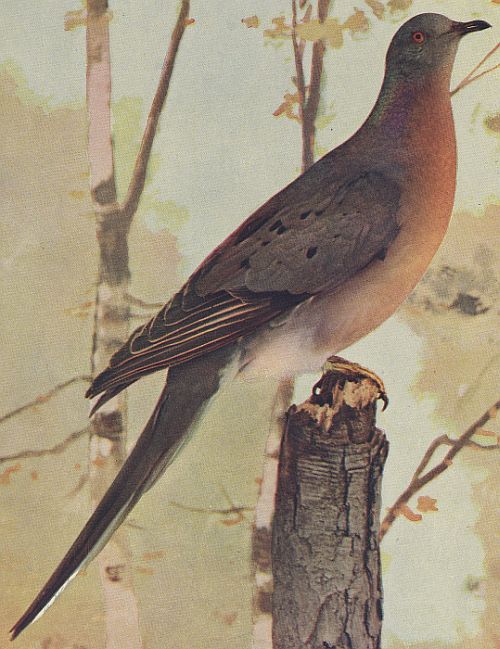
Length.—16 to 25 inches.
Male.—Upper parts bluish slate shaded with olive gray on back and shoulders, and with metallic violet, gold, and greenish reflections on back and sides of head; the wing covets with velvety black spots; throat bluish slate, quickly shading into a rich reddish buff on breast, and paling into white underneath; two middle tail feathers blackish; others fading from pearl to white. Eyes red, like the feet; bill black.
Female.—Similar, but upper parts washed with more olive brown; less iridescence; breast pale grayish brown fading to white underneath.
Range.—Eastern North America, nesting chiefly north of or along the northern borders of United States as far west as the Dakotas and Manitoba, and north to Hudson Bay.
Season.—Chiefly a transient visitor in the United States of late years.
Length.—12 to 13 inches.
Male.—Grayish brown or fawn color above, varying to bluish gray. Crown and upper part of head greenish blue, with green and golden metallic reflections on sides of neck. A black spot under each ear. Forehead and breast reddish buff; lighter underneath. (General impression of color, bluish fawn.) Bill black, with tumid, fleshy covering; feet red; two middle tail feathers longest; all others banded with black and tipped with ashy white. Wing coverts spasely spotted with black. Flanks and underneath the wings bluish.
Female.—Duller and without iridescent reflections on neck.
Range.—North America, from Quebec to Panama, and westward to Arizona. Most common in temperate climate, east of Rocky Mountains.
Season.—March to November. Common summer resident; not migratory south Virginia.
The wild pigeon barely survives to refute the adage, "In union there is strength." No birds have shown greater gregariousness, the flocks once numbering not hundreds nor thousands but millions of birds; Wilson in 1808 mentioning a flock seen by him near Frankfort, Kentucky, which he conservatively estimated at over two billion, and Audubon told of flights so dense that they darkened the sky, and streamed across it like mighty rivers. So late as our Centennial year one nesting ground in Michigan extended over an area twenty-eight miles in length by three or four in width. The modern mind, accustomed to deal only with pitiful remnants of feathered races, can scarcely grasp the vast numbers that once made our land the sportsman's paradise. Union for once has been fatal. Unlimited netting, even during the entire nesting season, has resulted in sending over one million pigeons to market from a single roost in one year, leaving perhaps as many more wounded bids and starving, helpless, naked squabs behind, until the poultry stalls became so glutted with pigeons that the low price per barrel scarcely paid for their transportation, and they were fed to the hogs. This abominable practice of netting pigeons, discontinued only because there are no flocks left to capture, has driven the birds either to nest north of the United States, or, when within its borders, to change their habits and live in couples chiefly. Captain Bendire, than whom no writer ever expressed an opinion out of fuller knowledge, said in 1892; "The extermination of the passenger pigeon has progressed so rapidly during the past twenty years that it looks now as if their (sic) total extermination might be accomplished within the present century." Already they are scarce as the great auk in the Atlantic states.
One, or at most two white eggs, laid on a rickety platform of sticks in a tree, where they are visible from below, would scarcely account for the myriads of pigeons once seen, were not frequent nestings common throughout the summer; and it is said the birds lay again on their return south. Both of the devoted mates take regular turns at incubating, the female between two o'clock in the afternoon and nine or ten the next morning, daily, leaving the male only four or five hours sitting, according to Mr. William Brewster. "The males feed twice each day," he says, "namely, from daylight to about eight A.M., and again late in the afternoon. The females feed only in the forenoon. The change is made with great regularity as to time, all the males being on the nest by ten o'clock A.M. . . . The sitting bird does not leave the nest until the bill of its incoming mate nearly touches its tail, the former slipping off as the latter takes its place. . . . Five weeks are consumed by a single nesting. . . . Usually the male pushes the young off the nest by force. The latter struggles and squeals precisely like a tame squab, but is finally crowded out along the branch, and after further feeble resistance flutters down to the ground. Three or four days elapse before it is able to fly well. Upon leaving the nest it is often fatter and heavier than the old birds; but it quickly becomes thinner and lighter, despite the enormous quantity of food it consumes." Before it leaves the nest it is nourished with food brought up from the parents' crops, where, mixed with a peculiar whitish fluid, it passes among the credulous as "pigeon's milk." Is not this the nearest approach among birds to the mammals' method of feeding their young?