Home › Volumes › Game Birds › Mergansers; River and Pond Ducks; Sea and Bay Ducks; Geese; Swans
Mallard Duck
Also called: WILD OR DOMESTIC DUCK; GREEN HEAD
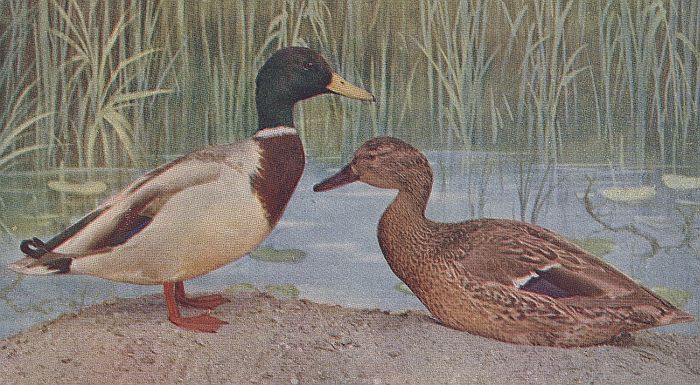
Length.—23 inches.
Male.—Head and neck glossy green with white ring like a collar defining the dividing line from the rich chestnut breast; underneath grayish white, finely marked with waving black lines; back dark grayish brown, shading to black on lower back and tail. Four black upper feathers of tail curve backward; rest of tail white, black below. Speculum or wing-bar rich purple with green reflections and bordered by black and white. Bill greenish yellow with gutters on the side.
Female.—Plumage generally dark brown varied with buff; breast and underneath buff, mottled with grayish brown; wings marked like male's.
Range.—Nests rarely from Indiana and Iowa and chiefly from Labrador northward; winters from Chesapeake Bay and Kansas southward to Central America. Rare in New England.
Season.—Winter resident in southern states; a transient visitor or migrant, during the winter months, at the north.
Small, grassy ponds, slow-moving streams, sloughs, and the labyrinths of lakes and rivers that are thickly grown with wild rice and rushes, such as abound in the interior of the United States and Canada, make the ideal resort of the mallards, or, indeed, of most ducks dear to the sportsman's heart. Here large companies gather in August and September when the ripened grain invites them to the feast they most enjoy, flying at dusk or by night in wedge-shaped battalions from their resting-grounds at the far north, to remain until the ice locks up their food and they must shift their home farther south. In Illinois, Minnesota, Iowa, and Indiana, they are among the first ducks to arrive and the last to leave with the hardy scaups or bluebills. And in sheltered localities a few sometimes winter, just as a few break through traditions and nest in secluded spots in the same states; but from Kansas and the Chesapeake country southward, they may be positively relied upon until the time arrives for the spring migration, however more abundant they may be in the interior than along our coast. Let no one imagine that because some ducks are classified in the books as "river and pond," and others as "sea and bay ducks," they are not often found in the same places. It is the lobed hind toe of the latter group that really differentiates them, and not always their habitats.
Well concealed in the tall sedges that literally drop food into their gaping mouths, the mallards feed silently upon the ripe grain and seeds, dabbling on the surface of the water or, suddenly tipping tail upward and stretching head downward in the shallow waters, probe the muddy bottom for the small mollusks, fish, worms, rootlets, and vegetable matter they delight in. When a good mouthful has been taken in the bill is closed tight, thus forcing out through the gutters along the sides, that act as strainers, the mud and water that were taken in with the food. Ripe corn that has dropped in the fields is a favorite cereal. Fish and animal substances form a small fraction of the mallards' diet; they are very near to being vegetarians, the fact that makes their flesh so delicious.
"In the spring and fall the Kankakee region of Illinois and Indiana is one of the finest grounds for mallards, teal, woodduck and geese, to be found in the United States," says Maurice Thompson. "I need not say to the sportsman that the mallard is the king's own duck for the table. The canvasback does not surpass it. I have shot corn-fed mallards whose flesh was as sweet as that of a young quail, and at the same time as choice as that of the woodcock."