Home › Volumes › Game Birds › Mergansers; River and Pond Ducks; Sea and Bay Ducks; Geese; Swans
Green-winged Teal
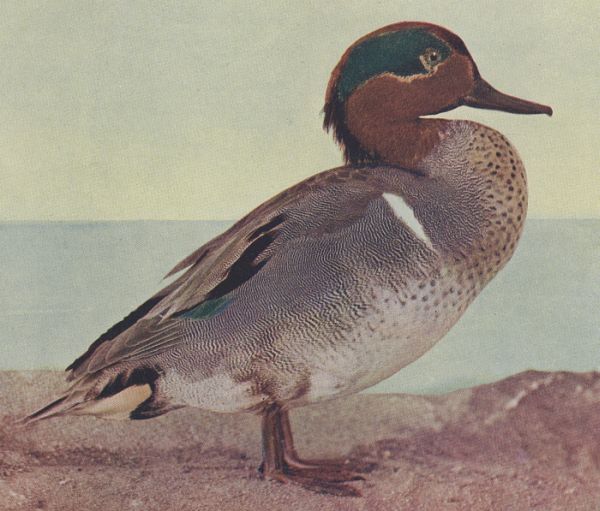
Length.—14 inches. One of the smallest ducks.
Male.—Head and neck rich chestnut, with a broad band of glossy green running from eyes to nape of neck; chin black; breast light pinkish-brown, spotted with black; upper back and sides finely marked with waving black and white lines; lower back dark grayish brown, underneath white. A white crescent in front of the bend of the wing; wings dull gray, tipped with buff and with patch or speculum half purplish black and half rich green. Head slightly subcrested. Bill black. Feet bluish gray.
Female.—Less green on wings; no crest; throat white; head and neck streaked with light reddish brown on dark-brown ground; mottled brownish and buff above; lower parts whitish changing to buff on breast and lower neck, which are clouded with dusky spots.
Range.—North America at large; nests in Montana, Minnesota, and other northern states, but chiefly north of the United States; winters from Virginia and Kansas, south to Cuba, Honduras, and Mexico.
Season.—Spring and autumn migratory visitor north of Washington and Kansas; more abundant in the interior than on the coasts.
Next to the wood duck, this diminutive, exquisitely marked and colored kinsman is perhaps the handsomest member of its tribe; and, next to the merganser, it is said to be the most fleet of wing as it is of foot, unlike many of its waddling relations; but epicures declare its delicious flesh is the one characteristic worth expending superlatives upon. When the teal has fed on wild oats in the west, or on soaked rice in the fields of Georgia and Carolina, Audubon declared it is much superior to the glorified canvasback. Nothing about its rankness of flavor when it has gorged on putrid salmon lying in the creeks in the north-west, or the maggots they contain, ever creeps into the books; and yet this dainty little exquisite of the southern rice fields has a voracious appetite worthy of the mallard, around the salmon canneries of British Columbia, where the stench from a flock of teals passing overhead betrays a taste for high living, no other gourmand can approve. When clean fed, however, there is no better table-duck than a teal.
Among the earliest arrivals from the horde of water-fowl that follow the food supply from the far north into the United States every autumn, the green-wings are exceedingly abundant in the fresh water lakes and ponds of the interior, and less so on the salt water lagoons and creeks of the coast until frost locks up the celery, sedges, wild rice, berries, seeds of grasses, tadpoles, and the various kinds of insects on which they commonly feed. Then the teals go into winter quarters, and as they pass in small, densely packed companies overhead, the peculiar reed-like whistling of their swift wings may be plainly heard. Old sportsmen tell of clouds of ducks, numbering countless thousands, but they best know why such flights are gone forever from the United States.