Home › Volumes › Game Birds › Mergansers; River and Pond Ducks; Sea and Bay Ducks; Geese; Swans
Greater Scaup Duck
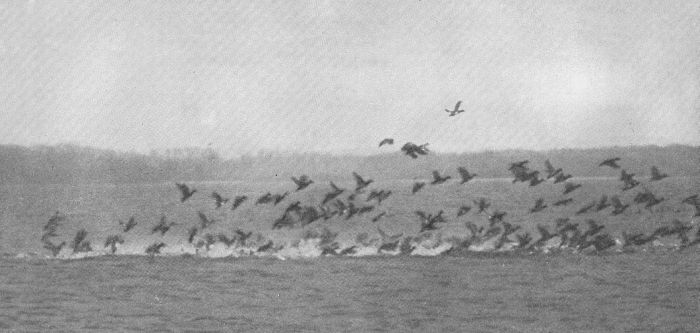
Called also.—AMERICAN SCAUP; BROADBILL; BLACK-HEAD; BLUEBILL; RAFT DUCK; FLOCKING FOWL; SHUFFLER.
Length.—17.50 to 20 inches.
Male.—Black on upper parts, with greenish and purplish reflections on head; lower back and about shoulders waved with black and white; under parts white, with black waving bars on sides of body and near the tail; speculum, or wing mirror, white. Bill dull blue, broad, and heavy; dark, slate-colored feet.
Female.—A white space around base of bill, but other fore parts rusty, the rusty feathers edged with buff on the breast; back and shoulders dusky, and the sides dark grayish brown, finely marked with waving white lines; under parts and speculum white.
Range.—North America at large; nesting inland, chiefly from Manitoba northward; winters from Long Island to South America.
Season.—Common spring and autumn migrant, and winter resident south of New England and the Great Lakes.
If the number of popular names that get attached to a bird is an indication of man's intimacy with it, then the American scaup is among the most familiar game birds on the continent. It is still a mooted question whether the word scaup refers to the broken shell fish which this duck feeds upon when wild celery, insects, and fry are not accessible, or to the harsh, discordant scaup it utters, but which most people think sounds more like quauck. Its broad, bluish bill, its glossy black head, its not unique habit of living in large flocks, its readiness to dive under a raft rather than swim around one, and its awkward, shuffling gait on land, where it rarely ventures, make up the sum of its eccentricities set forth in its nicknames.
Gunners in the west and on the Atlantic shores from Long Island southward, especially in the Chesapeake, where wild celery abounds, find the bluebills among the most inveterate divers: they plunge for food or to escape danger, loon fashion, and when wounded have been known to cling to a rock or tuft of sedges under water with an agonized grip that even death did not unfasten. They do not rise with ease from the surface of the water, which doubtless often makes diving a safer resort than flight. Audubon spoke of their "laborious flight;" but when once fairly launched in the air, their wings set in rigid curves, they rush through the sky with a hissing sound and a rate of speed that no amateur marksman ever estimates correctly. They are high flyers, these bluebills; and as they come swiftly winding downward to rest upon the bays of the seacoast or large bodies of inland waters, they seem to drop from the very clouds.
No dabblers in mud puddles are they: they must have water deep enough for diving and cold enough to be exhilarating. Diving ducks feed by daylight chiefly, or they would never be able to distinguish a crab claw from a celery blade; but they also take advantage of moonlight for extra late suppers. In the Chesapeake region flocks of ducks that have "bedded" for the night rise with the rising moon, and disport themselves above and below the silvery waters with greater abandon even than by day. Owing to the thick feathered armor these ducks wear, the sportsman often counts birds shot that, being only stunned, are able to escape under water.
It is only when the nesting season has closed that we find the bluebills near the seacoast. They build the usual rude, duck-like cradle--or, rather, the duck builds it, for the drake gives nursery duties no thought whatever--in the sedges near an inland lake or stream, where this ideal mother closely confines herself for four weeks on from six to ten pale olive buff eggs. Nuttall observed that "both male and female make a similar grunting noise" (the quauck or scaup referred to), "and have the same singular toss of the head with an opening of the bill when sporting on the water in spring."
The Lesser Scaup Duck (Aythyra affinis), Creek Broadbill, Little Bluebill, and so on through diminutives of all the greater scaup's popular names, may scarcely be distinguished from its larger counterpart, except when close enough for its smaller size (sixteen inches), the purplish reflections on its head and neck, and the heavier black and white markings on its flanks to be noted. Apparently there is no great difference in the habits of these frequently confused allies, except the preference for fresh water and inland creeks shown by the lesser scaup, which is not common in the salt waters near the sea at the north, and its more southern distribution in winter. Chapman says: "It is by far the most abundant duck in Florida waters at that season, where it occurs in enormous flocks in the rivers and bays along the coasts."