Home › Volumes › Game Birds › Bob Whites, Grouse, Etc.
Dusky Grouse
Also called: BLUE, GRAY, MOUNTAIN, PINE, AND FOOL GROUSE; PINE HEN
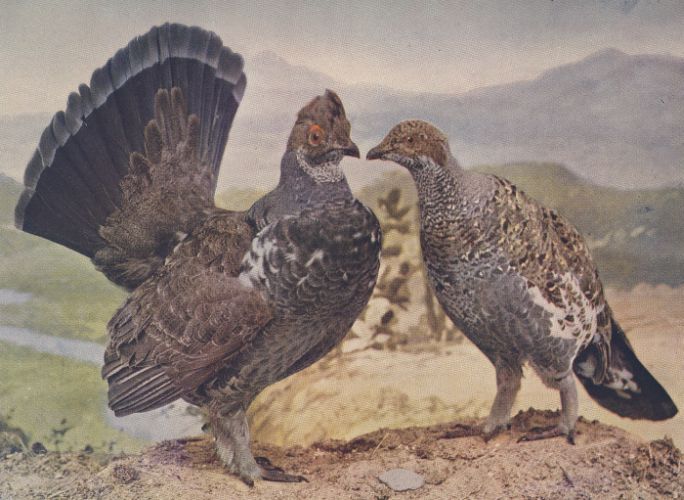
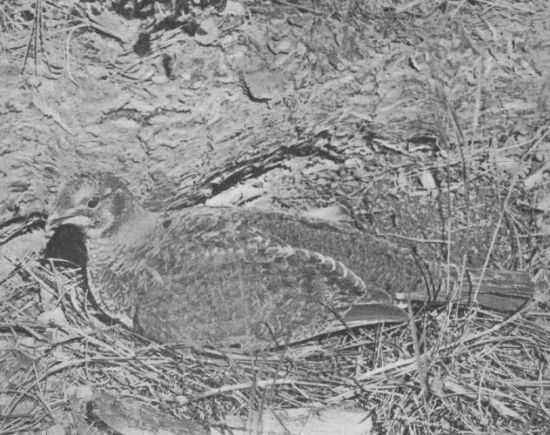
Length.—20 to 24 inches; length variable.
Male.—Upper parts blackish brown, finely zigzagged with slatey gray mixed with lighter brown, and sometimes coarsely mottled with gray, especially on wings; forehead dull reddish brown; back of head blackish, the feathers tipped with rusty; sides of head black; shoulders streaked with white; long feathers on sides have white ends and shaft stripes; throat white, finely speckled with black; under parts bluish gray or slate, varied with white on flanks and underneath. Tail rounded, the twenty broad feathers blackish-brown, marbled with gray, and broadly banded across end with slate gray; legs covered to toes with pale brown feathers; a comb over eye; bill horn color.
Female.—Smaller, lighter, more mottled, or blotched with blackish and tawny or buff, the feathers generally edged with white; slate gray under parts, and tail broadly banded with same; the flanks tipped with white and mottled with black and buff.
Range.—Rocky and other mountain ranges in western United States.
Season.—Permanent resident.
Two variations of the dusky grouse, known as Richardson's grouse and the sooty grouse--constantly confused in reports--make it somewhat difficult to define the exact habitat of this splendid game bird, so well known in one form or another by sportsmen throughout the western half of the United States, from New Mexico to Alaska and British Columbia. The habits of all three birds being practically the same, their plumage differing chiefly in degrees of duskiness, and their boundary lines constantly overlapping, it is small wonder the untrained observer confuses both their names and ranges. The Rocky Mountains, from central Montana and southeastern Idaho to New Mexico and Arizona, eastward to the Black Hills, South Dakota, and westward to East Humboldt Mountains, Nevada, is the range set down for the dusky grouse by the A. O. U., and a more westerly district, including California, for the sooty grouse; while Richardson's bird confines itself chiefly to the eastern slope of the Rockies. The latter is to be distinguished by its rather longer, square tail, with broader feathers, only slightly banded with gray, if at all, and its blacker throat. The sooty grouse, even darker still, and with a broad band on its tail, is minutely freckled with gray and rusty on its upper parts and very dark lead color below; the hen being particularly richly marked with rusty red and chestnut brown.