Home › Volumes › Game Birds › Gulls and Terns
Common Tern
Also called: WILSON'S TERN; SEA SWALLOW; SUMMER GULL; MACKEREL GULL
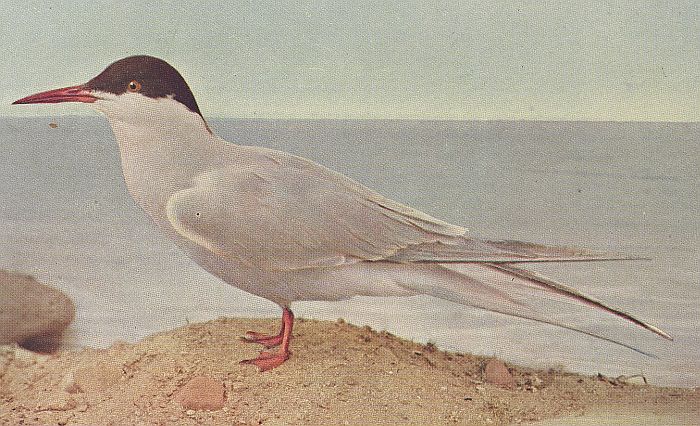
Length.—14 to 15 inches.
Male and Female.—In summer: Whole top of head velvety black, tinged with greenish and extending to the lower level of the eyes and onto the nape of neck. Mantle over back and wings pearl gray. Throat white, but breast and underneath a lighter shade of gray, the characteristic that chiefly distinguishes it from Forster's tern, which is pure white on its under parts. Inner border of inner web of outer primaries white, except at the tip. Tail white, the outer webs of the outer feathers pearl gray. Tail forked and moderately elongated, but the folded wings reach one or two inches beyond it. Legs and feet orange red. Bill, which is as long as head, is bright coral about two-thirds of its length, a black space separating it from the extreme tip, which is yellow. In winter: Similar to summer plumage, except that the front part of head and under parts are pure white; also that the bill becomes mostly black. Young birds similar to adults in winter, but with brownish wash or mottles on the back, with slaty shoulders and shorter tail.
Range.—"In North America, chiefly east of the plains, breeding from the Arctic coast, somewhat irregularly, to Florida, Texas, and Arizona, and wintering northward to Virginia; also coast of Lower California." A. O. U.
Season.—Summer resident. May to October.
Ironically must this particularly beautiful, graceful sea swallow now be called the common tern, for common it scarcely has been, except in the dry-goods stores, since its sharply pointed wings, and often its entire body also, were thought by the milliners to give style to women's hats. Great boxes full of distorted terns, their bills at impossible angles, their wings and tails bunched together, sicken the bird-lover who strolls through the large city shops on "opening day." Countless thousands of these birds must have been slaughtered to supply the demand of thoughtless women in the last twenty years; and although the egret has had its turn of persecution, and that in an especially cruel way, the fashion for wearing terns, either entire or in sections, continues with a hopeless pertinacity that no other mode of hat trimming seems wholly to divert. Chicken feathers, arranged to imitate them, are necessarily accepted as substitutes more and more, however.
Through the efforts of Mr. Mackay, of Nantucket, the terns are at last protected on a number of low, sandy islands adjacent to his home, where nesting colonies had resorted from the earliest recollection until they were all but exterminated by the companies of men and boys who sailed over from the mainland to collect plumage and the delicately flavored eggs. Muskegat and Penekese Islands, off the extreme southeastern end of Massachusetts--the latter made famous by Agassiz--and Gull Island, off the Long Island coast, the only nesting grounds left these sea swallows in the north, are now guarded by paid keepers, who see to it that no unfriendly visitor sets foot on the shores until the downy chicks are able to fly in September. It was mainly through the efforts of Mr. William Dutcher that the terns were taken under the protection of the A. O. U., the Linnaean Society, and the A. S. P. C. A., at Gull Island. In May the terns begin to arrive from the south, having apparently mated on the journey. Little or no part of the honeymoon is spent in making a nest, as any little accumulation of drift, or the bare sand itself, will answer the purpose of these shiftless merry-makers that no responsibilities can depress nor persecution harden. Lightness and grace of flight, as well as of heart, are their certain characteristics. Before family cares divert them, in June, how particularly lively, dashing, impetuous, exultant, free, and full of spirit they are! A sail across to the terns' nesting grounds is recommended to those summer visitors who sit about on the piazzas complaining of ennui at Nantucket, Martha's Vineyard, and Shelter Island.
As a boat approaches a nesting colony on one of the few low, sandy islands where one may be still found, a canopy or cloud of birds spreads overhead--a surging mass of excited creatures, darting, diving in a maze without plan or direction, like a flurry of huge snowflakes through the summer sky. The air fairly vibrates with the sharp, rasping notes of alarm uttered in a mighty chorus of complaint, very different from the almost musical call, half melancholy, half piping, that the birds continually utter when undisturbed. If the visit be made to the island in June, the upper beach, above the reach of tide, will be scattered over here and there with clutches of eggs that so closely imitate the speckled sand, one is apt to step on them unawares. Only the slightest depression, lined with a wisp of grass or bit of seaweed, is made in pretense of a nest; and as the gay mothers leave the work of incubating chiefly to the sun, confining themselves only at night or during storms, the visitor may be forgiven if the sound of a crushed shell under foot is his first intimation of a nest among the dried seaweed or beach grass among the rocks. It was Audubon who said there were never more than three eggs in a nest; but Mr. Parkhurst, at least, has found four.