Home › Volumes › Game Birds › Mergansers; River and Pond Ducks; Sea and Bay Ducks; Geese; Swans
Canada Goose
Also called: WILD GOOSE; GRAY GOOSE; HONKER
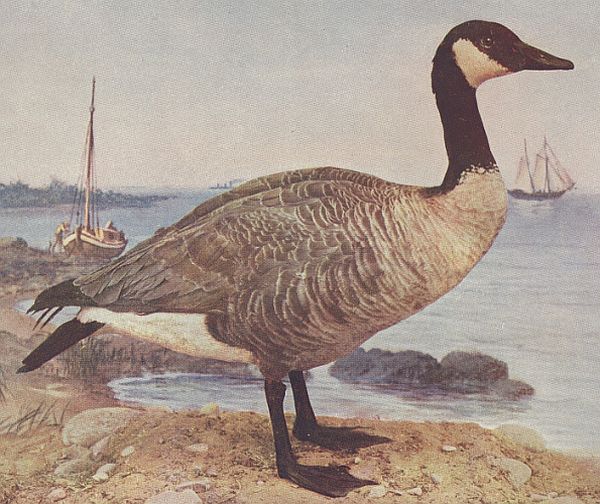
Length.—From 1 yard to 43 inches.
Male and Female.—Head and neck black, a broad white band running from eye to eye under the head; mantle over back and wings grayish brown, the edges of feathers lightest; breast gray, fading to soiled white underneath. Female paler; tail, bill, and feet black.
Range.—North America at large; nests in northern parts of the United States and in the British possessions; winters southward to Mexico.
Season.—Chiefly a spring and autumn migrant, north of Washington; although a few remain so late (December) and return so early (March) they may almost be said to be winter residents north as well as in the south. The most abundant and widely distributed of all our wild geese.
Heralded by a mellow honk, honk, from the leader of a flying wedge, on come the long-necked wild geese from their northern nesting grounds, and stream across the sky so far above us that their large bodies appear like two lines of dark dots describing the letter V. In spite of their height, which never seems as great as it actually is because of the goose's large size, one can distinctly hear the honk of the temporary captain--some heavy veteran--answered in clearer, deeper tones, as the birds pass above, by the rear guardsmen in the long array that moves with impressive unison across the clouds. Often the fanning of their wings is distinctly audible too. The migration of all birds can but excite winder and stir the imagination; but that of the wild goose embarked on a pilgrimage of several thousand miles, made often at night, but chiefly by broad daylight, attracts perhaps the most attention. Sometimes the two diverging lines come together into one, and a serpent seems to crawl with snake-like undulations across the sky; or, again, the flock in Indian file shoots straight as an arrow. It is as a bird of passage that one thinks of the goose, however well one knows that it remains resident in many places at least a part of the winter.
A slow drift down a slope of a mile or more, on almost motionless wings, brings them to the surface with majestic grace, and flying low until the precise spot is reached where they wish to rest, they settle on the water with a heavy splash. Usually they stop flying near sunset to feed on the eel-grass, sedges, roots of aquatic plants, insects, and occasionally on small fish, or on the wheat, corn, and other grain that has dropped among the stubble in the farmer's fields, and the berries, grass, and leaf buds they find in swamps and bushy pastures. Quantities of gravel are swallowed with their food. After a good supper they return to the water, preferably to a good-sized lake, to sleep, and there they float about with head tucked under wing until daybreak, when another flight must be made inland to secure a breakfast. These two regular daily flights are characteristic of all the geese.
Such punctuality at meals is confidently reckoned upon by the sportsman, who is thereby saved unnecessary waiting as he crouches, cramped and cold, in a pit among the stubble and concealed by a blind. These holes are about thirty inches in diameter and about forty inches in depth. There are no birds with keener, more suspicious eyes; no sentinel of a flock more on the alert, unless it be the sandhill crane, that often feeds with them and is their ally; no game birds more wary when the sportsman tries to stalk them than these; and so no one can possibly appreciate the expression "a wild goose chase" who has not hunted them. The goose is by no means the dolt tradition says it is. The ordinary methods of hunting water-fowl do not answer with it, and in different parts of the country a different ruse is practiced to secure its flesh. Strangely enough, ducks and geese alike, that are thrown into a state of panic at sight of a man or dog, show no fear whatever of cows; and taking advantage of this fact, gunners often hide behind cattle, or lead a horse or an ox to get within range. On the great plains and in California, oxen trained for the purpose screen the hunters on horseback, and walk straight into the flocks of Canada, snow, and laughing geese that have been lured by live or artificial decoys placed in some good feeding ground. Geese are not only gregarious, but extremely sociable to their kin and to other birds as quick to take alarm as they. A constant gabbling goose-talk is overheard wherever they congregate, like members of a country sewing society.