Home › Volumes › Game Birds › Bob Whites, Grouse, Etc.
Bob White
Also called: QUAIL; PARTRIDGE; VIRGINIA PARTRIDGE
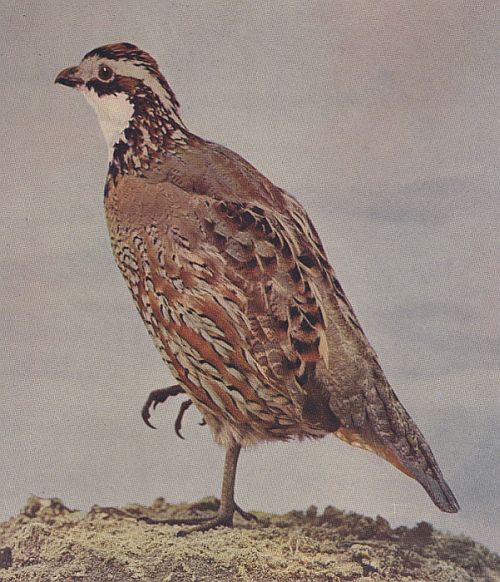
Length.—9.50 to 10.50 inches.
Male and Female.—Upper parts reddish brown or chestnut, flecked with black, white, and tawny; rump grayish brown, finely mottled, and with a few streaks of blackish; tail ashy, the inner feathers mottled with buff; front of crown, a line from bill beneath the eye, and band on upper breast, black; forehead, and stripe over the eye, extending down the side of the neck, white; breast and under parts white or buff, crossed with irregular narrow black lines; feathers on sides and flanks chestnut, with white edges barred with black. The female has forehead, line over the eye, and throat, buff, and little or no black on upper breast. Summer birds have blacker crowns and paler buff markings. Much individual variation in plumage.
Range.—"Eastern United States and southern Ontario, from southern Maine to the south Atlantic and Gulf states; west to central South Dakota, Nebraska; Kansas, Oklahoma and eastern Texas. Of late years has gradually extended its range west-ward along lines of railroad and settlements; also introduced at various points in Colorado, New Mexico, Utah, Idaho, California, Oregon, and Washington. Breeds throughout its range." A. O. U.
Season.—Permanent resident.
Endless confusion has arisen through the incorrect local names given to the Bob White, which in New England is called quail wherever the ruffed grouse is called partridge, and called partridge in the middle and southern states wherever the ruffed grouse is called pheasant; but true partridges and quail, quite different in habits and appearance from ours, are confined to the Old World, however firmly their names cling to the American species. That which we call a quail, by any other name would taste as sweet; and it is surely time the characteristic game bird of this country received in all sections its characteristic, distinctive title. Bob White, the name it calls itself, also has the sanction of that dignified, conservative body, the American Ornithologists' Union, than which can there be two higher authorities ?
Before the snow and ice have been melted by spring sunshine, Bob White! ah, Bob White ! a clear staccato whistle, rings out from some plump little feathered breast swelling with tender and sincere emotions. Mates are not easily won: sharp contests of rival males, that fight desperately, like game cocks, occur throughout the pairing season; the demure, coy little sweetheart, concealing her admiration for the proud victor strutting before her, only fans his flame by her feigned indifference. In vain he jumps upon a stump and, like a ruffled orator, repeats his protestations. He runs beside her, now bowing, now crossing her path, ardently entreating some sign that his handsome feathers, his gallantry, his musical voice, his sworn devotion to her, have made an impression; but the shy little lady, appearing to be frightened by such ardor, discreetly withdraws, knowing perfectly well, as every coquette must, that such coyness never discourages a suitor worth the having. Marriage is not entered into lightly or irreverently by these monogamous birds, unlike their European Mormon kin that utterly lack the gallantry and affectionate nature characteristic of the American bird. It is a slander to call Bob White by the name of the disreputable, pugnacious, selfish, mean-looking quail. Rarely, indeed, does he lapse from rectitude and take a second mate.