Home › Volumes › Game Birds › Plovers
American Golden Plover
Also called: PALE RING-NECK
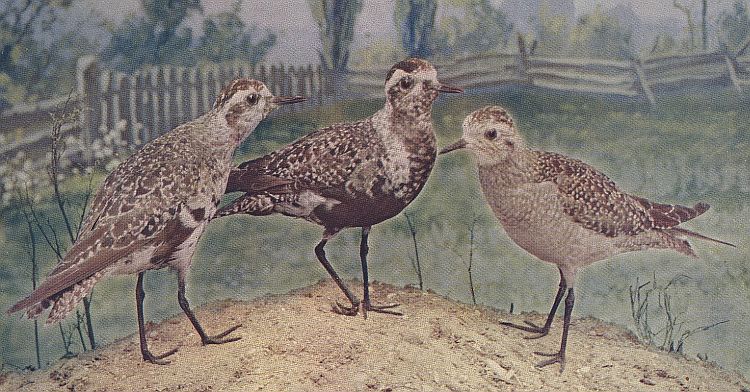
Called also.—FIELD PLOVER; GREENBACK; GREEN PLOVER; PALE-BREAST; TOAD-HEAD; PRAIRIE PIGEON; FROST BIRD; SQUEALER
Length.—10.50 inches.
Male and Female.—In summer: Mottled upper parts black, greenish, golden yellow, and a little white, the yellow in excess; tail brownish gray indistinctly barred with whitish; sides of breast white; other under parts and sides of head black; under wing coverts ashy gray. Bill and feet black. In winter : Upper parts and tail dusky, spotted or barred with yellow or whitish, the colors not so pure as in summer; under parts grayish white, purest on chin and abdomen; the throat and sides of head streaked; the breast and sides of neck and body mottled with dusky grayish brown; legs dusky. Immature birds resemble winter adults; also like black-breasted plovers; but the grayish axillars and the lack of a fourth toe sufficiently distinguish this species from the preceding, however variable the plumage may be at different seasons.
Range.—North America at large; nests in Arctic regions; winters from Florida to Patagonia.
Season.—Spring and autumn migrant; May; August to November.
Length.—9.50 to 10.50 inches. About the size of the robin.
Male and Female.—Grayish brown washed with olive above; the forehead, spot behind eyes, throat, a ring around the neck, a patch on wing, a band across breast, and underneath, white; front of crown, cheeks, a ring around neck, and a band across breast, black; lower back and base of tail chestnut; inner tail feathers like upper parts; outer feathers chestnut and white, all with subterminal band of black tipped with white. Bill black; legs light; eyelids red.
Range.—Temperate North America to Newfoundland and Manitoba; nests throughout range; winters usually south of New England to Bermuda, the West Indies, Central and South America.
Season.—Resident, March to November, or later; most abundant in spring and autumn migrations.
Length.—6.75 to 7 inches. A trifle larger than the English sparrow.
Male and Female.—Upper parts brownish gray; front of crown, band across base of bill, sides of head below eye, and band on breast, that almost encircles the neck, black; forehead, throat, ring around neck, parts of outer tail feathers, and under parts white. Brownish gray replaces the black in winter plumage. Bill black, orange at base; ring around eye bright orange; yellow toes, webbed at the base.
Range.—North America at large; nesting from Labrador and Alaska northward to Arctic sea; winters from Gulf states to Bermuda, West Indies, Peru, and Brazil.
Season.—Spring and autumn migrant; April, May; July, August, September; most plentiful in late summer and early autumn.
Length.—7 inches. A trifle larger than the English sparrow.
Male and Female.—Upper parts very pale ash; forehead, ring around neck, and under parts white; front of the crown and a link of incomplete collar either side of breast, black; inner tail feathers dusky, the outer ones becoming white. In winter plumage the black is replaced by brownish ash.
Range.—North America east of the Rockies; nesting from coast of Virginia northward to Newfoundland; winters in West Indies.
Season.—Summer resident, March to September; most abundant in autumn migrations.
Golden grain, golden rod, golden maple leaves, and golden plover all come together; the birds not so yellow, it is true, as they were in the spring, when they gave us only a passing glimpse of their clearer, more intense speckled plumage, but still yellow enough to be in harmony with nature's autumnal color scheme. Indeed, they blend so well with their surroundings as to be all but invisible. Usually the under parts of birds are light colored to help make them inconspicuous on the wing; but the black markings on this and the preceding plovers are notable exceptions. High above the corn and buckwheat, the stubble, the burned and ploughed fields of the interior, or the level stretches of grass far back of the beaches, the sandy dunes, and flats bared at low tide along the coast, come the plovers in crescent-shaped flocks, now massed, now scattered, now rising, now dipping, the wings tremulous with speed, and swinging round in a circle at sight of a feeding ground to their liking. With soft, trilled mellow whistles rippling from their throats, the birds drift down-ward on set, decurved wings, and skim low before alighting. For an instant, as their dangling legs touch the ground, they raise their wings high above their backs until they meet, then slowly fold them against their sides. Now they scatter, and running nimbly and gracefully hither and thither, check themselves suddenly from time to time, raise their heads and look about to reconnoitire. Every motion is quick; they strike at a particle of food as if about to take a dive loon fashion, then run lightly on again, soon returning to the same spot if driven off. A hasty run must be taken, even when frightened, before the plovers spring into the air. A flock has a curious way of standing stock still at an alarming noise, before starting to run. When they squat and hide behind tufts of beach grass, it takes sharp eyes to detect birds from sand.