Home › Volumes › Fishes › The Sea-bass
White Bass; White Lake Bass
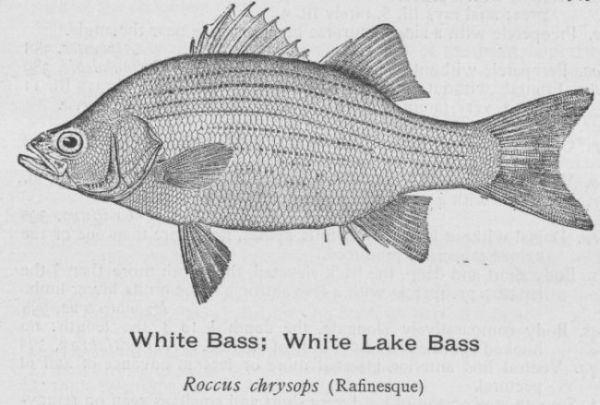
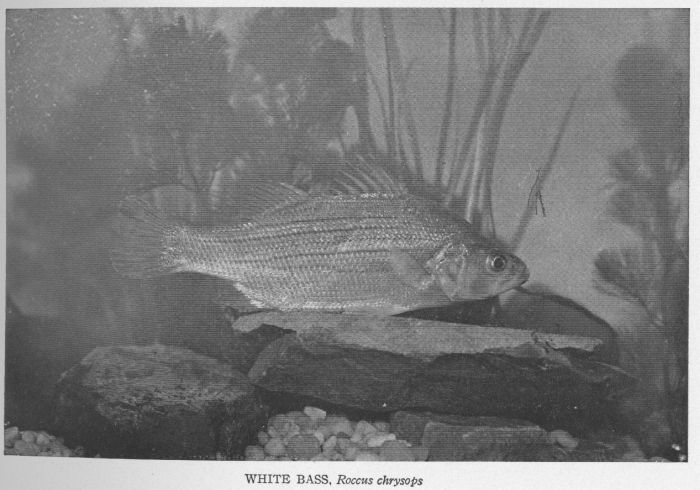
The white bass is found throughout the Great Lakes region from the St. Lawrence to Manitoba, and south in the Mississippi Valley to the Ouachita River in Arkansas. It is generally abundant in the Great Lakes, rare in the Mississippi basin, and not found at all east of the Alleghenies. It does not occur in salt water, but frequents the deep, still waters of the lakes, seldom ascending small streams. It reaches a length of a foot to 18 inches and a weight of 1 to 2 pounds. It is a good food-fish and ranks well as a game-fish. It readily takes the hook when baited with grub, angleworm, or small minnow, and will rise to the fly. Thaddeus Norris tells about fly-fishing for the white bass many years ago with a young army officer near Detroit. They met with indifferent success until they tried the mouth of a small creek on the Canadian side, where they caught 25 fish in a short time. They later discovered they had been fishing in preserved waters. The Canadian owner of the land through which the creek flowed was in the habit of seining the fish out of the river and retaining them in the creek (across the mouth of which he had placed netting) until the market price was high enough to please him.
Body rather deep and compressed, the back considerably arched; head subconical, slightly depressed at the nape; mouth moderate, nearly horizontal, the lower jaw little projecting; maxillary reaching middle of pupil, 2 3/4 in head; teeth on base of tongue in a single patch, a patch also on each side of tongue; margin of subopercle with a deep notch; head scaled to between the nostrils; preopercular serrae feeble, strongest at the angle; gill-rakers rather long and slender, as long as the gill-fringes; longest dorsal spine 2 in head; anal spines graduated, the second 1/3 length of head; middle caudal rays 1 2/3 in outer.
Colour, silvery, tinged with golden below; sides with narrow dusky lines, about 5 above the lateral line, 1 along it, and a variable number below it, these sometimes more or less interrupted or transposed.