Home › Volumes › Fishes › The Sea-bass
Striped Bass; Rockfish; Rock
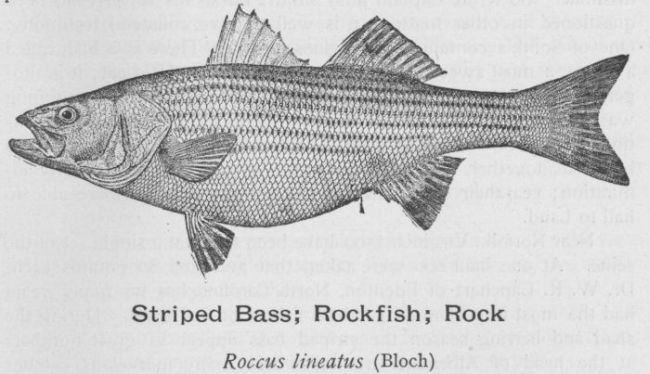
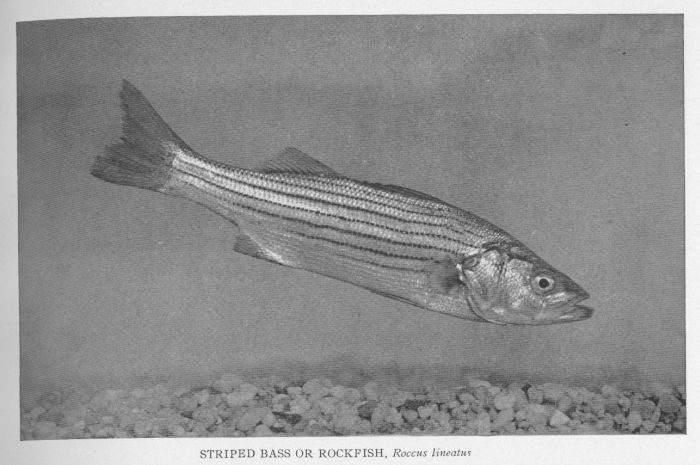
"The stately Bass, old Neptune's fleeting Post
That tides it out and in from sea to coast."
-Wood, New England's Prospect(1634).
The striped bass occurs on our Atlantic coast north to the St. Lawrence River and south to the Escambia River in western Florida. It is rather rare in the Gulf of Mexico, and is most common between Cape May and Cape Cod and on the North Carolina coast. It is particularly abundant in the great estuaries and open stretches of large rivers. It is strictly an anadromous fish, living chiefly in salt or brackish water and entering fresh water only at spawning-time. It ascends the Potomac to the Great Falls, and the other rivers of the Middle States until it meets obstructions. In the St. Lawrence it reaches Quebec at least, and there is a record of an example taken in the Niagara River at Lewiston, but this may have been a misidentification of the white bass.
The great abundance of the striped bass excited the wonder of the early colonists.
"The Basse is an excellent fish, both fresh & salte, one hundred whereof salted (at market) have yielded 5 pounds. They are so large, the head of one will give a good eater a dinner, & for daintinesse of diet they excell the Marybones of Beefe. There are such multitudes that I have seene stopped in the river close adjoining to my house with a sande at one tide so many as will loade a ship of 100 tonnes. I myselfe, at the turning of the tyde have seene such multitudes pass out of a pounde that it seemed to me that one mighte go over their backs drishod." So wrote Captain John Smith; but as his veracity has been questioned in other matters, it is well to give collateral testimony. One of Smith's contemporary divines wrote: "There is a Fish called a Basse, a most sweet & wholesome Fish as ever I did eat; it is altogether as good as our fresh Sammon & the season of their comming was begun when we came first to New England in June and so continued about three months space. Of this Fish our Fishers take many hundreds together, which I have seene lying on the shore to my admiration; yea, their Netts ordinarily take more than they are able to hall to Land."
Near Norfolk, Virginia, 1500 have been taken at a single set of the seine. At one haul 600 were taken that averaged 80 pounds each. Dr. W. R. Capehart of Edenton, North Carolina, has for many years had the most important striped bass fishery on our coast. During the shad and herring season the striped bass appear in great numbers at the head of Albemarle Sound, where many marvelous catches have been made. At one time about 30,000 pounds were taken at one haul. Many of these weighed 75 to 85 pounds each. At another haul 820 fish weighing 37,000 pounds were taken. Among these were many of 65 pounds, many of 85 pounds, and a few of 90 pounds. In 6 hours' fishing 50,000 pounds were taken May 6, 1876.
On May 6, 1896, 38,000 pounds of rockfish were landed at one haul. Among them were about 600 fish that averaged 60 pounds each, and several that weighed 105 pounds each. The roe of one fish weighed 44 pounds.
Some very large fish have been reported. Dr. Henshall saw one weighed in Baltimore which tipped the beam at more than 100 pounds; one taken at Cuttyhunk weighed 104 pounds; and Dr. Goode records an example caught at Orleans which weighed 112 pounds and which must have been 6 feet long. The average of those seen in the Washington market now does not exceed 5 pounds.
Though the striped bass has undoubtedly decreased greatly in abundance during the century, it is still an abundant fish. The catch on our Atlantic coast for 1897 amounted to nearly one and a half million pounds, valued at $128,000.
The splendid results of the artificial propagation of useful food-fishes are clearly and indisputably shown by the fate of the striped bass on the Pacific coast, where it was planted by the United States and California fish commissions a few years ago. The fish was not native to those waters, and all striped bass now found there are the descendants of those artificially planted. The few fish put in those waters thrived exceedingly, and for several years past the catch has been very large. In 1899 it aggregated 1,234,320 pounds, valued at $61,814.
As a food-fish the striped bass is one of the very best; as a game-fish there is none better. Frank Forester calls it "a gallant fish and a bold biter"; and Genio Scott says it is his favourite of all American game-fishes.