Home › Volumes › Fishes › The Tarpons
Bony-fish; Ten-pounder
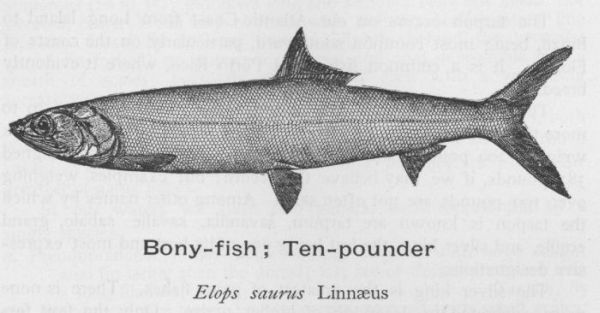
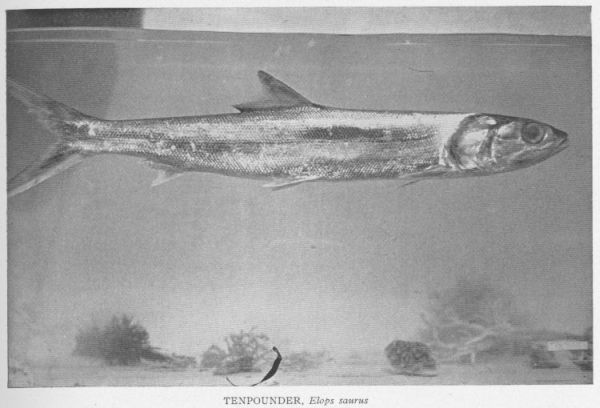
An abundant and widely distributed fish, found in all tropical seas; common in America north to the Carolinas and the Gulf of California. On our coasts it is probably most numerous in Florida.
It reaches a length of 2 to 3 feet and a weight of several pounds. The young are ribbon-shaped, long, thin, and transparent, passing through a metamorphosis analogous to that seen in the conger eels. They are at first band-shaped, with very small head and loose, transparent tissues. From this condition they become gradually shorter and more compact, shrinking from 3 1/2 inches to 2 inches in length. During these stages the young of this species, the lady-fish, and other fishes which undergo similar changes, are the so-called "ghost-fishes" which are sometimes thrown up on the beach in large numbers by the waves.
The bony-fish rejoices in a multiplicity of vernacular names, among which are big-eyed herring, piojo, matajuelo real, chiro, Liza, Francesca, ten-pounder, and John Mariggle. Its excellent qualities as a game-fish are only beginning to be appreciated.
Head 4 1/3; depth 5 to 6; eye 4 to 5; snout 4 1/3; maxillary 1 2/3; mandible 1 1/2; interorbital 5 2/3; D. 20; A. 13; V. 15; B. 30; pectoral 1 4/5; ventral 2; caudal 4/5; scales 13-110 to 120-12; gular plate 3 to 4 times as long as broad. Body very elongate; head small and pointed; mouth very large, the extremely long maxillary reaching far beyond the eye; jaws subequal; caudal lobes long and slender. Colour, bluish above; the sides silvery; white beneath.