Home › Volumes › Fishes › The Whitefish, Salmon and Trout
Sunapee Trout; American Saibling
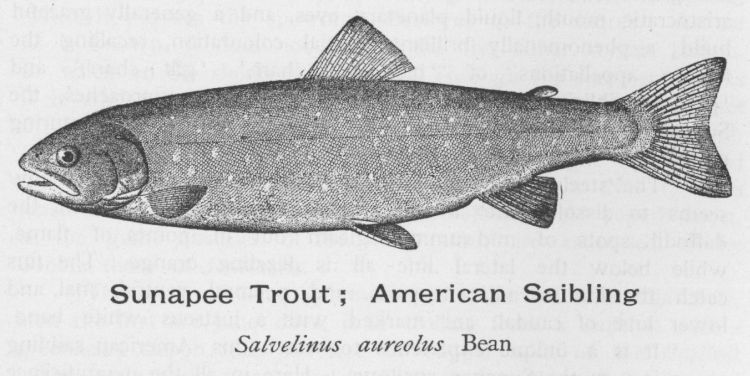
The golden trout of Sunapee Lake was not known to anglers until about twenty years ago, and it was not described and named until 1888. Through the interesting writings of Dr. John D. Quackenbos and others its name is now a familiar one to anglers everywhere, though but few have a personal acquaintance with the fish in its native waters, for this beautiful trout has a very restricted habitat. So far as known it is native only to Sunapee Lake, New Hampshire, and Flood Pond, near Ellsworth, Maine, but through fish cultural operations it has been introduced into a number of other lakes.
The water of both Sunapee Lake and Flood Pond is exceptionally pure and cold, the bottom temperature varying from 38 degree to 52 degree, according to the depth, as giving by Dr. Quackenbos. The maximum depth of each is over 100 feet, the bottom is of white sand and gravel, and there is in each an abundance of crustacea and other fish-food.
These are the environing conditions which have made the Sunapee trout a fish of surprising beauty and gracefulness. According to Dr. Quackenbos who has a more intimate acquaintance with this fish than any other who has written about it, the distinguishing characteristics are as follows: "The presence of a broad row of teeth on the hyoid bone between the lower extremities of the first 2 gill-arches; the absence of mottling on the dark sea-green back, and the excessively developed fins; inconspicuous yellow spots without areola: a square or slightly emarginate tail; a small and delicately shaped head; diminutive, aristocratic mouth, liquid planetary eyes, and a generally graceful build; a phenomenally brilliant nuptial colouration, recalling the foreign appellations of 'blood-red charr,' 'gilt charr,' and 'golden saibling.' As the October pairing time approaches, the Sunapee fish becomes illuminated with the flushes of maturing passion.
"The steel-green mantle of the back and shoulders now seems to dissolve into a veil of amethyst, through which the daffodil spots of mid-summer gleam out in points of flame, while below the lateral line all is dazzling orange. The fins catch the hue of adjacent parts, and pectoral, ventral, anal, and lower lobe of caudal, are marked with a lustrous white band.
"It is a unique experience to watch this American saibling spawning on the Sunapee shallows. Here in all the magnificence of their nuptial decoration flash schools of painted beauties, circling in proud sweeps about the submerged boulders they would select as the scenes of their loves--the poetry of an epithalamium in every motion--in one direction, uncovering to the sunbeams in amorous leaps their golden-tinctured sides, gemmed with the fire of rubies; in another, darting in little companies, the penciled margins of their fins seeming to trail behind them like white ribbons under the ripples. There are conspicuous differences in intensity of general colouration, and the gaudy dyes of the milter are tempered in the spawner to a dead-lustre cadmium cream or olive chrome, with opal spots. The wedding garment nature has given to this charr is unparagoned. Those who have seen the bridal march of the glistening hordes, in all their glory of colour and majesty of action, pronounce it a spectacle never to be forgotten."
That so conspicuous a game and food-fish could have been aboriginal to Sunapee Lake, and for 100 years have escaped the notice alike of visiting and resident anglers, persistent poachers, and alert scientists is accounted for, as suggested by Dr. Quackenbos, by its habit of remaining almost constantly in deep water, by its spawning on mid-lake reefs late in the fall when angling is out of season and the locality of the beds dangerous of access, and by its comparative scarcity prior to the introduction of black bass in 1868. Quoting still further from Dr. Quackenbos, to whom we are indebted for our account of this fish, "the Sunapee saibling takes live bait readily, preferring a cast smelt in spring, when it pursues the spawning Osmerus to the shores. As far as is known, it does not rise to the fly, either at this season, or when on the shoals in autumn. Through the summer months it is angled for with a live minnow or smelt, in 60 to 70 feet of water, over cold bottom, in localities that have been baited. While the smelt are inshore, trolling with a light fly-rod and fine tackle, either with a Skinner fluted spoon, No. 1, or a small smelt on a single hook, will sometimes yield superb sport, as the game qualities of the white trout are estimated to be double those of fontinalis.