Home › Volumes › Fishes › The Mackerels
Spanish Mackerel
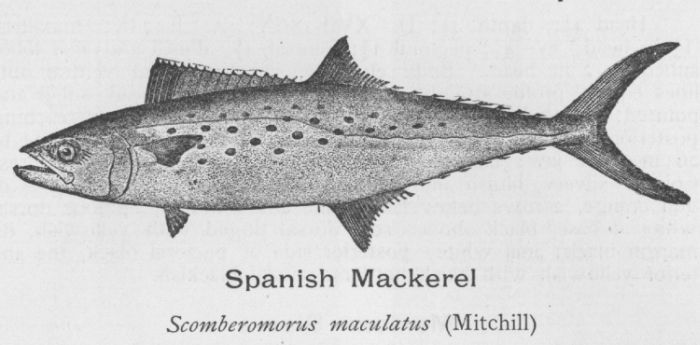
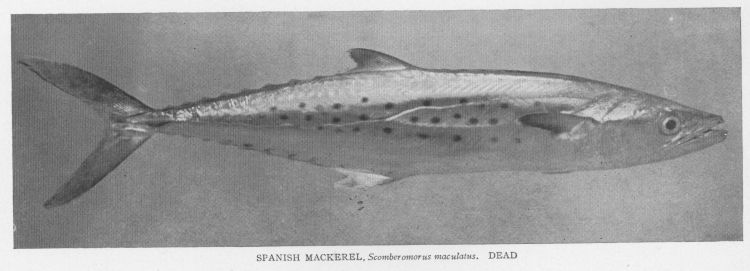
The Spanish mackerel is a fish of wide distribution on our Atlantic Coast, ranging north in the fall as far as Cape Ann, and in the south to Brazil. In the West Indies it has been found about Jamaica and Porto Rico, but is probably not known from Cuba. In the Gulf of Mexico and on our South Atlantic Coast it appears irregularly in large schools.
The catch on our Atlantic and Gulf Coasts has been subject to great variations. In the early history of this country the Spanish Mackerel was scarcely known, and not until within the last 30 years has it become of much commercial importance. The catch in 1897 amounted to 1,183,456 pounds, worth $69,778.
It is now one of the most highly prized of all our fishes, and always commands a high price.
Ordinarily it reaches a weight of 6 to 10 pounds, but occasionally very large individuals are taken. The largest we have seen was taken in October, 1901, off Chesapeake Bay, and weighed 25 pounds. It was 41 inches long.
This fish is usually taken in pounds or gillnets, though many are taken by trolling. It is an excellent game-fish. It is a fish of the sunnier climes and comes to us only in the spring, summer and autumn, when it may be seen, sometimes in large schools, swimming at the surface, feeding upon other fishes, often leaping and disporting itself in the sun. The menhaden is probably its principal food, though many other species are eaten.
The Spanish mackerel spawns on the Carolina Coast in April and May and in the lower Chesapeake during the first half of June. Their eggs are very small and very numerous, a 6-pound fish producing about 1,500,000 eggs.
Head 4 1/2; depth 4 1/2; D. XVII-18-IX; A. II-17-IX; maxillary 1 4/5 in head; eye 4 3/4; pectoral 1 3/4; ventral 4 1/2; dorsal and anal lobes subequal, 2 in head. Body elongate, its dorsal and ventral outlines equal; profile straight from snout to dorsal; head small and pointed; mouth large, oblique, the jaws equal; maxillary reaching posterior edge of orbit; teeth large, compressed and sharp, 24 to 26 in each jaw; lateral line undulating, with about 175 pores. Colour, silvery, bluish above; sides with many elliptical spots of dull orange, 2 rows below lateral line and 1 above; spinous dorsal margin black; anal white; posterior side of pectoral black, the anterior yellowish with black borders; caudal blackish.