Home › Volumes › Fishes › The Mackerels
Sierra; Pintado; Kingfish
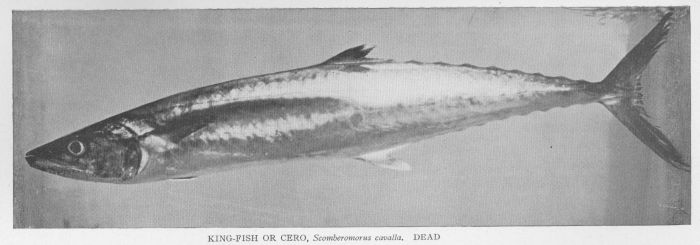
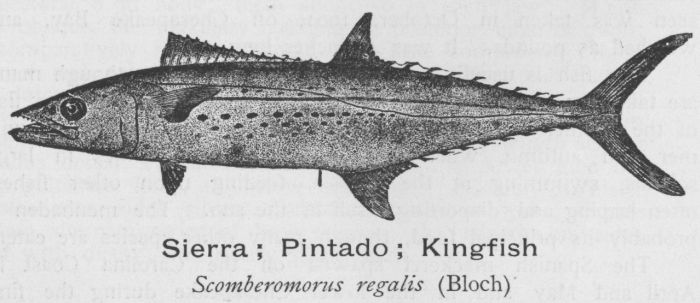
This fine fish is found from Cape Cod to Brazil, but it is not common anywhere except about Florida and Cuba. It grows to 5 or 6 feet in length, 20 pounds or more in weight, and is an excellent game and food-fish. It is found on the south Florida Coast and is caught by trolling. It is not always distinguished by the fishermen from the Spanish mackerel or the cero.
Head 4 1/4; depth 4 1/2; D. XVII-I, 15-VIII; A. II-14-VIII. Body rather elongate, its dorsal and ventral curves about equal; lateral line descending obliquely, undulating along the tail; mouth large, maxillary reaching to below eye; angle of peopercle produced backward; caudal peduncle rather slender, its least depth 5 1/2 in head; caudal fin less widely forked than in the Spanish mackerel; teeth triangular, strongly compressed, about 40 in each jaw; pectoral scaly. Colour, silvery; side with 2 blackish longitudinal bands crossing lateral line below soft dorsal, each posteriorly broken up into longitudinal spots, above and below these are numerous brownish spots in rows, persistent in adult; front of spinous dorsal black.
Kingfish; Cero: Cavalla
Scomberomorus cavalla (Cuvier & Valenciennes)
Of all the host of Florida game-fishes that are used as food this is the greatest, Indeed, there are few game-fishes which excel it in size, strength, swiftness of movement, or fighting powers. The cero is a fish of the tropical seas, often coming in immense numbers to the coasts of Florida and the Carolinas, and ranging north to Cape Cod and south to Brazil and Africa. It is common on our South Atlantic Coast and among the Florida Keys. At Key West it is, next to the grunt, the most important food-fish. It usually appears in November and remains until April, during which time it is caught by trolling. It is said to school at spawning time which is late in winter. As a food-fish it takes a very high rank, the flesh being firm and of excellent flavour.
The cero reaches a length of 5 feet and a weight of 100 pounds. Examples weighing 40 to 50 pounds are not rare. The largest one of which we could find an authentic record at Key West dressed 52 pounds. The average size, however, of those taken about Key West is only about 10 pounds, or perhaps even less. When the Key West fisherman desires large cero he directs his course toward the inshore grounds, lying in about 3 fathoms of water and 1 1/2 to 3 miles from shore, where the water is less clear; and when smaller ones are wanted they are found further off shore along the edge of the Gulf Stream where the water is clearer. The large and smaller one are almost invariably found in separate schools.
The cero is usually caught by trolling and is justly regarded as one of the greatest of all game-fishes. A stout braided line is best, though laid cotton cod-lines are often used. A cod hook with long shank, and a foot or 2 of stout copper or brass wire to withstand the numerous sharp teeth are needed. For bait a strip of white bacon rind, 5 to 8 inches long, cut to resemble a fish, with a slit in the upper end and one in the middle through which it is placed on the hook, the upper end being secured by a fine wire. A block tin squid or a very heavy spinner is, however, a better lure.
In lieu of anything better the hook may be wrapped with white muslin; tin foil, or anything that the fish can easily see, will answer very well. As a fighter the cero is chiefly famous on account of the marvellous leaps which he makes. Clearing the surface by 10 feet or more is no unusual thing. And Dr. Henshall tells some marvellous stories of its jumping powers, but it is fair to say he does not vouch for them.
Head 5; depth 6; eye large, 2 in snout; D. XV-I, 15-VIII; A. II-15-VIII; pectoral 5; gillrakers very short, less than half diameter of eye, about 8 below angle. Mouth large, maxillary reaching below eye; lateral line decending abruptly below second dorsal; teeth triangular, strongly compressed, about 30 in each jaw. Colour of adult, iron-gray, nearly or quite immaculate; young with the sides with darker yellowish spots; no black blotch on spinous dorsal anteriorly.
GENUS ACANTHOCYBIUM GILL
The Petos
This genus differs from the other Scombroids in the large size of the spinous dorsal, there being about 25 spines instead of 10 to 16 as in the other genera.
The only species is A. solandri, known variously as peto, wahoo, and guarapucu, a very large, mackerel-like fish, widely distributed in tropical seas. This great fish reaches our borders only in the West Indies and among the Florida Keys. It reaches a length of 5 or 6 feet and a weight of 50 to 100 pounds, and is known to spawn off Cuba. It is an excellent food-fish and is taken by trolling, but we know nothing regarding its game qualities.