Home › Volumes › Fishes › The Grunts
Pork-fish; Sisi
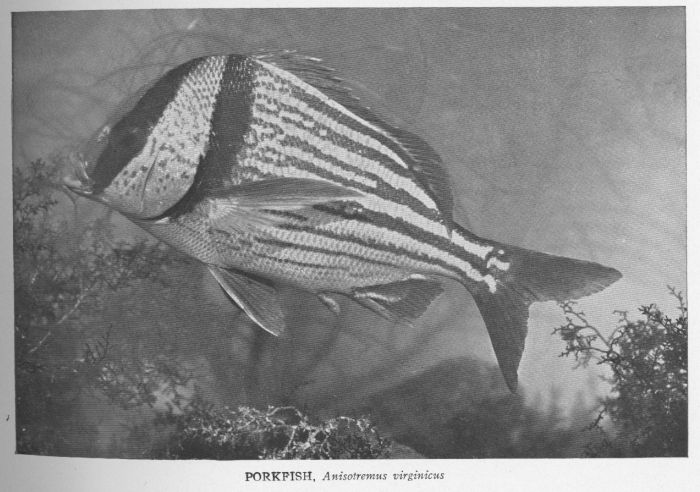
A very handsome fish ranging from Florida to Brazil; known from Biscayne Bay, Key West, Santo Domingo, Jamaica, Porto Rico, Martinique, and St. Catharine Island. About Key West it is said to school from June to August, which is its spawning season. It is then found about shoals, but soon retires to deeper water. It spawns in the channels among the shoals, where it is caught in great numbers, chiefly in traps and with hook and line. About a month after spawning-time immense numbers of young are said to be found about the shoals.
The species reaches a length of about a foot and a weight of 2 pounds, but those brought to market do not average more than 1/3 of a pound. In Porto Rico, where it is called sisi, it is not common. It is everywhere regarded as an excellent pan-fish.
Colour in life, side with about 8 broad lemon-yellow longitudinal bars, alternating with similar bars of dirty silvery, the upper 3 or 4 of the yellow lines branching anteriorly, the fifth extending on middle of caudal peduncle; belly silvery white; a broad black bar from origin of spinous dorsal to base of pectoral, continuing on shoulder-girdle to near isthmus; another broad black band from occiput through eye to angle of mouth; cheek metallic or brassy green; top of head brassy; fins all orange-yellow; spinous dorsal, pectoral, and ventral dusted with brownish; scaly sheath at base of anal rich yellow.
GENUS BRACHYDEUTERUS GILL
This genus in most respects resembles Pomadasis. Body oblong; scales large, those above in series parallel with the lateral line; mouth small; outer teeth somewhat enlarged; inside of jaws not red; anal spines small or moderate, the second little, if any, longer or stronger than third, and shorter than soft rays; soft dorsal and anal largely covered with small scales; D. XII, 14 to 16. None of the 4 species of this genus is of much importance.
Brachydeuterus nitidus is known only from the Gulf of California, Mazatlan, and Panama. It reaches about a foot in length, and is used as food, though it is not abundant. In colour it is silvery, darker above, with dark streaks along the rows of scales, especially distinct below lateral line; a large round dark blotch at beginning of lateral line, about as large as eye.
B. corvinaeformis ranges from the West Indies to Brazil, apparently most common about Porto Rico. It reaches a foot in length, and is a good pan-fish.
B. leuciscus is probably the most important species of the genus. It is found on our Pacific coast from Guaymas to Peru. It is very common about Mazatlan and Panama, and is a valued pan-fish.
B. axillaris, the burro blanco, reaches a foot in length, and is known only from Guaymas and Mazatlan, where it is used as food.
GENUS POMADASIS LACEPEDE
The Burros
This genus is composed of small shore-fishes, some of its representatives being found in most tropical seas. Several of the species enter fresh waters, and others are found in brackish waters. Numerous species occur on the west coast of Africa and about the Cape Verde Islands, but, so far as known, none enters European waters. The genus is represented in our waters by about 8 species, all of those sufficiently abundant being food-fishes of some little value.
Pomadasis panamensis is a well-marked species occurring on the Pacific coast of tropical America, and rather common at both Panama and Mazatlan. It reaches a foot or more in length, 2nd is a good pan-fish.
Colour, gray silvery; young with 6 very faint cross-bars, one of these below spinous dorsal appearing as a roundish dark spot; lower fins white; a distinct dark blotch on opercle and a fainter one n side below spinous dorsal.
P. bayanus is known only from Panama, the only known specimens having come from the Rio Bayano. Colour, uniform olivaceous above, silvery below; fins plain.
P. productus is a very rare species known only from Cuba. Colour, nearly plain, silvery below.
P. macracanthus occurs on the Pacific coast of tropical America from Mazatlan to Panama. It reaches 15 inches in length, and is used as food. When caught it makes a loud snore-like noise very much like that made by a donkey, hence its common name burro.
P. andrei has been recorded only from the Rio Guayas, near Guay-aquil, Ecuador. It is a doubtful species.
P. crocro occurs throughout the West Indies from Cuba to Brazil, and is generally common on sandy shores. Colour, plain olivaceous, silvery below, with about 3 or 4 ill-defined longitudinal dark stripes along side, one from tip of snout to middle of base of caudal.
P. branicki, the burrito, reaching a length of 7 inches, occurs on the Pacific coast of tropical America, from Mazatlan to Peru. It is not uncommon on sandy shores.