The Grunts
BODY oblong, more or less elevated, covered with moderate-sized scales which are adherent and more or less strongly ctenoid or almost cycloid; lateral line well developed, concurrent with the back, usually not extending on the caudal fin; head large, the crests of the skull usually largely developed; mouth large or small, usually low, horizontal, and terminal; premaxillaries protractile; no supplemental maxillary bone; teeth all pointed, none of them forming marked canines; no teeth on vomer, palatines, or tongue; pseudobranchiae large; gill-membranes separate, free from the isthmus; opercle without spines; side of head usually scaly; dorsal fin continuous or deeply notched, sometimes divided into 2 fins, the spines usually strong, depressible in a groove, the spines heteracanthous, that is, alternating, the one stronger on the right side, the other on the left; anal similar to soft dorsal, with 3 spines; caudal usually more or less concave behind; air-bladder present.
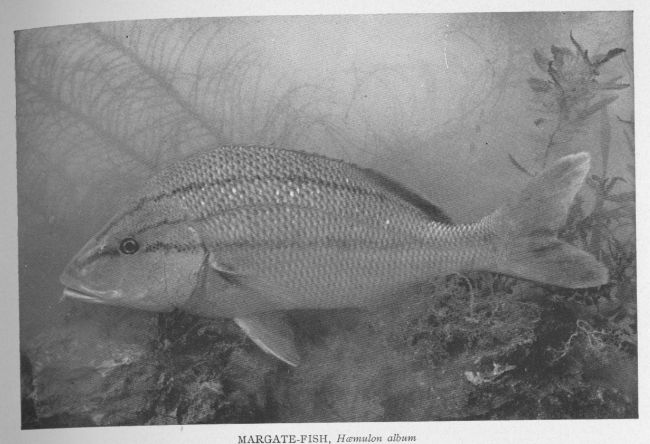 Margate-fish; Margaret Grunt Haemulon album Cuvier & Valenciennes
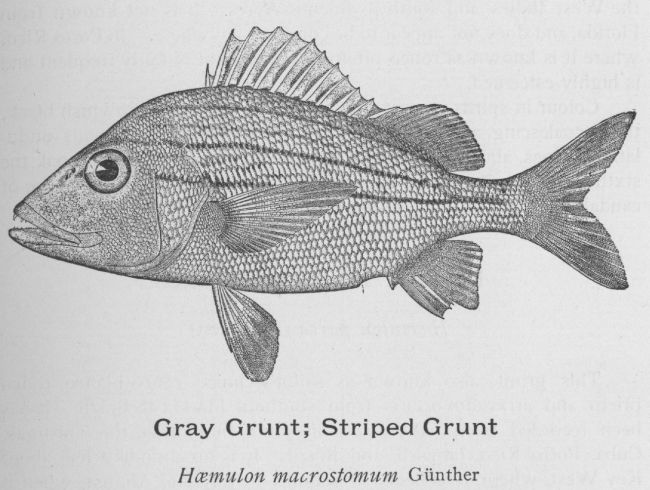 Gray Grunt; Striped Grunt Haemulon macrostomum Gunther
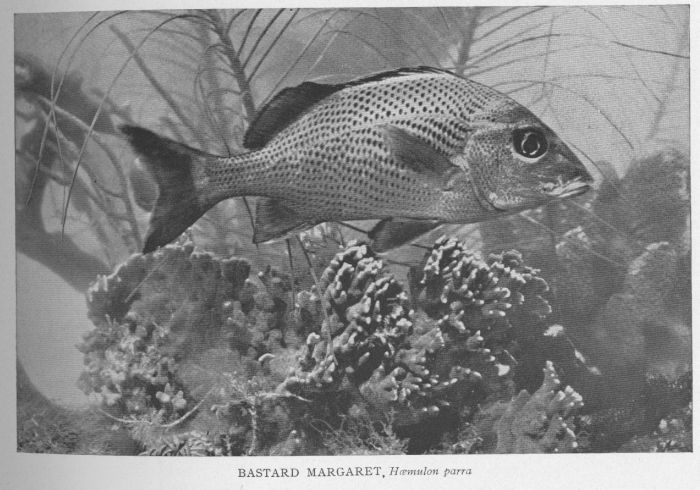 Bastard Margaret; Ronco Haemulon parra (Desmarest)
- Mojarra Prieta Haemulon scudderi Gill
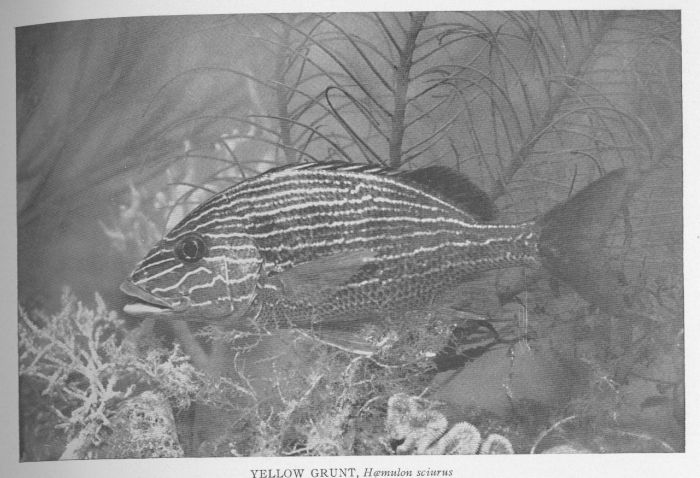 Yellow Grunt; Boar Grunt Haemulon sciurus (Shaw)
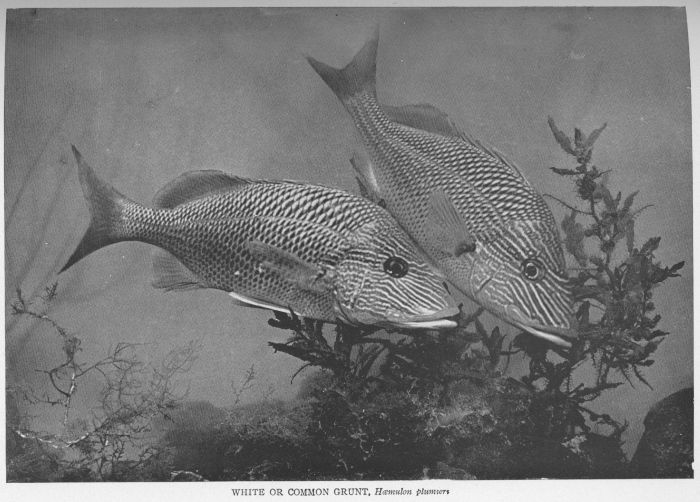 Common Grunt; White Grunt Haemulon plumieri (Lacepede)
- French Grunt; Open-mouthed Grunt Haemulon flavolineatum (Desmarest)
- French Grunt; Open-mouthed Grunt — Part 2 Haemulon flavolineatum (Desmarest)
- Pompon Anisotremus surinamensis (Bloch)
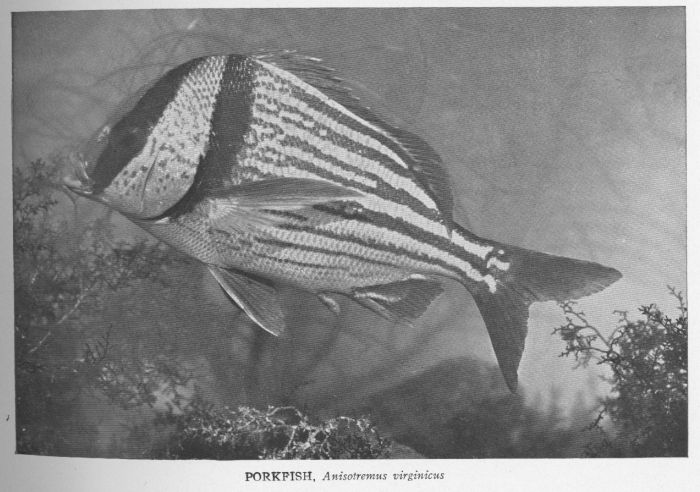 Pork-fish; Sisi Anisotremus virginicus (Linnaeus)
- Pork-fish; Sisi — Part 2 Anisotremus virginicus (Linnaeus)
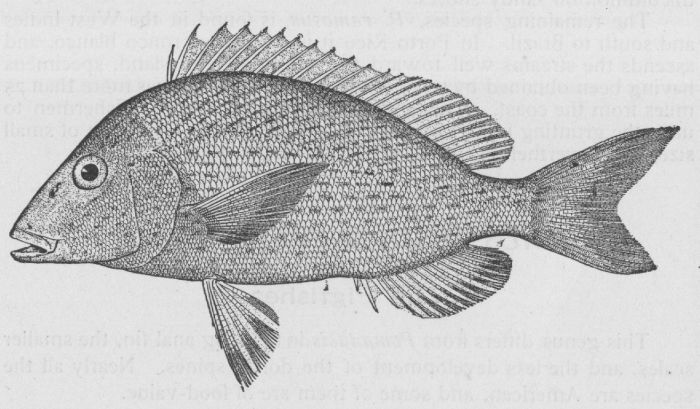 Pigfish; Hogfish Orthopristis chrysopterus (Linnaeus)