Home › Volumes › Fishes › The Herrings
Menhaden; Mossbunker; Pogy
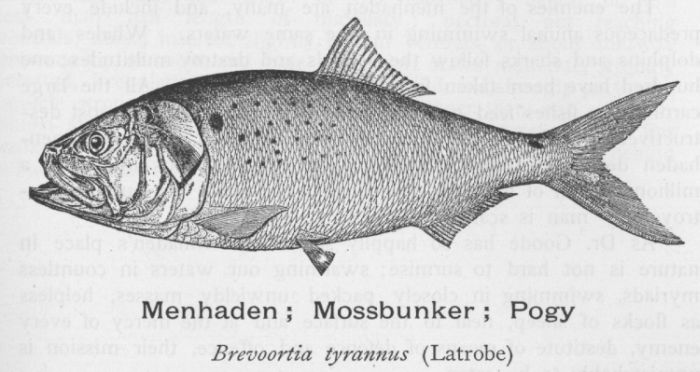
The menhaden occurs from Nova Scotia to Brazil, and is by far the most abundant fish on the eastern coast of the United States. Several hundred thousand have been taken in a single draft of a purse-seine. A firm at Milford, Connecticut, captured in 1870, 8,800,000; in 1871, 8,000,000; in 1872, 10,000,000, and in 1873, 12,000,000. In 1877, 3 sloops from New London seined 13,000,000. Though this was an unprofitable year the Pemaquid Oil Company took 20,000,000, and the town of Booth Bay alone took 50,000,000.
Though no decrease was visible up to 1880, since that time many fishermen believe a very great decrease has taken place. This, however, has not been proved, and many intelligent observers deny that any appreciable decrease has really occurred.
The food of the menhaden consists almost wholly of plankton--the minute unicellular algae, and the smaller animals which swarm in untold myriads at the surface of the sea, particularly along the coasts.
The spawning time and method are not well understood. According to Goode, the breeding grounds are probably on the off-shore banks, and the eggs are presumably cast in late winter or early spring. Recently the menhaden has been found breeding in brackish water in Buzzards Bay.
The fecundity of the menhaden is very great, exceeding that of the shad and the herring. More than 140,000 eggs have been taken from one fish.
The enemies of the menhaden are many, and include every predaceous animal swimming in the same waters. Whales and dolphins and sharks follow the schools and destroy multitudes; one hundred have been taken from a shark's stomach. All the large carnivorous fishes feed upon them, the tunny being the most destructive. Dr. Goode, in 1880, estimated the total number of menhaden destroyed annually on our coast by predaceous animals at a million million of millions, compared with which the number destroyed by man is scarcely more than infinitesimal.
As Dr. Goode has so happily said, the menhaden's place in nature is not hard to surmise; swarming our waters in countless myriads, swimming in closely packed unwieldy masses, helpless as flocks of sheep, near to the surface and at the mercy of every enemy, destitute of means of defence and offence, their mission is unmistakably to be eaten.
Besides entering so largely into the food-supply of many important food-fishes, though of little value itself as food for man, the menhaden is nevertheless a fish of very great commercial importance; As a bait fish in the mackerel, cod and halibut fisheries it is unexcelled. In 1877 more than 80,000 barrels, or 26,000,000 fish, valued at $500,000, were used for this purpose. As a source of oil the menhaden is of greater importance than any other marine animal. After the oil is expressed the residue supplies a valuable manure when made into manufactured fertilizers.
Though little valued in the United States as a food-fish, nevertheless many barrels of salted menhaden are shipped to the West Indies, and some are consumed along our own coast. They have been packed in oil, after the manner of sardines, for domestic and foreign consumption. A preparation resembling Liebig's "Extract of Beef" has also been prepared from this fish. And as a food for domestic animals in the form of "fish meal" the menhaden is of value. After all, however, the menhaden must ever be of greatest value as food for other fishes.
The menhaden has received perhaps more common names than any other American fish. Dr. Goode enumerates at least 30 which have been given to it.
Head 3 1/5; depth 3; D. 19; A, 20; scales 60 to 80. Head rather short and heavy; fins comparatively short, the height of the dorsal less than the length of the maxillary; height of anal less than half length of maxillary; pectoral not reaching ventrals; dorsal inserted slightly behind ventrals, or about midway between tip of snout and base of caudal; scales moderate, strongly serrated, irregularly arranged, those before dorsal strongly pectinate; opercle strongly striated; gillrakers much longer than eye. Colour, bluish above, the sides silvery, with a strong brassy lustre; fins usually yellowish; a conspicuous dark scapular blotch, behind which are often smaller spots. Length 12 to 18 inches.