The Croakers
BODY compressed, more or less elongate, covered with rather thin scales which are usually more or less ctenoid; lateral line continuous, extending on caudal fin; head usually large, scaly; bones of head cavernous, the muciferous system highly developed, the surface of the skull very uneven; chin usually with pores, sometimes with barbels; mouth small or large, the teeth in one or more series, the outer sometimes enlarged; canines often present; no incisors or molars; no teeth on vomer, palatines, or tongue; maxillary without supplemental bone; premaxillaries somewhat protractile; nostrils double; pseudobranchiae usually present and usually large; branchiostegals 7; gill-membranes separate, free from the isthmus; lower pharyngeals separate or united, often enlarged, the teeth conic or molar; preopercle serrate or not; opercle usually ending in 2 flat points; dorsal deeply notched or divided into 2 fins, the soft portion being the longer, the spines depressible into a groove; anal with never more than 2 spines; caudal usually not forked; ear-bones or otoliths very large; air-bladder usually large and complicated (wanting in Menticirrhus).
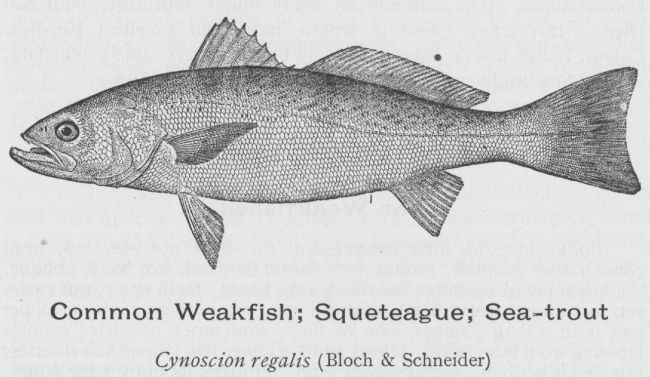 Common Weakfish; Squeteague; Sea-trout Cynoscion regalis (Bloch & Schneider)
- California White Sea-bass Cynoscion nobilis (Ayres)
- California White Sea-bass — Part 2 Cynoscion nobilis (Ayres)
- California White Sea-bass — Part 3 Cynoscion nobilis (Ayres)
- California White Sea-bass — Part 4 Cynoscion nobilis (Ayres)