Home › Volumes › Fishes › The Croakers
Common Weakfish; Squeteague; Sea-trout
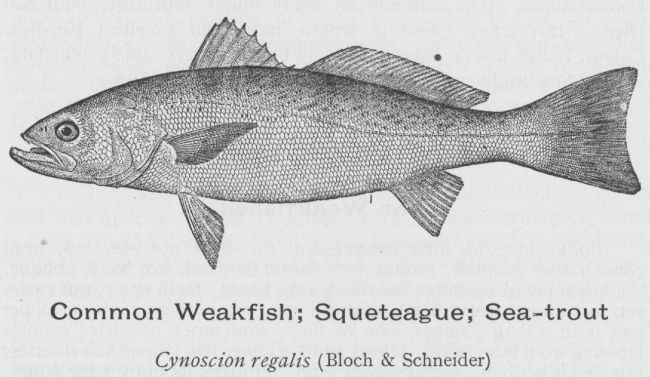
The squeteague is found throughout the entire length of our Atlantic and Gulf coasts, and ranges as far north as the Bay of Fundy. It has varied greatly in abundance within the last hundred years, but is always one of our commonest and best-known fishes. At certain times and places it is exceedingly abundant. A catch of over 200,000 pounds in one day in 1881 two miles off Rockaway Beach is on record. It is rare in the Gulf of Mexico, but from Florida to Long Island it is usually abundant.
Although essentially a coast and still-water fish, the squeteague sometimes runs up tidal waters and prefers the vicinity of river-mouths. Though seen in the markets everywhere, this fish is not much valued in the North, but in the South it is highly prized.
As a game-fish the squeteague is the greatest of the family. No salt-water fish of our Atlantic coast affords more sport to the angler than this species. It is only the great freedom with which it takes the bait and the large numbers which may be caught that cause it to fail of the highest appreciation. Its strength and endurance are perhaps not so great as that of the rock, but the strike and first rush are not less vigorous. They take almost any kind of bait, especially clams, soft crabs, or pieces of meat, as well as the trolling-spoon, and bite with a snap. On account of the extreme tenderness of the mouth, they must be handled with extreme care. "His first dash is from the boat and 10 yards of line will be run off in a jiffy. He fights well and at long range if you allow him line, but bear well on him, as the least slacking of the line gives him a chance to disengage the hook, which he sometimes attempts to do by jumping above the water and shaking his head."
Great numbers of weakfish are taken with the hand-line by what is called "drifting"; that is, to sail into a school of them in a mid-tide, and, letting the sheet go, allow the boat to drift while you fish over the sides at half-depth.
The squeteague reaches a maximum weight of 30 pounds, though examples of more than 10 or 12 pounds are very rare, and the average weight is very much less.
This fish is one of the principal species upon which the bluefish feeds, and marvelously great numbers are doubtless destroyed every year by that rapacious fish.
Colour, silvery, darker above, and marked with many small, irregular dark blotches, some of which form undulating lines running downward and forward; back and head with bright reflections; dorsal and caudal fins dusky; ventrals, anal, and lower edge of caudal yellowish, sometimes speckled.
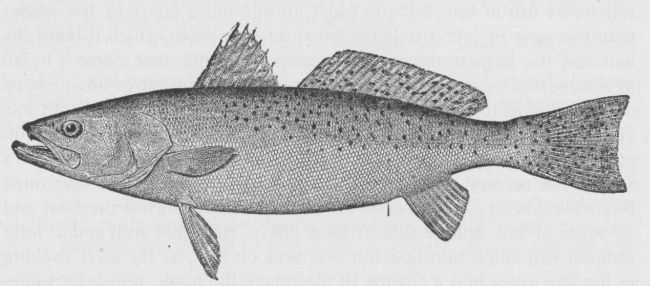
Spotted Weakfish; Spotted Sea-trout
Cynoscion nebulosus (Cuvier & Valenciennes)
This species is associated on the coasts of New Jersey and Virginia with the squeteague, from which it may readily be distinguished by the presence of numerous round black spots on the body posteriorly. It becomes more abundant southward until, off the coast from North Carolina to Georgia, it is one of the most common food-fishes. Owing to its shape and spots, it is known on the Southern coast as salmon or spotted sea-trout, names wholly inappropriate. Spotted squeteague is a much better name.
Among the commercial fishes of Indian River this species ranks fourth. Though it is present throughout the year, the largest catches are made during the latter part of winter and early spring. The average weight is 2 to 4 pounds, though the maximum is much greater; we have seen an example at Fort Pierce, Indian River, weighing 13 1/2 pounds.
The spotted squeteague is more migratory in its habits than its relatives. At Beaufort it appears from the South in the spring and passes through the inlets on the flood-tide. Early in May they proceed northward, extending their journeys as far as Long Island. On the North Carolina coast they are perhaps more abundant than any other species, excepting, of course, the mullet.
As a game-fish this species is scarcely inferior to the common squeteague.