Home › Volumes › Fishes › The Herrings
Common Shad; American Shad
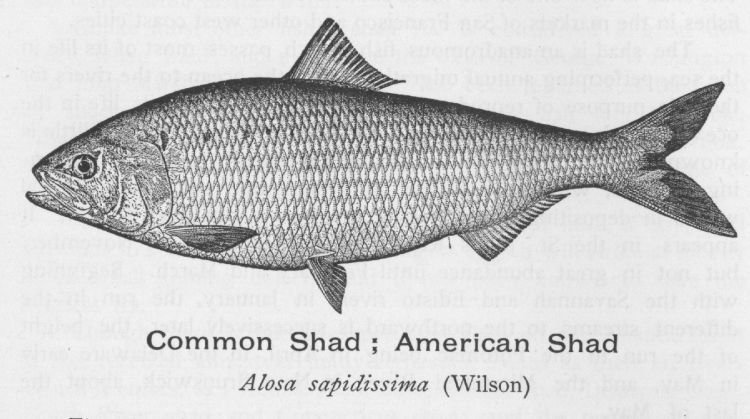
The shad is found on our Atlantic coast from Florida to New-foundland, its centre of abundance being from North Carolina to Long Island. The principal shad rivers are the Potomac, Susquehanna, and Delaware. In the early history of the country the abundance of the shad excited unbounded astonishment. Nearly every river on the Atlantic Coast was invaded in the spring by immense schools, which, in their upward course, furnished an ample supply of choice food. But through ever-increasing fishing operations the supply gradually diminished until 30 years ago when the Federal and various State governments began hatching the shad artificially. So successful have these efforts been that, notwithstanding greatly increased fishing operations and the curtailment of the spawning-grounds, the supply in recent years has not only been maintained but largely augmented in many streams.
One of the satisfactory results of the artificial propagation of useful food-fishes--satisfactory because they are absolutely proved and can not be questioned--has been the introduction of the shad into the waters of our Pacific Coast in which no shad were previously found.
At various times between 1871 and 1880, 619,000 shad fry were planted in the Sacramento River, and in 1885 and 1886 910,000 were placed in the Columbia River. There young shad found the environment congenial, suitable spawning grounds were found, and they have thrived so well that they have spread to San Diego on the South and to Fort Wrangel on the North-a distance of more than 2,000 miles. The shad is now one of the most abundant and most delicious food-fishes in the markets of San Francisco and other west coast cities.
The shad is an anadromous fish which passes most of its life in the sea, performing annual migrations from the ocean to the rivers for the sole purpose of reproduction. Little is known of its life in the ocean, the places to which it resorts are unknown and but little is known regarding its food. In the spring it ascends to suitable spawning grounds, which are always in fresh water, occupying several weeks in depositing and fertilizing its eggs in any given stream. It appears in the St. Johns River, Florida, as early as November, but not in great abundance until February and March. Beginning with the Savannah and Edisto rivers in January, the run in the different streams to the northward is successively later, the height of the run in the Potomac being in April, in the Delaware early in May, and the Miramichi River, in New Brunswick, about the last of May.
The main body ascends when the water temperature is 56 degree to 66 degree, the number diminishing when the temperature is over 66 degree. They come in successive schools, the males preceding the females. Of 61,000 shad received at Washington from March 19 to 24, 1897, 90% were males. Toward the close of the season males were extremely scarce. Formerly the shad ascended many streams much farther than they are now able to go, owing to the erection of many impassable dams, beyond which the fish cannot go.
As the shad enter the rivers only for the purpose of spawning, the fisheries are necessarily prosecuted during the spawning season, and often upon the favourite spawning-grounds. So great is the demand for this delicious food-fish, and so assiduously do the fishermen ply their vocation with many kinds of gear during the period when, under ordinary circumstances, the fish should be protected, that the shad-fisheries would long since have been a thing of the past had it not been for artificial propagation. During the spring of 1900 the U. S. Fish Commission planted in the Atlantic Coast streams a total of 241,056,000 young shad.
The shad is very prolific. Single fish have been known to yield from 60,000 to 156,000 eggs, though the usual number does not exceed 30,000. The eggs are very small, semi-buoyant, and usually require 6 to 10 days for hatching, the time varying with the temperature of the water.
Unlike most other fishes shad roe is considered a great delicacy when fried; and ever since the days of George Washington and John Marshall "planked shad" has been regarded as the acme of success in the preparation of a delicious fish for the table. And a planked shad dinner at Marshall Hall, near Mount Vernon, is quite sure to constitute a feature in the spring programme of many Washington societies.
After entering the rivers, the shad take but little, if any, food previous to spawning, but after casting its eggs it will strike at flies or other small shining objects, and it has been known to take the artifical fly.
Though there is but one species of shad on our Atlantic Coast it has received almost as many vernacular names as there are rivers which it enters, as Potomac shad, Susquehanna shad, Delaware shad, North River shad, and Connecticut shad; and the people on each particular stream regard their shad as the best; and all are right, for the sweetness and delicate flavour of the shad depend much upon its freshness. The shad one gets from a nearby river are apt to reach the table fresher than those shipped from a distance.