Home › Volumes › Fishes › The Mackerels
Common Mackerel
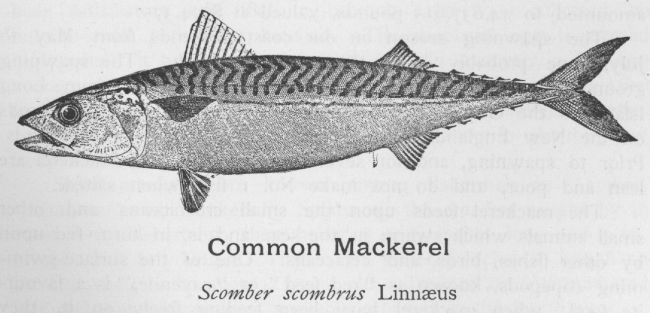
The mackerel inhabits the North Atlantic Ocean. On our coast it ranges from Cape Hatteras to the Straits of Belle Isle; while in European waters it is found from Norway to the Mediterranean and Adriatic.
The mackerel first appear in spring off Cape Hatteras, and later reach the shores of the Middle and New England States and the British possessions, coming in from the sea from a southerly or southeasterly direction. They leave the coast in the same way in fall and winter. It is a wandering fish, and its movements and the causes thereof are not fully understood. It is one of the most abundant fishes on our Atlantic Coast, going in schools often of great extent. It is on record that in 1848 a school was seen one-half mile wide, and at least 20 miles long. Another school, seen in 1877 off Block Island, was estimated to contain 1,000,000 barrels. The schools swim at the surface or near it, and in a rather compact body.
Periods of scarcity alternate with seasons of abundance. The New England catch in 1885 was 330,000 barrels, and the average for the 8 years ending in 1885 was 309,000 barrels. In 1886 it dropped to 80,000 barrels, and in the succeeding 10 years it amounted to only 481,000. The yield in 1898 was 5,769,000 pounds, valued at $307,000, and 15,500 barrels salted, valued at $179,000.
In 1900 the catch landed at Boston and Gloucester amounted to 8,889,294 pounds fresh, valued at $389,952, and 15,965,500 pounds salted, valued at $837,743, or a total of 24,854,794 pounds, valued at $1,227,695. For 1901 the catch landed at these 2 ports amounted to 14,637,615 pounds, valued at $704,375.
The spawning season on our coasts extends from May to July, June probably being the principal month. The spawning grounds are in rather deep water along the coast from Long Island to the Gulf of St. Lawrence. Most of the bays and sounds on the New England Coast contain important spawning-grounds. Prior to spawning, and for several weeks after, the mackerel are lean and poor, and do not make No. 1 fish when salted.
The mackerel feeds upon the small crustaceans and other small animals which swarm in the sea, and is, in turn, fed upon by other fishes, birds, and cetaceans. One of the surface-swimming copepods, known as "red feed" or "cayenne," is a favourite food; when mackerel have been feeding freely on it, they spoil very quickly after being caught, owing to their sides rotting or "burning." Among the fish which the mackerel eat may be named herring, anchovy, sand launce, menhaden, and silver-sides. Among fishes, sharks are, perhaps, the worst enemies of the mackerel. Other fish-enemies are the bluefish and cod. Porpoises and whales are often seen feeding on the mackerel schools. Large squid do great damage to small mackerel and, among birds, the gannet is especially destructive.
As a food-fish, the mackerel is one of the best and most valuable. On our coast the vessel fishery is carried on chiefly from Gloucester. The vessels go south in the early spring, falling in with the fish when they first appear off our southern coast, and landing their catch fresh at Philadelphia and New York. The fleet next seeks the school off the southern shore of Nova Scotia and follows it to the Gulf of St. Lawrence. Most of the fall fishing is done on the New England shore. Some of the finest fishing vessels in the United States are engaged in this fishery. In recent years the fleet has numbered 150 to 225 vessels, but formerly nearly 1,000 were engaged in this business.
The shore and boat fishing is carried on from New Jersey to Maine, the catch being usually sold fresh.
The local mackerel has so fallen off in recent years that the catch does not supply the home demand, and large quantities are received, both fresh and salt, from Norway, Ireland, and the British provinces.
The United States Fish Commission has undertaken the artificial propagation of the mackerel, but the results have not yet been satisfactory. In 1896, 24,000,000 eggs were collected, but only a small percentage hatched. The mackerel egg is exceedingly small, it being only 1/24 of an inch in diameter. The eggs average about 40,000 to the fish, but 200,000 have been taken from 1 fish. The largest mackerel would doubtless produce 1,000,000 eggs each. The period of incubation is about 5 days in water at 58 degree.
Small mackerel are known among fishermen as "spikes," "blinkers," and "tinkers." Spikes are the smallest caught by the commercial fishermen, they being 5 or 6 inches long and 5 to 7 months old, or younger. Tinkers are under 9 inches in length and are supposed to be about 2 years old. Blinkers are intermediate in size and age. Maturity is probably attained in the fourth year.
The common mackerel is so well known as to render a detailed description unnecessary.