Home › Volumes › Fishes › The Mackerels
Chub Mackerel; Tinker Mackerel
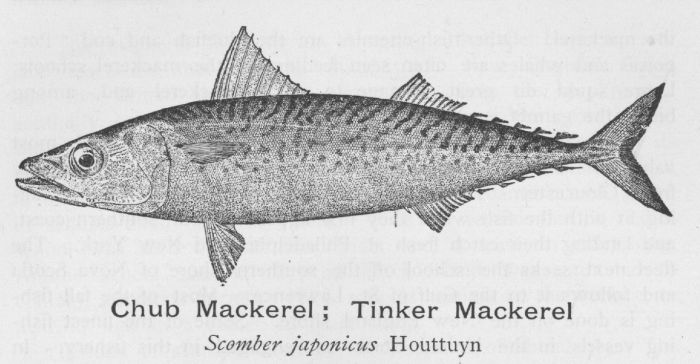
This mackerel is widely distributed, occurring in both the Atlantic and Pacific, north in the former to England and Maine, and to San Francisco on our west coast. It is very common in the Mediterranean and off southern California.
The history of the chub mackerel on our Atlantic Coast shows great variation in abundance. Up to about 1840 it was apparently an abundant fish, but between 1840 and 1850 it seems to have wholly disappeared from our coast. But in 1879 a considerable school was seen at Provincetown. It again disappeared in 1880, but is not rare at the present time.
This is an excellent food-fish and has been regarded even as superior to the common mackerel.
Colour, blue with about 30 wavy, blackish streaks which reach just below lateral line, some of these forming reticulations enclosing pale spots; more than 20 black specks or mucous pores on base of preopercle, generally arranged in more than 1 row; belly and sides silvery, but always with roundish dusky spots or cloudings in the adult; a black axillary spot.
GENUS AUXIS CUVIER
The Frigate Mackerels
Body oblong, plump, mostly naked posteriorly, anteriorly covered with small cycloid scales, those of the pectoral region enlarged, forming a corselet; snout very short, conical, scarcely compressed; mouth rather small, the jaws equal; teeth very small, mostly in a single series, on jaws only; tail very slender, depressed, with a rather large keel on each side; first dorsal short, some distance from second; second dorsal and anal small, each with 7 or 8 finlets; no air-bladder; gillrakers numerous, very long and slender.
The only species of this genus is the frigate mackerel (A. thazard). This fish occurs in all warm seas. On our Atlantic Coast it is seen occasionally as far north as Cape Cod. It appears to be very erratic in its movements, and rarely reaches the United States coasts. It swims in large schools and sometimes appears in immense numbers. In the Adriatic it is called "Timberello."
It resembles in some respects the common mackerel; in other characters it resembles the bonito, the genus Auxis being intermediate between Scomber and the related genera Pelamys and Orcynus. It is not much valued as food.
Colour, blue, variegated with darker above, becoming paler with age; belly silvery.
GENUS GYMNOSARDA GILL
The Little Tunnies
This genus differs from that of the great tunnies in the absence of teeth on the vomer, the complete absence of scales outside the corselet, and in the peculiar development, in the form of a network or trellis, of a portion of the abdominal part of the backbone.
Two species of small size in our waters, little valued as food. The first of these, the ocean bonito (G.pelamis) occurs in all warm seas, is pelagic, not common anywhere, and on our Atlantic Coast it has been seen as far north as Cape Cod and the Bermudas. It is also frequent in southern California. This species may be distinguished from the next by the distinct curve in the lateral line below second dorsal and in having 4 lengthwise stripes on side below lateral line.
The other species, the little tunny (G. alleterata) is also pelagic, occurring in all warm seas. It is not uncommon in the Mediterranean and the West Indies; on our Atlantic Coast it occurs as far north as Cape Cod. It is not known from California. From the ocean bonito it may be readily distinguished by the absence of a curve in the lateral line and in having no stripes.
GENUS THUNNUS SOUTH
The Great Tunnies
Body oblong, robust, with very slender caudal peduncle; head conic; mouth wide, with one series of small, conic teeth in the jaws and bands of minute villiform or sand-like teeth on the vomer and palatines; scales present, those of the pectoral region forming an obscure corselet.
The only known species is the tuna (Thunnus thynnus).
This great fish is pelagic in its habits and is found in all warm seas. In the Atlantic it occurs as far north as Newfoundland and the Loffoden Islands, and on the California coast at least to Monterey Bay. It is the "tuna" of the Mediterranean and of California and the "tunny" of the English. On our Atlantic Coast it is the "tunny," "horse mackerel," or "great albacore." They appear on our Atlantic Coast early in summer and remain until October. On some occasions they are very abundant, for so large a fish. During one season one fisherman harpooned 30 of these monsters which weighed in the aggregate at least 30,000 pounds. They are harpooned on the surface of the water, after the manner of taking the sword-fish.
The tuna attains a very great size and is the largest of the mackerel family. A length of 10 or more feet and a weight of 1,500 pounds has been recorded. One taken in 1838, off Cape Ann, was 15 feet long and weighed 1,000 pounds. They do not appear to reach so great a size on the coast of Europe, a 500-pound fish there being considered a monster. Nor do they reach so large a size on the California Coast, the largest example taken with rod and line at Santa Catalina having weighed but 251 pounds. An example measuring 8 feet in length was seen by us at Monterey Bay.