Home › Volumes › Fishes › The True Eels
Common Eel
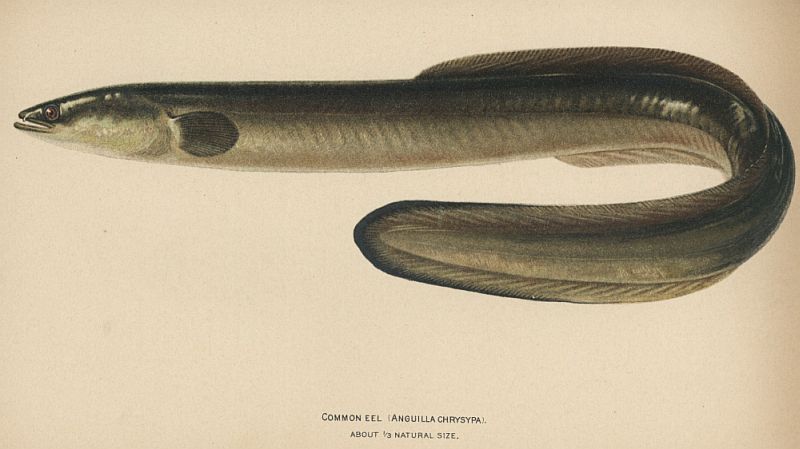
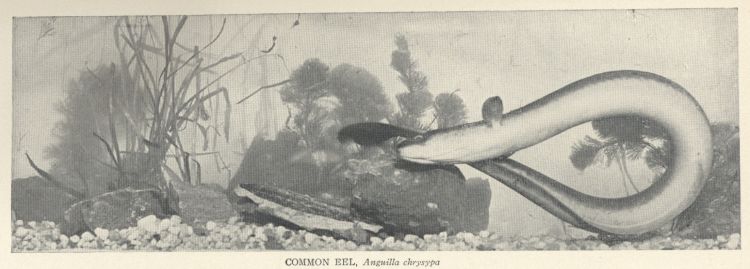
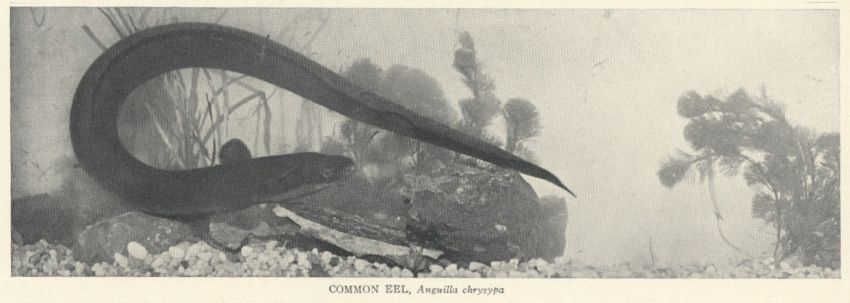
The common eel is familiar to every one who has lived in Eastern North America, and who has given any attention to things out doors. On our Atlantic Coast it ranges from New foundland to Mexico and Central America, and is also abundant among the islands of the West Indies. It is found likewise along the Gulf Coast. Unlike other eels it ascends freshwater streams long distances, and may be found even in the headwaters of nearly all the rivers of the Atlantic Coast and the Mississippi Valley. It is frequently found in lakes which would seem to be difficult to reach from the sea, but however great the barriers appear to be, it is certain that they have not been insurmountable, and that the eels got into the lakes from some connecting water.
The eel is really a freshwater fish, whose real home is in the freshwater rivers and lakes, but which runs down to salt water only at spawning time. Such fishes are called catadromous species, and their movements at spawning time are in marked contrast with, and the exact opposite of, those of the anadromous fishes (such as the salmon and the shad) whose true home is in salt water, but which run up freshwater streams to spawn.
The method of reproduction of the common eel was long a mystery, and even to this day it continues to be such among the illiterate and uninformed. While its method of reproduction has long been fully understood, scarcely a year passes that does not bring to the U. S. Fish Commission a communication from someone who claims that he has discovered that the lamprey--an animal belonging to an entirely different class from the eel, and only most remotely related to it--is really the female eel!
Jacoby has remarked that the eel was from the earliest times a riddle to the Greeks; while ages ago they knew the manner of reproduction among other fishes, they were not able to make any such discovery regarding the common eel. The Greek poets, following the usage of their day, which was to attribute to Jupiter all children whose paternity was doubtful, were accustomed to say that Jupiter was also the progenitor of the eel.
Aristotle states in his "History of Animals" that eels have no sexes, nor eggs, nor semen, and that they rise from ges entera, the entrails of the sea. Some have thought that by this expression Aristotle meant earthworms, while others have claimed that the Greeks used this term for all sorts of creeping, limbless things living in soil or mud, and that these were spontaneously generated.
"When we bear in mind," says Jacoby, "the veneration in which Aristotle was held in ancient times, and still more throughout the middle ages--a period of nearly 2,000 years--it could not be otherwise than that this wonderful statement should be believed, and that it should become embellished by numerous additional legends and amplifications, many of which have held their own in the popular mind even to this day."
There is no other animal concerning whose origin and existence there is such a number of false beliefs and ridiculous fables.
Though Aristotle's absurd views continued to receive credence for many centuries, there were those who accepted them only in part, or rejected them altogether. Pliny maintained that young eels spring from the slime and fragments of skin which come off when eels rub themselves against the rocks.
Albertus Magnus (1,200 years later) accepted Pliny's views, but says he has heard that eels are also born alive from eels! Rondelet (400 years still later) says that eels are born not only from putrefied matter, but also from eggs produced by copulation of male and female eels.
Walpiglie (17th century) declares that the ovaries of eels are fatty productions, which he calls "striae adiposae." Redi, of the same period, claimed that eels are produced just the same as other fishes are, while Leuwenhoek, an expert microscopist, found certain small parasites in the bladder of an eel, and, mistaking the bladder for the uterus, thought these parasites were young eels.
Not until the 18th century was the presence of ovaries in the female eel demonstrated by Sancassini, a learned surgeon of Comacchio, Italy. But his demonstration was questioned by other investigators. Apparently the first to describe fully the ovaries and eggs of the eel was the Italian naturalist, Mondini, in 1777, so that the discovery of the female eel must date from him.
The search for the male eel was scarcely less prolonged or less interesting. The details need not be given here. Not until 1873 was anyone successful. On November 29 of that year, Dr. Syrski, then at Trieste, made the important discovery, which many other investigators have since verified.