Home › Volumes › Fishes › The Minnows
Common Chub
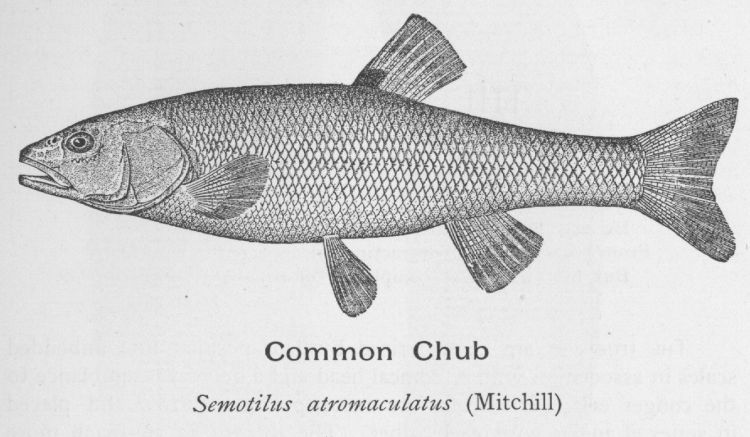
This fish closely resembles the preceding, from which it may be readily distinguished, however, by the more posterior position of the dorsal fin (midway between middle of eye and base of caudal, and well behind ventrals), the closer crowding of the scales on anterior part of body, and the presence of a large black spot on base of anterior dorsal rays. The scales also are somewhat smaller, the number in the lateral line being usually 50 to 55. Colour, dusky bluish above, side with a vague, dusky band, black in the young, disappearing in the adult; belly whitish, rosy in males in spring; dorsal fin always with a conspicuous black spot on base of anterior rays which is bordered with red in the male; a dark vertebral line; scales everywhere edged with dark punctulations; a dusky bar behind opercle; males with snout coarsely tuberculate in spring; young with a small black caudal spot.
The common chub is found from Maine westward to Wyoming and south to Georgia and Alabama, everywhere abundant, particularly in small creeks, where it is often the largest and most voracious inhabitant.
It reaches a length of a foot or less and is one of the most common species seen on the small boy's string. Its food value is not great, though it serves a useful purpose in many a region where better fish are rare. Moreover, it is an excellent bait minnow for bass, walleyed pike, pickerel, and muskallunge. Among the common names borne by this fish are horned dace, chub, and creek chub.