Home › Volumes › Fishes › The Pampanos
Bumper; Casabe
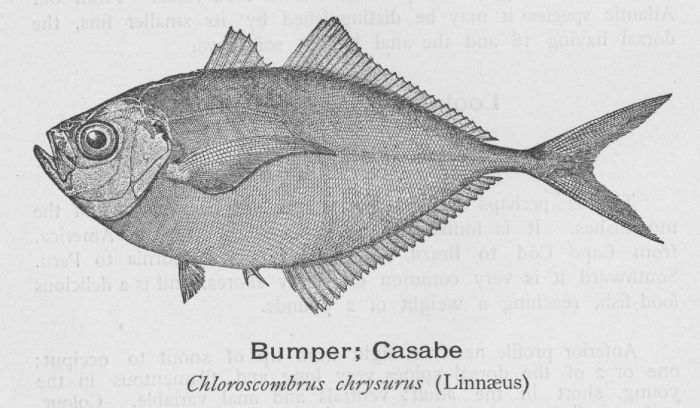
The bumper is found from Cape Cod to Brazil. It is common on our South Atlantic Coast and about Cuba, and specimens were obtained by us in Porto Rico. It is not valued as food, the flesh being thin and dry, and the bones large. Where common it is of some interest as a game-fish, as it takes the hook readily and may be caught either by still-fishing or trolling.
Colour, greenish above, the sides and below golden; caudal peduncle dusky above; dark opercular and axillary spots; inside of mouth black, fins not bordered nor tipped with black.
GENUS TRACHINOTUS LACEPEDE
The Pampanos or Pompanos
This is, commercially, the most important genus of the Carangidae, containing, as it does, some of the most delicious of all food-fishes.
Body compressed, moderately elevated, the general outline ovate; caudal peduncle short and rather slender; abdomen not trenchant, shorter than the anal fin; head moderately compressed, very blunt, the snout abruptly truncate; mouth nearly horizontal, maxillary reaching middle of eye; premaxillaries protractile; no distinct supplemental maxillary bone; jaws, vomer, and palatines with bands of villiform teeth, which disappear with age; spinous dorsal represented by 6 rather low spines, connected by membrane in the young but free in adult; second dorsal long, elevated in front, anal opposite and similar to it; 2 stout, nearly free spines in front of anal, and one connected with the fin, these often disappearing with age; scales small and smooth; lateral line unarmed, little arched, no caudal keel.
Species numerous, about a dozen in our waters, most of them of some value as food, and a few among the most highly prized of food-fishes.
a. Dorsal with 19 or 20 soft rays; anal with 17 to 19.
b. Body very much compressed; sides with narrow black crossbars; lobes of vertical fins elongate, reaching past middle of caudal in adult.
c. Snout subtruncate or nearly vertical; profile from supraorbital to front of dorsal fin convex; .....glaucus
cc. Snout low, very oblique; profile from supraorbital to front of dorsal scarcely convex..... rhodopus
bb. Body moderately compressed; sides without narrow black crossbars.
d. Body broad, ovate, the back arched.
e. Lobes of vertical fins much elevated, that of dorsal in adult much longer than head; colour pale.
f. Caudal lobes about 2 2/3 in length of body; ........falcatus
ff. Caudal lobes longer, about 2 1/3 in body; .....rhomboides
ee. Lobes of vertical fins low, that of dorsal in adult shorter than head; colour dusky; .......culveri
dd. Body oblong, the profile not strongly arched.
g. Axil with a jet-black spot; depth about 2 1/4 in length; kennedyi
gg. Axil not black; depth about 2 3/5; ..........goodei
aa. Dorsal with 25 to 27 soft rays; anal with 22 to 26.
h. Dorsal with 25 soft rays; anal with 22.
i. Body very deep, half as deep as long; ..........argenteus
ii. Body more slender, the depth 2/5 the length.
j. Head moderate, about 1/4 as long as body; dorsal lobe pale; carolinus
jj. Head larger, 3 1/4 to 3 1/2 in body; dorsal lobe black; .........paloma, 319
hh. Dorsal with 27 soft rays; anal with 26; .......cayennensis