Home › Volumes › Fishes › The Pampanos
Amber-jack
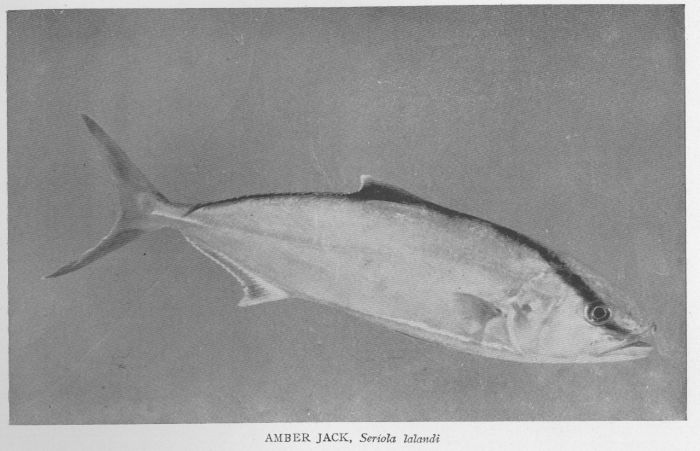
This species, also called amber-fish and coronado, is of wide distribution. It occurs both in the Mediterranean and the West Indies. It is rather common about Pensacola and Key West, and is a food-fish of some importance.
Colour, grayish silvery below; a gilt band through eye to caudal, and another through temporal region to front of soft dorsal; fins plain; no dark cross-bands. Very close to S. lalandi, but smaller, the body deeper and less compressed; mouth larger than in S. dorsalis, but about as in S. lalandi.
S. mazatlana, fasciata, rivoliana and falcata are unimportant species.
The genus Elagatis is close to Seriola and contains a single species, E. bipinnulatus, a large pelagic fish, reaching a length of 2 1/2 feet. It occurs in most tropical seas and is occasionally seen in the West Indies from which it sometimes strays north to Long Island. It may be known by the 2 small detached finlets and the short anal. It is sometimes called runner.
The genus Decapterus contains the mackerel scads of which there are several species, only 5 of which occur within our limits. One of these, D. punctatus, known as the scad, round robin or quia-quia, is common on the coasts of Florida and among the West Indies. It reaches a foot in length. Another species is the common mackerel scad, D. macarellus, which is found in the warmer parts of the Atlantic. It strays northward on our coast to Cape Cod.
The genus Trachurus has only 2 species within our limits, neither of much value as food.
The xurel or saurel, T. symmetricus, is common on our Pacific Coast from San Francisco south to the Galapagos. In summer it is abundant in the San Francisco markets where it is regarded as a good food-fish. It reaches 2 feet in length.
The other species is T. trachurus, which is found in the North Atlantic. It is rare on our coast.
The genus Trachurops differs from Carangus chiefly in the more elongate form. The single species, T. crumenophthalmus, is a well-known fish of wide distribution. In the Atlantic it is found among the West Indies and occasionally north to Cape Cod. On the Pacific Coast it occurs from Cape San Lucas southward. Among the Hawaiian Islands it is an abundant and important food-fish and is known as the akule. Its common names in American waters are goggler, big-eyed scad, and goggle-eyed jack.
The genus Hemicaranx differs from Carangus chiefly in the narrow maxillary. Our waters contain 6 or 7 species, none of great value as food. The most important is H. amblyrhynchus, which is found from Cape Hatteras to Brazil. It is rather common among the West Indies, and is seen now and then on the Florida coast.
GENUS CARANGUS GRIFFITH
The Cavallas
Body ovate or oblong, compressed, the back sometimes considerably elevated; mouth moderate or large, oblique; maxillary broad, reaching below eye, with a well-developed supplemental bone; premaxillaries protractile; teeth in one or few series, unequal, or at least not in villiform bands; villiform teeth usually present on vomer, palatines and tongue, deciduous or wanting in some species; gillrakers long; eye large with an adipose eyelid; dorsal spines rather low, connected; second dorsal long, usually elevated in front, both fins depressible in a groove; anal similar to second dorsal and nearly as long, preceded by 2 rather strong spines, its base longer than the abdomen; caudal fin strongly forked, the peduncle very slender; pectoral falcate; no finlets; scales present, usually very small; lateral line with its posterior portion armed with strong, bony plates, which grow larger on the tail, each plate armed with a spine; a short dorsal branch of lateral line usually present; preopercle entire in adult, serrate in the young; species very numerous in all warm seas, most of them valued as food.
a. Teeth on vomer and palatines persistent.
b. Soft dorsal and anal low, not much elevated in front, little if at all falcate; teeth in jaws in one or few series, with no canines.
c. Lateral line strongly arched, the arched part not half as long as straight portion; .... vinctus
cc. Lateral line little arched, the arched part not shorter than the straight portion.
d. Body slender, the depth about 3 1/2 in length; colour dark, chiefly bluish; .... ruber
dd. Body deeper, the depth about 2 4/5 in length; colour pale, mostly golden..... bartholomaei
bb. Soft dorsal and anal much elevated in front, and more or less falcate; upper teeth in a band, the outer enlarged; lower teeth in one series.
e. Breast naked, except a small rhombic area before ventrals; hippos
ee. Breast entirely covered with small scales.
f. Body subfusiform, the depth less than 1/3 the length; teeth of outer series small, not canine-like.