Home › Volumes › Butterflies › Nymphs
West Coast Lady
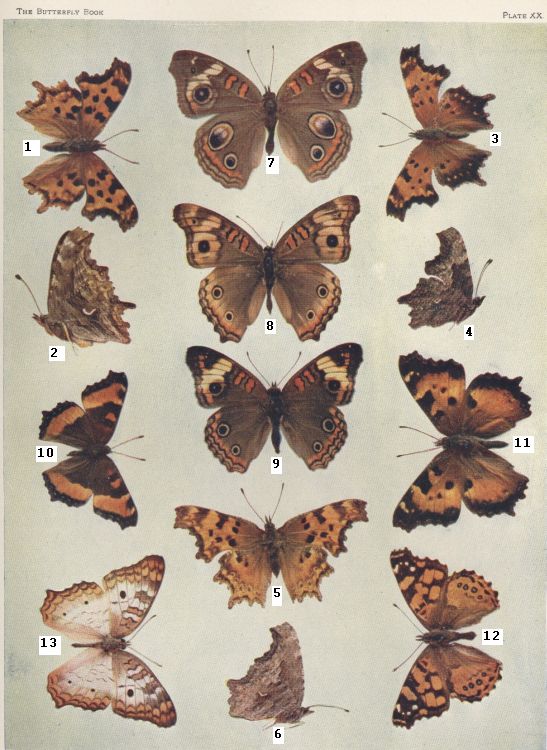
Butterfly.-This species is easily distinguished from P. cardui, its nearest ally, by the absence of the roseate tint peculiar to that species, the tawnier ground-color of the upper surfaces, and the complete black band which crosses the middle of the cell of the primaries. Expanse, 2.00 inches.
Early Stages.-These have not all been thoroughly described, but we have an account of the larva and chrysalis from the pen of Henry Edwards, in the "Proceedings of the California Academy of Sciences," vol. v, p. 329. The food-plant of the caterpillar is Lavatera assurgentiflora. This species ranges from Vancouver's Island to Argentina, and is found as far east as Utah.
WIDELY DISTRIBUTED BUTTERFLIES
The primal curse declared that the earth, because of man's sin, should bring forth thorns and thistles, and thistles are almost everywhere. Wherever thistles grow, there is found the thistle butterfly, or the "Painted Lady," as English collectors are in the habit of calling it, Pyrameis cardui. All over Europe, all over North America, in Africa,--save in the dense jungles of the Congo,--throughout South America, in far-off Australia, and in many of the islands of the sea this beautiful butterfly is found. At some times it is scarce, and then again there are seasons when it fairly swarms, every thistle-top having one of the gaily colored creatures seated upon its head, and among the thorny environment of the leaves being found the web which the caterpillar weaves. Another butterfly which bids fair ultimately to take possession of the earth is our own Anosia plexippus, the wanderings of which have already been alluded to.
Many species are found in the arctic regions both of the Old World and the New. Obscure forms are these, and lowly in their organization, survivors of the ice-age, hovering on the borderline of eternal frost, and pointing to the long-distant time when the great land-masses about the northern pole were knit together, as geologists teach us.
One of the curious phenomena in the distribution of butterflies is the fact that in Florida we find Hypolimnas misippus, a species which is exceedingly common in Africa and in the Indo-Malayan subregion. Another curious phenomenon of a like character is the presence in the Canary Islands of a Pyrameis, which appears to be only a subvariety of the well-known Pyrameis indica, which is common in India, southern China, and Japan. Away off in southeastern Africa, upon the peaks and foot-hills which surround the huge volcanic masses of Kilima-Njaro, Kenia, and Ruwenzori, was discovered by the martyred Bishop Hannington a beautiful species of Argynnis, representing a genus nowhere else found upon the continent of Africa south of Mediterranean lands. Strange isolation this for a butterfly claiming kin to the fritillaries that sip the sweets from clover-blossoms in the Bernese Oberland, in the valleys of Thibet, and on the prairies of the United States.