Home › Volumes › Butterflies › Papilioninae Family
Tiger Swallowtail
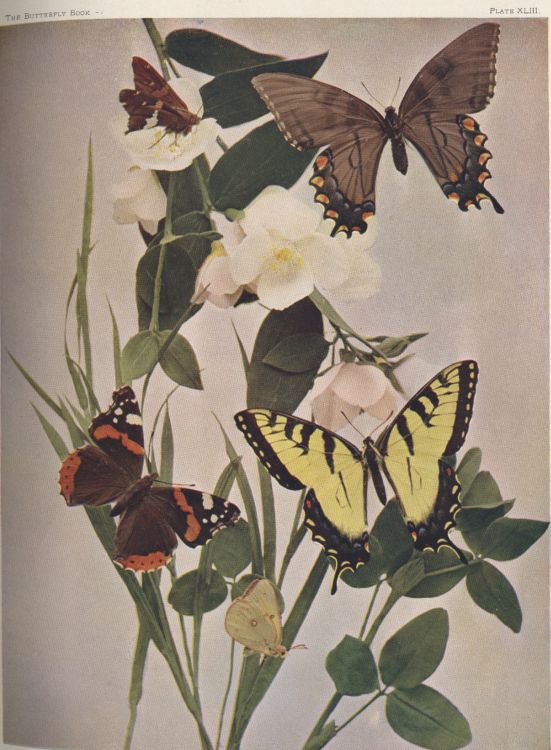
Butterfly.--The "lordly Turnus" is one of the most beautiful insects of the Carolinian fauna. The plate shows the figures about one third smaller than in life, but they are sufficient for the immediate identification of the species. The species is dimorphic in the female sex in the southern portions of the territory which it occupies. The black form of the female was regarded for a long while as a distinct species, until by the test of breeding it was ascertained that some eggs laid by yellow females produced black females, and that, conversely, eggs laid by black females often produced yellow females. In Canada and northward and west-ward in northern latitudes the dark dimorphic female does not occur. A small yellow dwarfed form is common about Sitka, whence I have obtained numerous specimens. Expanse, male, 3.00-4.00 inches; female, 3.50-5.00 inches.
Early Stages.--The egg is outlined on p. 4, Fig. 3. It is green or bluish-green, quite smooth, with a few reddish spots in some specimens. The caterpillar feeds on a great variety of plants, but has a peculiar preference for the leaves of various species of wild cherry (Cerasus). The chrysalis is accurately portrayed in Plate VI, Figs. 1-4.
The metropolis of this species seems to be the wooded forests of the Appalachian ranges at comparatively low levels. It abounds in southwestern Pennsylvania, the Virginias, the Carolinas, Kentucky, and Tennessee. I have often found as many as a dozen of these magnificent butterflies congregated on a moist spot on the banks of the Monongahela. At Berkeley Springs, in West Virginia, I counted, one summer day, forty specimens hovering over the weeds and flowers in a small deserted field. The movements of the butterfly on the wing are bold and rapid. Its flight is dashing. Now aloft to the tops of the highest trees, now down in the shadows of the undergrowth, hither and thither it goes, often settling for a moment on some attractive flower, or staying its flight to quench its thirst on the sandy edge of a brook, and then away again over the fields and into the forests. In New England it is not very abundant, and in the Gulf States, while numerous, is still less common than about the head waters of the Ohio.