Home › Volumes › Butterflies › Nymphs
Thekla
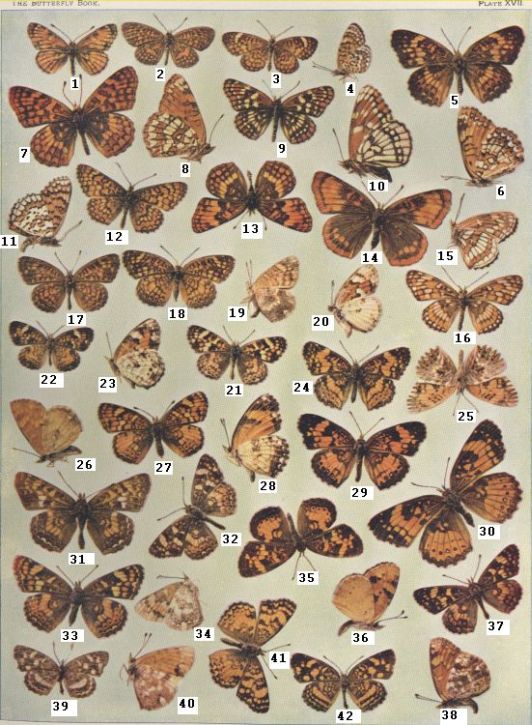
Butterfly, male.--The upper side of the wings is fulvous, black toward the base and on the outer margin. The primaries are adorned with a large oval pale-fulvous spot at the end of the cell, a small one on the middle of the upper side of the cell, and another small one below the cell, at the origin of the first median nervule. The discal area is defined outwardly by a very irregular fine black transverse line, beyond which is a transverse band of pale-fulvous oblong spots, an incomplete series of spots of the ground-color sharply defined upon the black outer shade, followed by a row of irregular white submarginal spots. The transverse bands of spots on the primaries are repeated upon the secondaries, where they are more regular and the spots more even in size. On the under side both wings are pale red, with the light spots of the upper side reappearing as pale-yellow sharply defined spots. The fringes are checkered black and white.
Female--Much like the male, but larger. Expanse, male, 1.35-1.50 inch; female, 1.50-1.75 inch.
Early Stages.--Unknown.
This species is common in Texas. It is identical, as an examination of the type shows, with M. bolli, Edwards, and the latter name as a synonym falls into disuse.