Home › Volumes › Butterflies › Nymphs
Silverbordered Fritillary
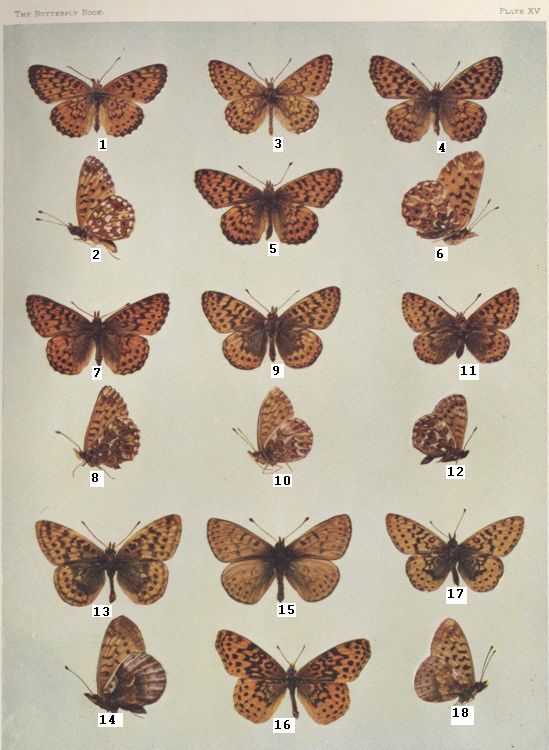
Butterfly.--The upper side of the wings is fulvous; the black markings are light, the borders heavy. The fore wings on the under side are yellowish-fulvous, ferruginous at the tip, with the marginal spots lightly silvered. The hind wings are ferruginous, mottled with buff. The spots, which are small, are well silvered. Expanse, male, 1.40 inch; female, 1.70 inch.
Egg.--The egg is conoidal, about one third higher than wide, marked by sixteen or seventeen vertical ribs, between which are a number of delicate cross-lines. It is pale greenish-yellow in color.
Caterpillar.--The caterpillar has been carefully studied, and its various stages are fully described in "The Butterflies of New England," by Dr. Scudder. In its final stage it is about seven eighths of an inch long, dark olive-brown, marked with green, the segments being adorned with fleshy tubercles armed with needle-shaped projections, the tubercles on the side of the first thoracic segment being four times as long as the others, cylindrical in form, and blunt at the upper end, the spines projecting upward at an angle of forty-five degrees to the axis of the tubercle.
Cbrysalis.--The chrysalis is yellowish-brown, spotted with darker brown spots, those of the thoracic and first and second abdominal segments having the lustre of mother-of-pearl.
This very pretty little species has a wide range, extending from New England to Montana, from Nova Scotia to Alaska, and southward along the ridges of the Alleghanies into Virginia and the mountains of North Carolina.