Home › Volumes › Butterflies › Nymphs
Red-spotted Purple
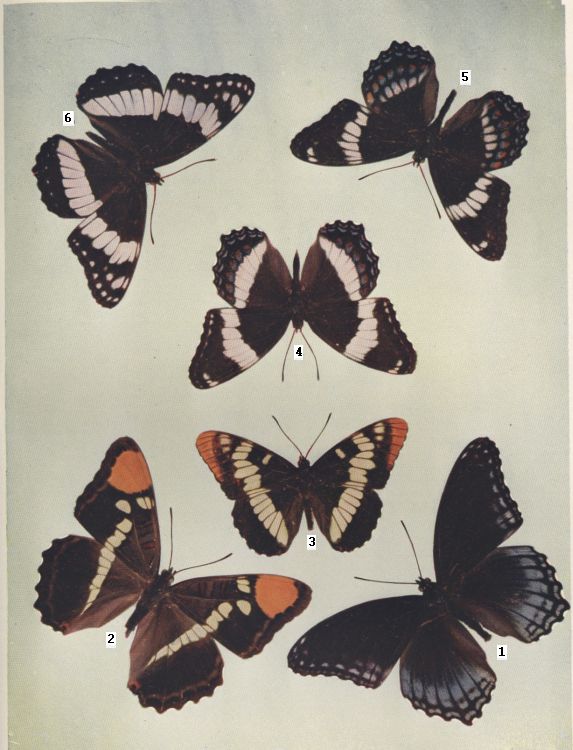
Butterfly.-This common but most beautiful species is sufficiently characterized by the plate so far as the upper surface is concerned. On the under side the wings are brownish, banded with black on the margins; the lunules are on this side as above, but the inner band of spots is red. There are two red spots at the base of the fore wings, and four at the base of the hind wings. The palpi are white below, and the abdomen is marked with a lateral white line on each side. Expanse, 3.00-3.25 inches.
Egg.-The egg, which resembles somewhat closely that of B. disippus is yellowish-green, gradually turning dark brown as the time for the emergence of the caterpillar approaches.
Caterpillar.-The caterpillar is so well delineated in Plate III, Fig. 17, as to obviate the necessity for a lengthy verbal description.
Chrysalis.-What has been said of the caterpillar is also true of the chrysalis.
The larva feeds upon the willow, cherry, apple, linden (Tilia), huckleberry, currant, and other allied shrubs and trees. The butterfly is somewhat variable, and a number of varietal forms have been described. It ranges generally over the United States and southern Canada as far as the Rocky Mountain ranges in the West, and is even said to occur at high elevations in Mexico.