Home › Volumes › Butterflies › Nymphs
Pearly Malachite
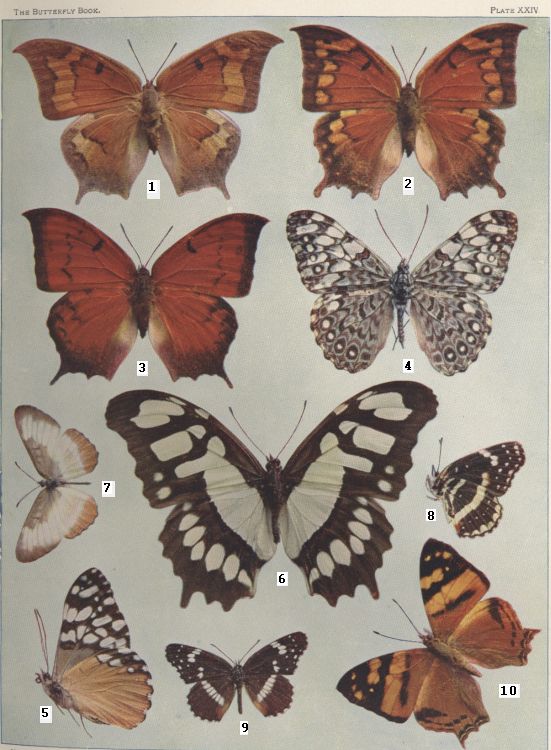
This splendid insect is occasionally found in southern Florida and the extreme southern part of Texas. It is common throughout tropical America. Nothing has ever been written upon its early stages.
FOSSIL INSECTS
Investigations within comparatively recent times have led to the discovery of the host of fossil insects. A few localities in Europe and in North America are rich in such remains, and the number of species that have been described amounts to several thousands. Strangely enough, some of these fossil insects are very closely allied in form to species that are living at the present time, showing the extreme antiquity of many of our genera. One of the comparatively recent discoveries has been the fossil remains of a butterfly which Dr. Scudder, who has described it, declares to be very near to the African Libythea labdaca, which differs in certain minor anatomical respects from the American Libytheas which are figured in this work; and Dr. Scudder has therefore proposed a new generic name, Dichora, meaning "an inhabitant of two lands," which he applies to the African species because related to the extinct American butterfly. The strange discoveries, which have been made by palaeontologists as to the huge character of many of the mammals, birds, and reptiles which at one time tenanted the globe, are paralleled by recent discoveries made in insect-bearing strata in France. M. Charles Brongniart of the Paris Museum is preparing an account of the collecting which he has made at Commentry, and among the creatures which he proposes to figure is an insect which is regarded by Brongniart as one of the forerunners of our dragonflies, which had an expanse of wing of two feet, a veritable giant in the insect world.
Of fossil butterflies there have thus far been discovered sixteen species. Of these, six belong to the subfamily of the Nymphalidae, and five of the six were found in the fossiliferous strata of Florissant, Colorado. Two species belong to the subfamily Satyrinae, both occurring in deposits found in southern France, and representing genera more nearly allied to those now found in India and America than to the Satyrinae existing at the present time in Europe. One of the fossils to which reference has already been made belongs to the subfamily of the Libytheinae. The remainder represent the subfamilies of the Pierinae, the Papilioninae, and the family Hesperiidae.
It is remarkable that the butterflies which have been found in a fossil state show a very close affinity to genera existing at the present time, for the most part, in the warmer regions of the earth. Though ages have elapsed since their remains were embedded in the mud which became transformed into stone, the processes of life have not wrought any marked structural changes in the centuries which have fled. This fixity of type is certainly remarkable in creatures so lowly in their organization.