Home › Volumes › Butterflies › Nymphs
Pearl Crescent
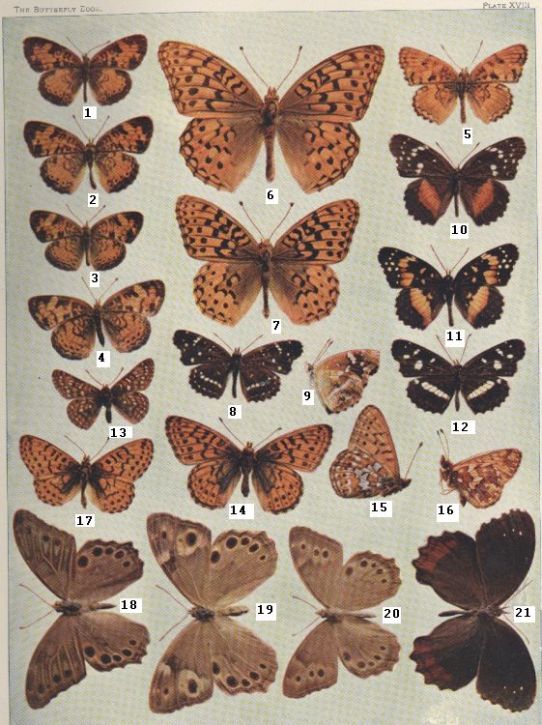
Butterfly.-This very common and well-known little insect scarcely needs to be described. The upper side is bright fulvous, with heavy black borders; all the other dark markings are slight. The wings on the under side are paler, with the dark markings of the upper side showing through, and there are additional markings of brown on the hind wings. Expanse, male, 1.25 inch; female, 1.65 inch.
Early Stages.-The early stages of this insect have been worked out with the most extreme care by Mr. Edwards, and the reader who is curious to know about them should consult "The Butterflies of North America." Dr. Scudder also has minutely and laboriously described the early stages in "The Butterflies of New England." The egg is light greenish-yellow. The caterpillar, which feeds upon various species of aster and allied Compositae, is dark brown after the third moult, its back dotted with yellow, adorned with short, black, bristly spines, which are yellow at the base. The chrysalis is grayish-white, mottled with dark spots and lines.
This species is one of many dimorphic species, the winter form marcia, which emerges in spring, having the under side brighter, and the light markings more conspicuous on that side than in the summer form, which has been called morpheus. Concerning all of this, and the way in which cold affects the color of butterflies, the reader will do well to consult the splendid pages of Edwards and of Scudder.
The pretty little Pearl Crescent ranges from southern Labrador to Florida; in fact, all over North America north of Texas and south of the region of Hudson Bay, except the Pacific coast of California.