Home › Volumes › Butterflies › Nymphs
Miss Owen's Fritillary
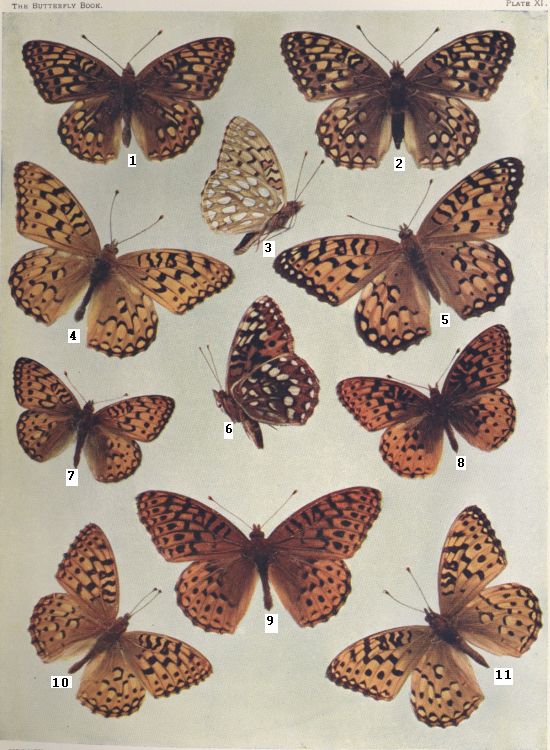
Butterfly, male.--The upper side of both wings is dark-brown from the base to the mesial band of spots, with the exception of the outer end of the cell. The space beyond the band is reddish-fulvous; the dark markings are not very heavy; the two marginal lines are fine, and confluent at the ends of the nervules. The under side of the fore wings is reddish-brown from the base to the outer margin on the inner half of the wing; the outer spaces toward the apex are yellowish; the subapical patch is reddish-brown, inclosing a small silvery spot; the outer margin is reddish-brown, adorned with five small silvery spots toward the apex. The hind wings on the under side are almost solid reddish-brown to the clear yellow submarginal belt, only slightly mottled on the discal area with buff. The spots are small and well silvered.
Female.--The female on the upper side is duller red, with the dark markings heavier; the marginal spots on the fore wings are pale yellowish, and the marginal lines are confluent on the upper half of these wings. The wings on the under side in this sex are as in the male, but the ground-color on the inner half of the wings is darker, and the spots are more brilliantly silvered. Expanse, 2.30-2.50 inches.
Early Stages.--Unknown.
This pretty species is found with A. electa and A. hesperis in Colorado. It was originally described from specimens taken at Manitou and Ouray, and named by Edwards in honor of a deceased daughter of Professor Owen of the University of Wisconsin.