Home › Volumes › Butterflies › Nymphs
Lorquin's Admiral
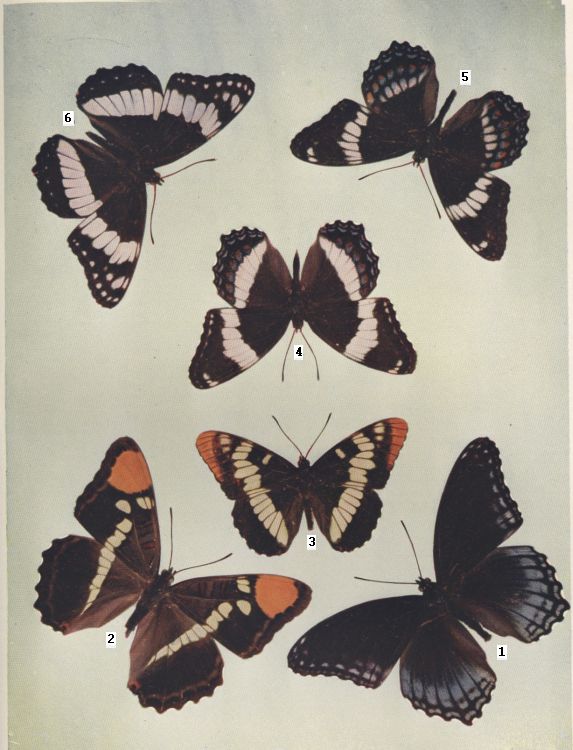
Butterfly.--Easily distinguished from all the other species of the genus by the yellowish-white bar near the end of the cell of the fore wings and the reddish color of the apex and upper margin of the same wings. Expanse, 2.25-2.75 inches.
Early Stages.--These have been partially described by Henry Edwards, and minutely worked out by Dr. Dyar, for whose description the reader may consult the "Canadian Entomologist," vol. xxiii, p. 172. The food-plant of the caterpillar is Populus, willows, and the choke-cherry (Prunus demissa).
Besides the forms figured in our plates there is a species in Florida named floridensis by Strecker, and subsequently eros by Edwards, which is generally larger and much darker than B. disippus, which it otherwise closely approximates.
THE BUTTERFLIES' FAD
"I happened one night in my travels
To stray into Butterfly Vale,
Where my wondering eyes beheld butterflies
With wings that were wide as a sail.
They lived in such houses of grandeur,
Their days were successions of joys,
And the very last fad these butterflies had
Was making collections of boys.
"There were boys of all sizes and ages
Pinned up on their walls. When I said
Twas a terrible sight to see boys in that plight,
I was answered: `Oh, well, they are dead.
We catch them alive, but we kill them
With ether-a very nice way:
Just look at this fellow-his hair is so yellow,
And his eyes such a beautiful gray.